 Claude
 ChatGPT
 Gemini
Most professionals now recognize the importance of building a presence on digital platforms for both their business and personal brand. However, they often do not have the time to consistently produce quality content to build a reputation. Ghostwriting simplifies your work by allowing you to delegate the creation of high-quality narratives that reflect your voice to a skilled writer.
Unsurprisingly, as demand for executive branding and online visibility continues to grow, ghostwriting has become a rapidly expanding industry.
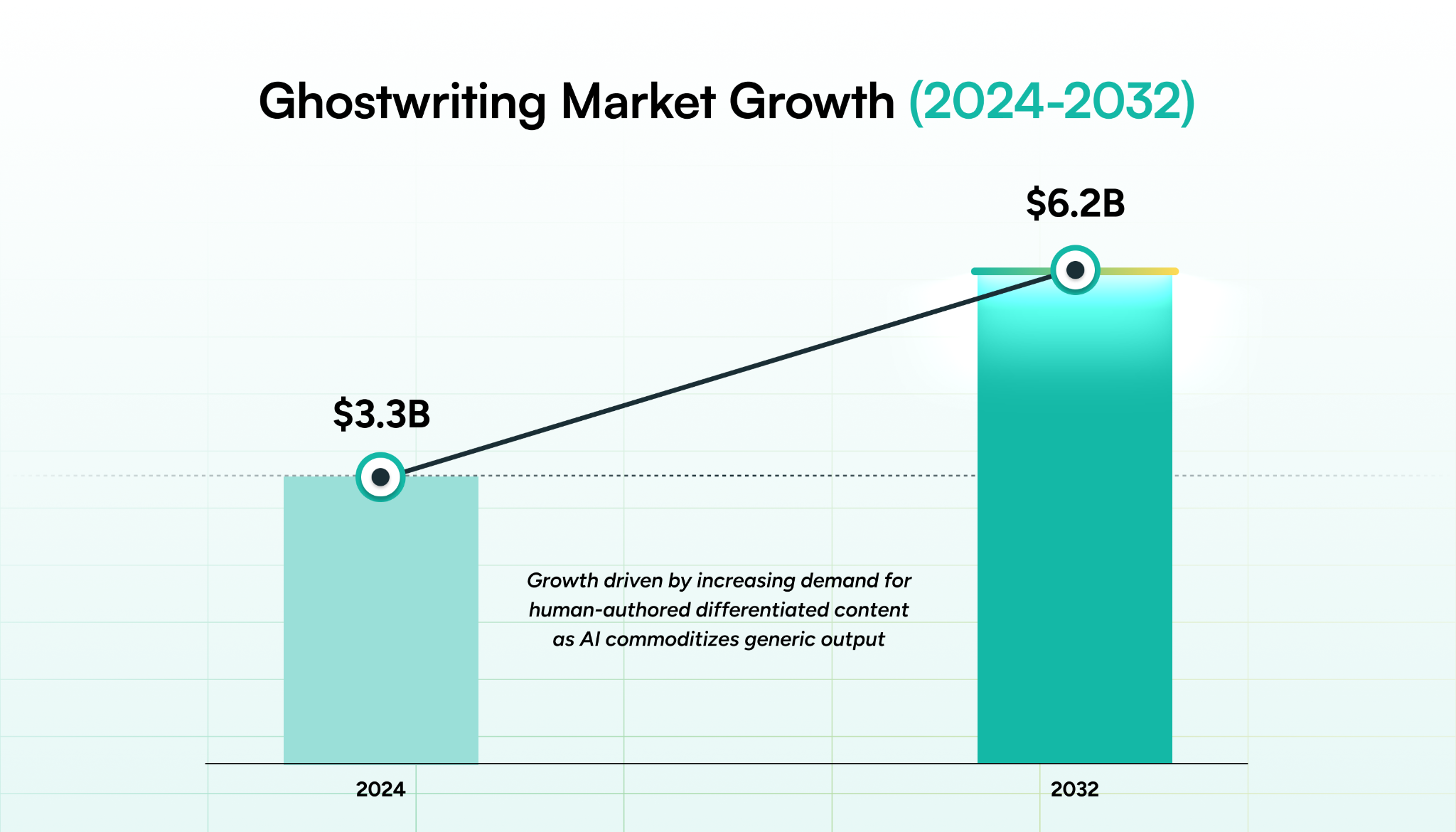
The ghostwriting market has already grown to $3.3B in 2024, and is projected to reach $6.2B by 2032 as AI commoditizes generic content.
The perception of ghostwriting has also changed significantly in recent years. What was once associated mainly with books and celebrity memoirs is now increasingly used by founders, executives, and subject-matter experts to communicate consistently in a digital-first professional environment.
This blog post explores what ghostwriting is, why the demand for it continues to grow, the value a skilled ghostwriter can bring, and how to find someone you can genuinely trust to represent your voice and ideas effectively.
What Ghostwriting Actually Is (And What It Isn’t)
Most people misunderstand ghostwriting because they assume the writer is responsible for the ideas. In reality, good ghostwriting works very differently.
The expertise, opinions, lived experience, and judgment still belong entirely to the client. The ghostwriter’s role is to structure those ideas clearly, shape them into compelling narratives, and communicate them in a way that sounds natural to the person behind the content.
A good ghostwriter does not manufacture authority. They help articulate authority that already exists.
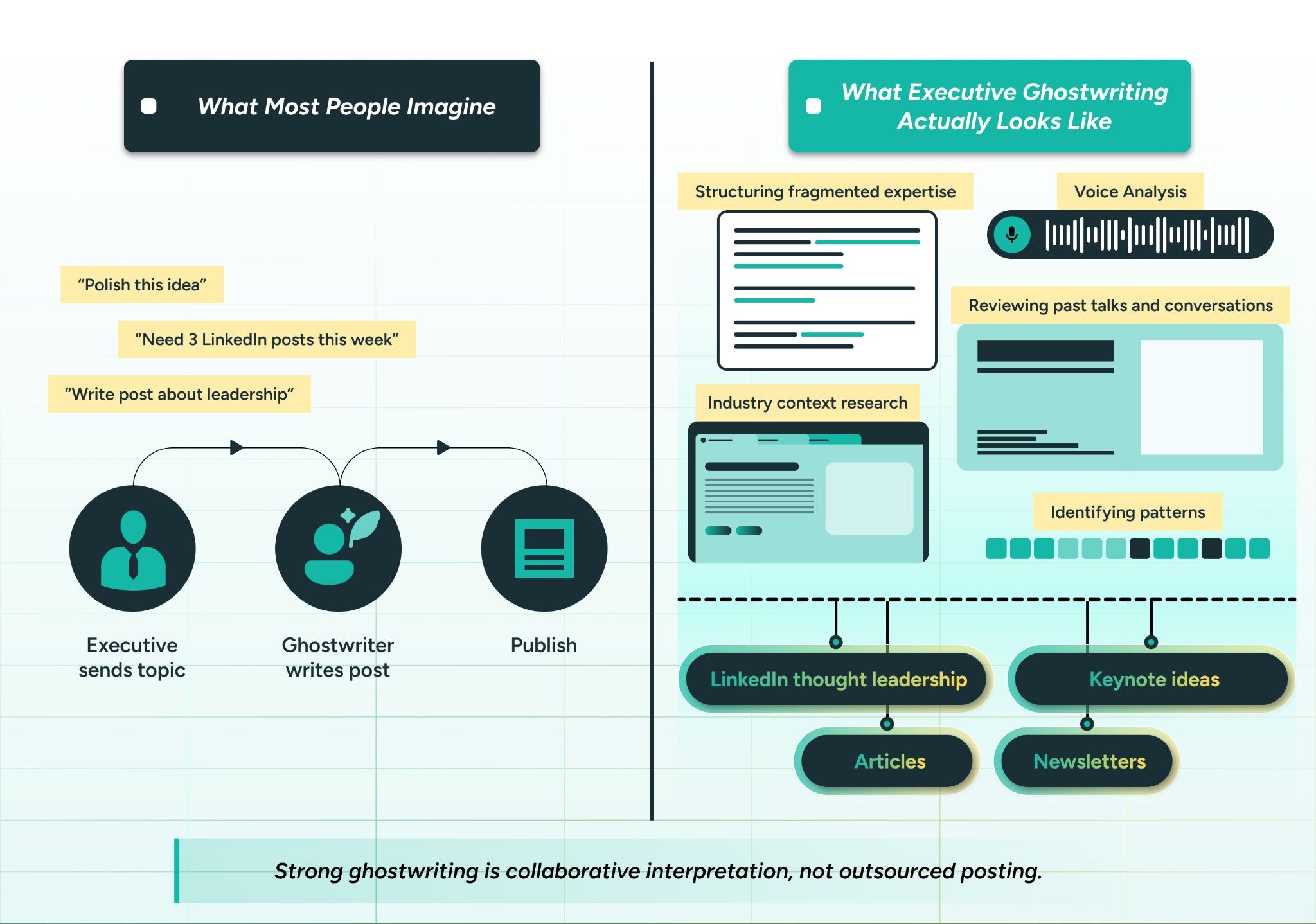
This is why executive ghostwriting is far more collaborative than most people imagine. The process usually involves:
- Long-form interviews
- Voice analysis
- Research into the client’s industry
- Reviewing past writing, presentations, or conversations
- Identifying recurring themes and perspectives
In many cases, executives already communicate brilliantly in meetings, podcasts, or internal discussions. The challenge is converting that expertise into structured, consistent public communication.
A strong ghostwriter acts less like a copywriter and more like an interpreter of expertise.
For example, when a founder explains during a call, ‘Most companies scale operations before fixing decision-making bottlenecks.’
A ghostwriter likely recognizes that as a:
- Leadership philosophy
- Repeatable operational insight
- Potential LinkedIn post
- Newsletter theme
- Foundation of a keynote talk
The insight already existed. The ghostwriter recognized, structured, and articulated it.
This distinction also makes the point that weak ghostwriting is immediately noticeable. Audiences can usually sense when content is generic, over-optimized, or disconnected from lived experience. According to the 2024 Edelman-LinkedIn B2B Thought Leadership Impact Report, only 15% of decision-makers rated the quality of most thought leadership content as ‘very good’ or ‘excellent.’
This explains why good ghostwriting is increasingly valuable. The role doesn’t confine itself to writing content; it helps professionals communicate real expertise clearly in an environment flooded with recycled opinions and low-effort AI-generated content.
And as more executives recognize that digital visibility now influences hiring, fundraising, partnerships, and reputation, demand for high-quality ghostwriting continues to rise.
Why More Professionals Are Hiring Ghostwriters in 2026
Up until a decade or so ago, professional reputation was built primarily through meetings, conferences, referrals, and traditional media exposure. Today, a significant portion of that evaluation happens long before any conversation takes place.
Investors search your name before a pitch meeting. Potential clients review your LinkedIn profile before responding to outreach. Prospective hires assess leadership credibility before accepting offers. Journalists, partners, and conference organizers often come across your digital presence before they encounter you directly.
Your online presence has become an extension of your professional reputation.
And increasingly, professionals are realizing that silence online creates its own perception problem.
According to LinkedIn, the platform now has over 1 billion members globally, including more than 65 million decision-makers and 10 million C-level executives. For many professionals, LinkedIn has evolved beyond networking into a public layer of credibility, expertise, and industry positioning.
In the past, expertise could remain largely private. Today, visibility influences real outcomes like hiring, fundraising, partnerships, speaking opportunities, media credibility and trust formation.
However, visibility alone is not enough. One of the biggest misconceptions about executive content is the belief that frequency automatically builds authority. In reality, generic posting often weakens perception rather than strengthening it.
A recurring pattern in executive content is high activity with very little depth:
- Broad motivational observations
- Recycled leadership advice
- Trend commentary without firsthand insight
- Polished language disconnected from operational experience
Sophisticated audiences recognize this quickly.
According to the 2024 Edelman and LinkedIn’s B2B Thought Leadership report, 70% of C-suite leaders say that thought leadership content has, at least occasionally, made them reconsider continuing to work with an existing supplier.
Clearly, buyers value thought leadership far more than many creators assume.
This creates an interesting contradiction: There is more professional content being published than ever before, but genuinely differentiated expertise has become harder to find.
The rise of AI has accelerated this further.
AI tools can now generate summaries, rewrite articles, and produce endless streams of generic professional content in seconds. As a result, informational content is becoming increasingly commoditized. What stands out now is not access to information, but:
- Original perspective
- Lived experience
- Pattern recognition
- Contextual judgment
This is one reason executive ghostwriting has grown so rapidly in recent years. The value is no longer simply “helping busy people write posts.” Instead, strong ghostwriters help professionals:
- Articulate nuanced thinking
- Structure complex experiences into clear narratives
- Maintain consistency without sacrificing depth
- Communicate expertise in ways audiences can quickly understand and trust

Signs You’re Ready to Hire a Ghostwriter
Not every professional needs a ghostwriter. Many do perfectly fine writing their own content, especially in the early stages of building a presence. But there’s a clear inflection point where writing feels less like a task and more like a bottleneck.
Here are the clearest signals that it may be time to bring in a ghostwriter.
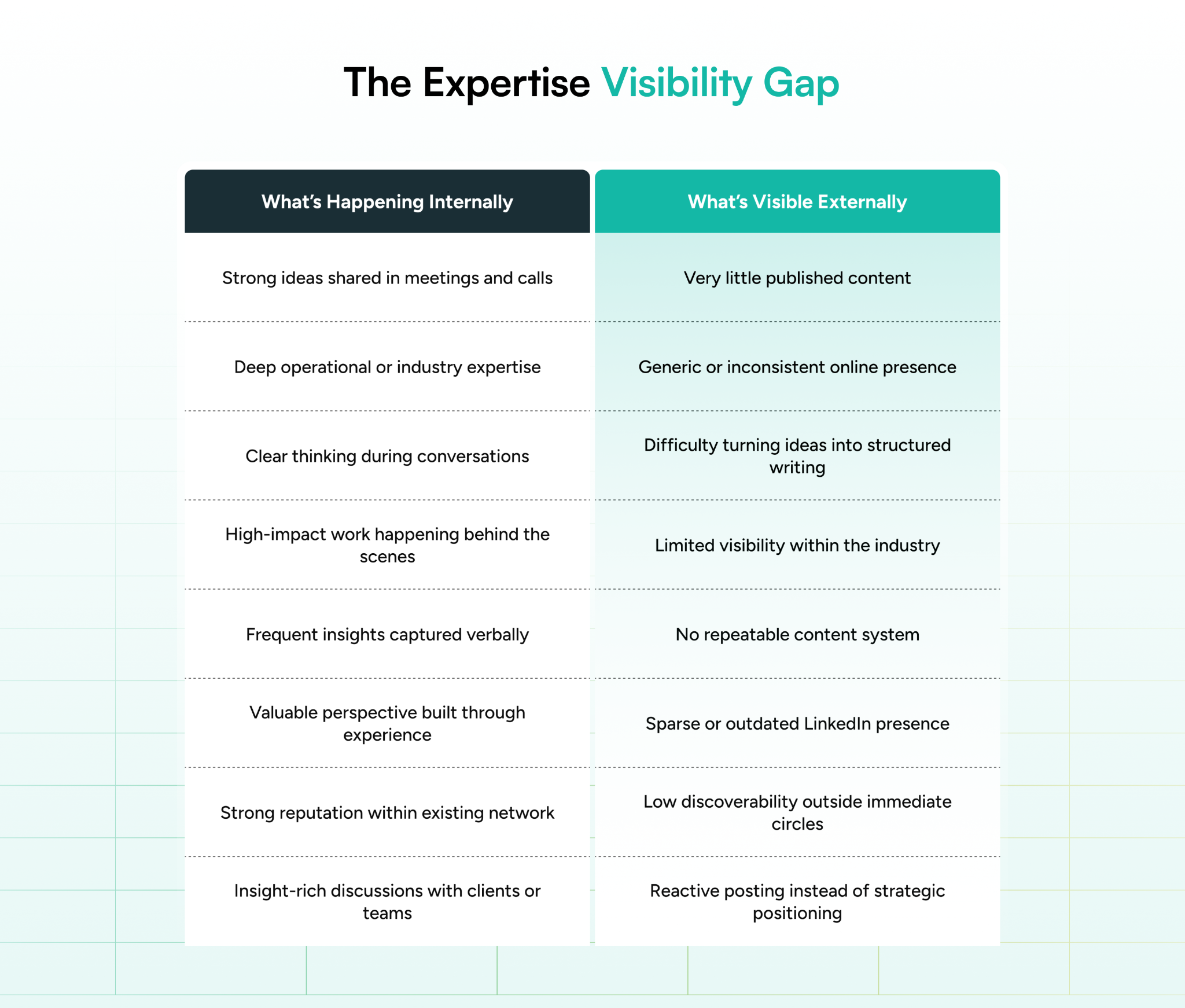
1. You Have Strong Ideas, But They Rarely Make It Into Public View
You contribute meaningfully in meetings, strategy discussions, or client conversations, but very little of that thinking gets documented or shared externally.
Over time, this creates a visibility gap between your internal thinking and external invisibility.
A ghostwriter helps convert those in-the-moment insights into structured, publishable narratives.
2. Your Expertise Lives in Conversations, Not Content
Many professionals are at their best when speaking, explaining, debating, and refining ideas in real time.
But spoken expertise doesn’t automatically translate into written clarity.
This is one of the core reasons ghostwriting exists: it bridges the gap between articulated thinking and structured communication.

3. Your Visibility Does Not Reflect Your Actual Seniority or Experience
You may be:
- Leading teams or functions
- Making high-impact decisions
- Operating at a senior level internally
But externally, your digital presence feels understated or outdated.
Ghostwriting helps close this perception mismatch by aligning visible narrative with professional depth.
4. Writing Consistently Feels Like a Time Trade-Off, Not a Habit
A strong signal to watch for is ‘Writing takes time away from higher-value work.’
For executives, the opportunity cost can look like strategic decisions, team leadership, investor conversations, and operational oversight.
If every post feels like a disruption rather than a lightweight extension of thinking, consistency becomes difficult to sustain.
Ghostwriting introduces structure without demanding constant time investment.
5. Your Content Feels Inconsistent or Reactive
Another subtle sign is inconsistency in tone, quality, themes, and frequency. Some posts may be strong, others generic or rushed.
This usually happens when content creation is ad hoc and time-constrained. A ghostwriter helps shift content from reactive output to a structured narrative where ideas are developed over time rather than created in isolation.
6. You Struggle to Turn Expertise Into Structured Narratives
Many professionals have deep expertise but find it difficult to:
- Organize ideas into clear frameworks
- Write with a consistent voice
- Simplify without losing depth
- Identify what actually matters to an external audience
This is a translation problem where ghostwriters add value, turning fragmented expertise into coherent, repeatable narratives.
If multiple of the above feel familiar, the underlying issue is the conversion of expertise into visibility.
A ghostwriter is most useful when your ideas are strong, your time is limited, and your visibility does not yet reflect your thinking.
How to Find the Right Ghostwriter
Finding a ghostwriter is relatively easy. Finding one who can accurately represent how you think is significantly harder.
This is where many professionals make the wrong evaluation. They assess ghostwriters primarily on writing polish, when the more important skill is interpretation.
The same ghostwriting process can produce completely different outcomes depending on the individual involved.
Two executives may work with similar systems, similar publishing strategies, and even similar goals. Yet one develops a highly differentiated voice online while the other continues sounding generic despite posting consistently.
The difference usually comes down to depth: depth of thinking, depth of articulation, and depth of understanding between the executive and the ghostwriter.
This is why choosing a ghostwriter should feel less like hiring a freelancer and more like selecting a strategic communication partner.
Here’s how to evaluate that properly.
1. Look for Curiosity Before Writing Ability
Most average ghostwriters focus immediately on output like the number of posts, the platforms targeted, and the content style. Strong ghostwriters tend to approach the process differently. Before they think about content, they try to understand how you think.
They ask questions like:
- What ideas do you repeat most often internally?
- What tensions are you seeing in your industry right now?
- Which experiences changed how you operate?
- What do people consistently misunderstand about your space?
That curiosity matters because executive ghostwriting is not primarily a writing problem. It is an extraction problem. The challenge is uncovering insights that already exist in fragmented form in conversations, operating decisions, lived experiences, and in pattern recognition accumulated over the years
A ghostwriter who cannot extract insight usually compensates with templates. And that is why so much executive content online feels interchangeable.
2. Evaluate Whether They Can Recognize Specificity
One of the clearest signs of a strong ghostwriter is their ability to recognize which ideas actually carry depth.
For example, compare these two statements:
“Leadership requires good communication,” vs. “Most communication problems inside companies happen because people are unclear on priorities, not because they lack information.”
The second statement contains tension, experience, and a recognizable perspective. A strong ghostwriter instinctively gravitates toward that kind of insight and knows how to build around it.
Weak ghostwriters often flatten nuanced thinking into generic professional language because it feels safe. But generic content doesn’t build authority.
When reviewing previous work, ask yourself: Does this content contain observations that feel earned?
That single question filters out a surprising amount of low-quality ghostwriting.

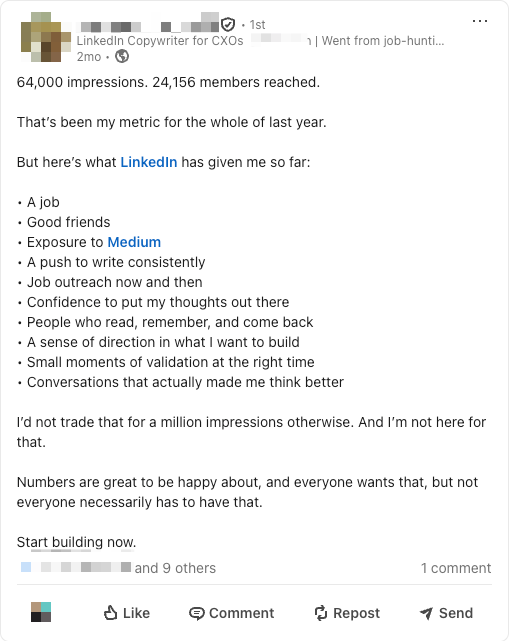
If we look at the above 2 posts on the topic of engagement, what stands out is that the first post relies heavily on familiar LinkedIn phrasing and recycled thought leadership patterns, which makes it feel structurally polished but lacking in originality or distinct perspective.
The second post, by contrast, is more grounded in lived experience, with specific numbers and concrete outcomes that make it feel more authentic and believable.
3. Pay Attention to Whether the Process Feels Collaborative
Many professionals assume ghostwriting works like outsourced production:
Assign topic → Receive draft → Publish
In practice, strong executive ghostwriting is usually much more iterative.
The best ghostwriters gradually learn:
- How you frame problems
- What language feels natural to you
- Where your strongest ideas emerge
- What themes consistently matter to you
- What level of detail reflects your actual thinking
Familiarity starts to compound.
Some executives articulate ideas naturally from day one. Others need several conversations before their thinking becomes structured enough to publish clearly. Neither is unusual.
Most professionals are not used to turning experience into public insight consistently. It is a learned skill.
A good ghostwriter recognizes this and builds a process around discovery, refinement, and iteration rather than simply producing content quickly.
4. Check Whether Their Work Sounds Distinct Across Clients
One useful exercise when reviewing portfolios: Remove the client names mentally and read the content in isolation.
Can you still feel different personalities, different operating styles, different worldviews, or does everything sound structurally identical?
A ghostwriter’s job is not to impose a personal writing style across clients. It is to preserve differentiation.
If every post sounds like recycled leadership advice, broad motivational commentary, or polished but vague observations, the writer may be optimizing for consistency rather than authenticity.
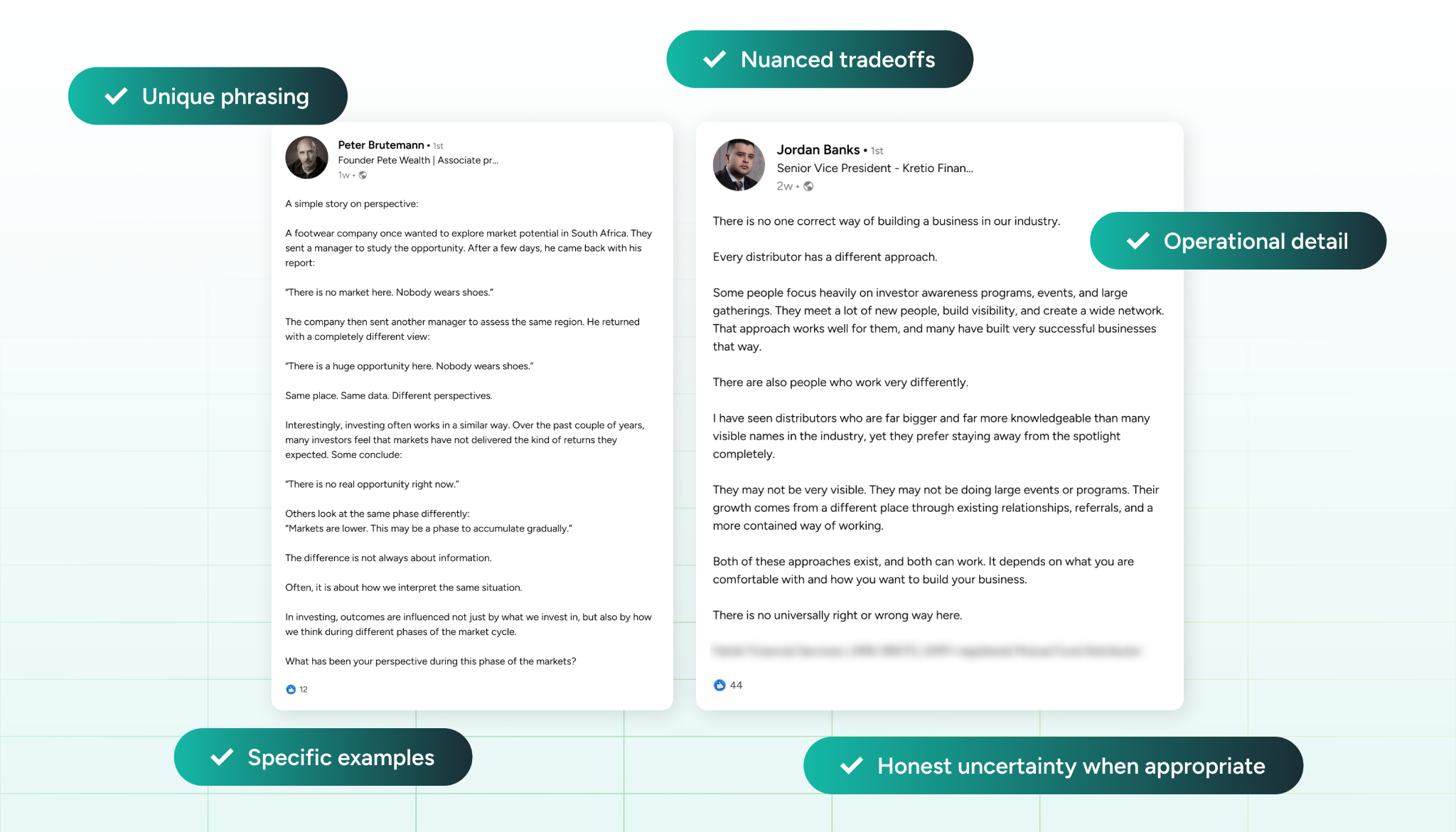
Strong ghostwriting preserves texture:
- Operational detail
- Unique phrasing
- Nuanced tradeoffs
- Specific examples
- Honest uncertainty when appropriate
That is what makes executive content believable.
5. Assess Their Research Skills
The best ghostwriters are versed in strengthening an executive's ideas with credible research, relevant examples, and real-world case studies.
This becomes significantly important when writing about industry trends, management practices, or emerging technologies. A well-researched post that connects personal experience with broader evidence feels more balanced, persuasive, and valuable.
Ask to see examples of content where they've successfully combined an executive's original insights with research to create a stronger argument. A good ghostwriter should know when an idea needs supporting data, a relevant case study, or an external example to reinforce the narrative without overshadowing the executive's perspective.
That ability separates strategic ghostwriters from those who simply rephrase opinions.
6. Prioritize Long-Term Fit Over Immediate Output
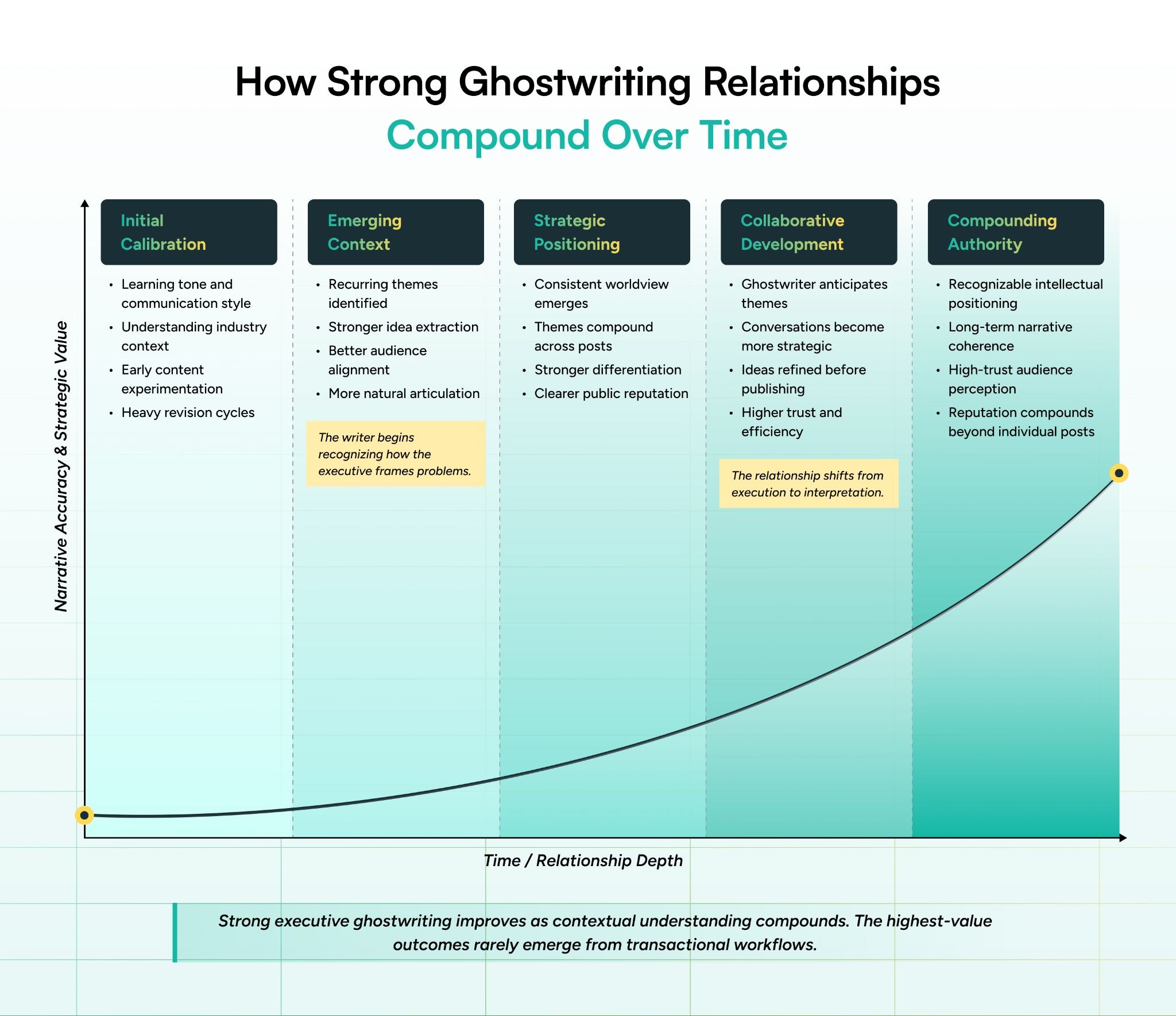
The strongest ghostwriting relationships rarely produce their best work in week one.
Like any strategic collaboration, quality improves as context accumulates.
Over time, the ghostwriter begins recognizing:
- Recurring patterns in your thinking
- Less-obvious themes across conversations
- Ideas worth developing further
- Perspectives that differentiate you from peers
That depth cannot be replicated through purely transactional workflows.
Which is why the best ghostwriting relationships often feel less like content services, and more like ongoing thought-partnerships.
A good ghostwriter can bring structure, consistency, editorial clarity and narrative direction.
But the substance still comes from the individual: what they’ve experienced, what they’ve learned, and how honestly they’re willing to communicate it.
That is ultimately what audiences connect with.
Questions to Ask Before Hiring a Ghostwriter
Hiring a ghostwriter is deceptively difficult because most of the important variables are invisible at the beginning.
Almost every ghostwriter can show polished samples. Many can explain content strategy. Some can even demonstrate strong engagement metrics. But none of those things automatically tell you whether they can accurately represent how you think in public.
That distinction matters more in 2026 than it did even a few years ago.
AI tools have made writing ridiculously easier to produce. As a result, the market is now flooded with content that may be structurally polished but is strategically empty. The real differentiator is no longer whether someone can write coherent posts. It is whether they can extract nuance, preserve depth of thought, and communicate expertise without flattening it into generic professional language.
This is why the hiring process should focus less on “content production” and more on interpretive ability.
A useful way to think about it is this:
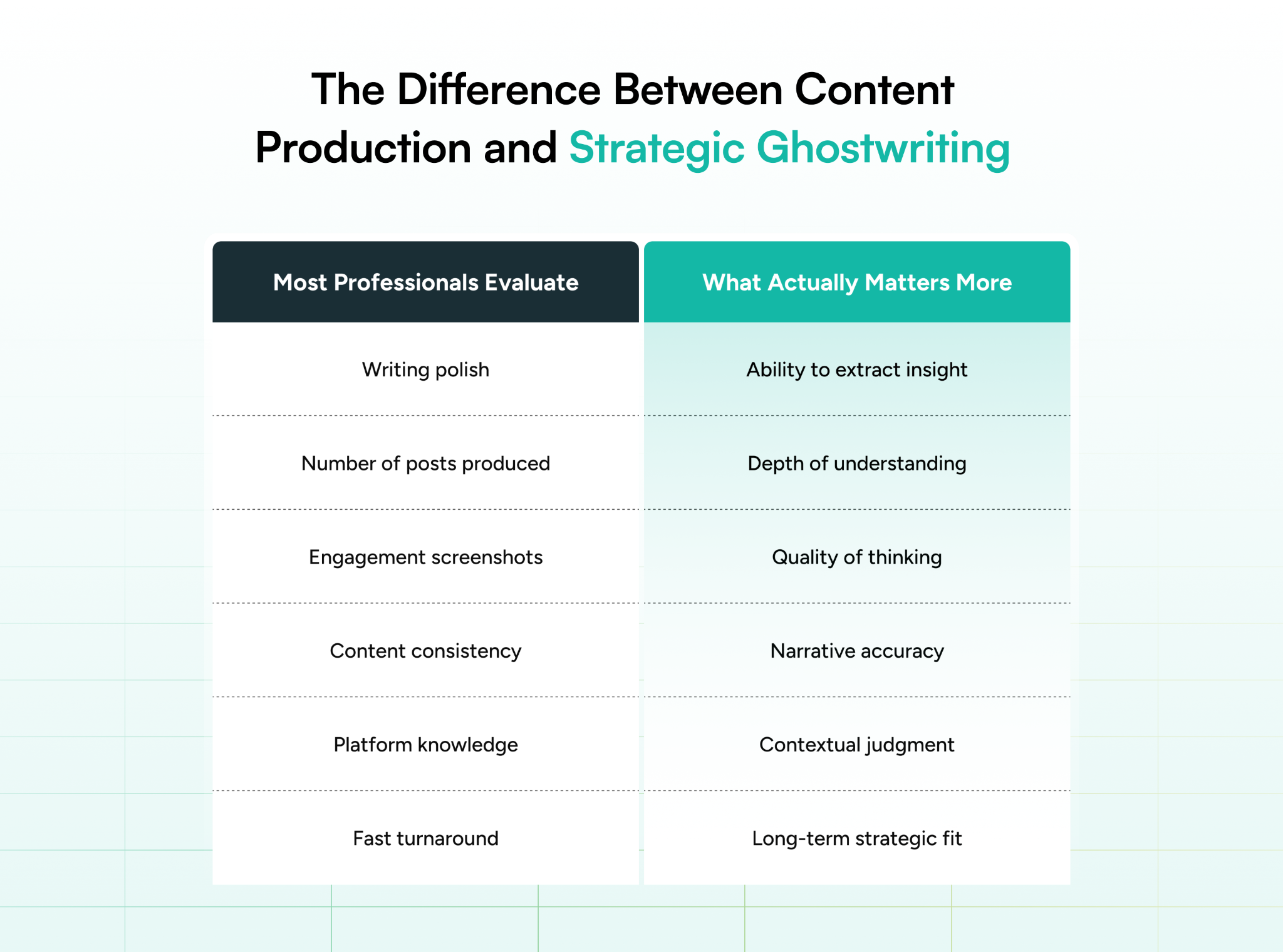
The strongest ghostwriting relationships usually resemble editorial partnerships more than outsourced execution.
That is also why the questions you ask during the evaluation process matter so much.
Q1. How do you learn a client’s voice?
This is often the single most revealing question. Weak ghostwriters tend to describe voice as tone matching, like sentence style, vocabulary, formatting preferences, or writing cadence.
But executive voice operates at a much deeper level than phrasing.
Voice is often a reflection of:
- How someone frames tradeoffs
- What they consistently pay attention to
- What frustrations recur in their thinking
- How they interpret problems under pressure
For example, two founders discussing scaling may sound completely different even if they operate in similar industries.
One may frame growth primarily through operational systems and another through talent density.
Those distinctions are not stylistic. They reveal a worldview. A strong ghostwriter learns to recognize those patterns over time. This is why the best discovery processes usually involve long-form conversations, observing spontaneous explanations, studying past interviews or presentations, reviewing internal memos or voice notes, and identifying recurring themes across discussions.
The goal is not to imitate but to interpret with accuracy.
A useful signal during hiring is whether the ghostwriter talks more about content formats or about how people think. The latter is usually a much stronger indicator of long-term fit.
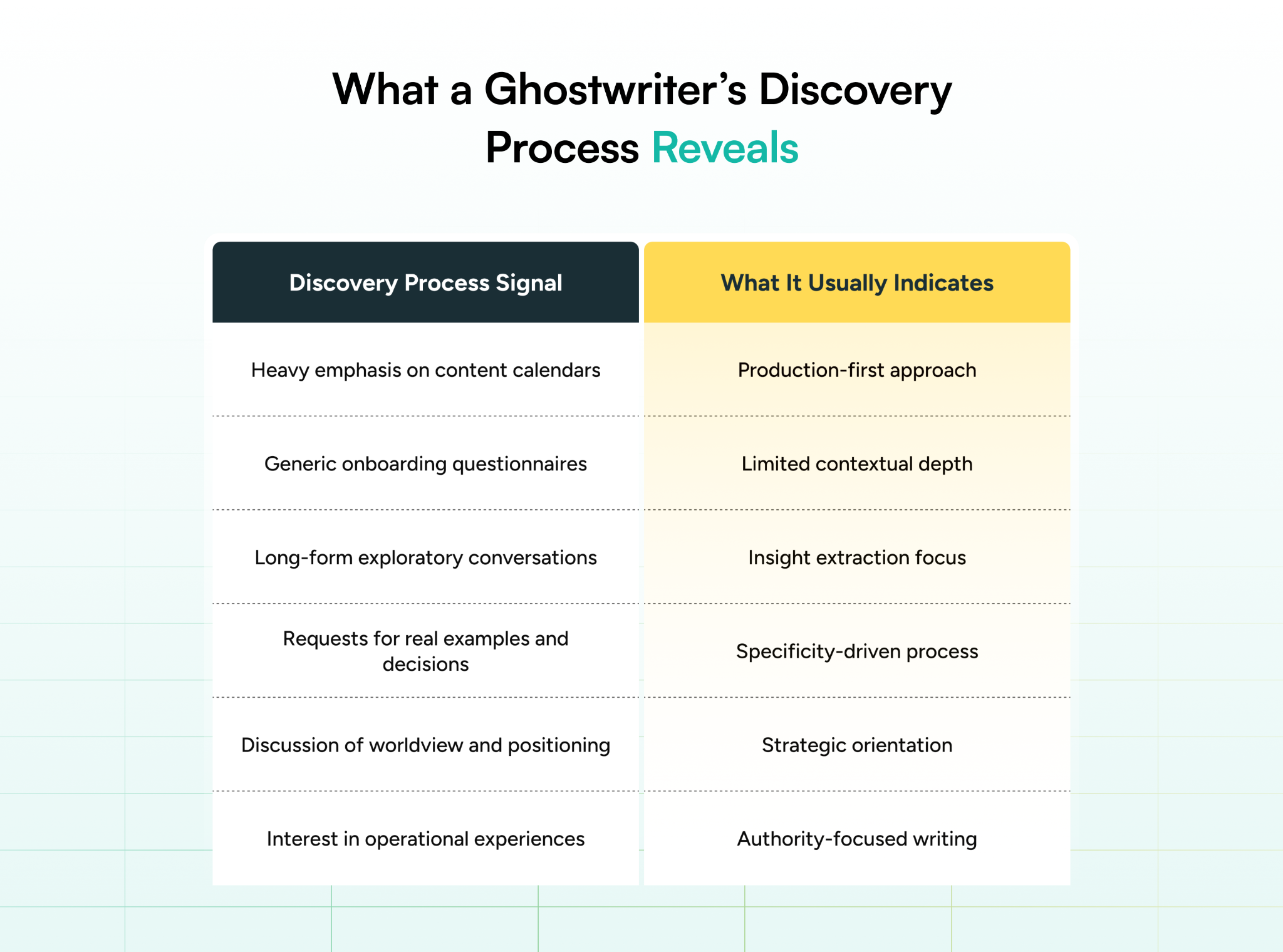
Q2. What does your interview or discovery process look like?
Many executives assume ghostwriting begins with drafting content. The strongest work often begins much earlier during discovery.
This phase determines whether the eventual content feels insight-driven, differentiated, and believable, or merely polished.
Good ghostwriters spend a significant amount of time identifying:
- Recurring operating philosophies
- Tension points inside the industry
- Stories with strategic value
- Contrarian observations
- Experiences that reveal earned perspective
The quality of questioning matters enormously here.
Average interviews tend to stay informational. They don’t go much beyond, “What topics do you want to post about?”
Better interviews become exploratory:
- What changed your mind recently?
- What problems do most people in your industry misdiagnose?
- What pattern keeps repeating across companies?
- What decisions become harder as organizations scale?
Those questions surface a perspective rather than simply content ideas. And perspective is what audiences actually remember.
One useful rule of thumb: if the process sounds highly templated, the resulting content usually will be too.
Q3. How involved do I need to be?
One of the most persistent myths around ghostwriting is that executives can remain completely detached from the process. Strong ghostwriting, however, tends to work more like assisted articulation than full delegation.
The substance still comes from the executive: experiences, judgments, pattern recognition, mistakes, operating principles, and industry context.
The ghostwriter’s role is to structure and communicate those ideas clearly.
This means the real objective is not eliminating executive involvement altogether. It is reducing the operational friction required to consistently maintain high-quality visibility. The best systems are usually lightweight but continuous.
Instead of asking executives to “sit down and write,” strong workflows often rely on short strategy calls, voice notes, meeting reflections, reactions to industry events, spontaneous observations, or quick discussions after important decisions.
This matters because expertise often emerges conversationally rather than compositionally.
Many senior operators explain ideas exceptionally well in meetings while struggling to convert those same ideas into structured public writing. Good ghostwriting bridges that gap.
Q4. How do you avoid generic content?
This question has become significantly more important in the AI era.
Today, almost anyone can generate leadership summaries, motivational observations, trend commentary, or polished-sounding professional content.
But informational abundance has only made audiences far more sensitive to originality and specificity.
Generic executive content has recognizable characteristics:
- Broad conclusions
- Consensus opinions
- Little operational detail
- Excessive abstraction
- Observations detached from real decisions or consequences
Strong ghostwriters avoid this by consistently pushing toward specificity.
That does not necessarily mean sharing confidential information. It means grounding ideas in real observations, practical experiences, meaningful trade-offs, and situations that feel lived rather than manufactured.
Q5. What does the revision process look like?
Revision is often misunderstood as a purely editorial step. In strong ghostwriting relationships, revisions function more as calibration mechanisms.
This is where the ghostwriter gradually learns:
- What feels authentic versus performative
- Which nuances matter most to you
- What kinds of examples resonate naturally
- Which ideas deserve deeper exploration
- Where your strongest perspectives consistently emerge
Over time, that accumulated context becomes a major strategic advantage.
This is also why the best ghostwriting relationships often improve significantly after the first few weeks. The ghostwriter is no longer working from isolated conversations. They are building a deeper understanding of how you think, what you value, and how you naturally communicate ideas.
A transactional process tends to produce isolated pieces of content. A collaborative one gradually produces narrative consistency.
And that consistency is what eventually creates recognizable authority online, over time.
Q6. Have you worked with executives in similar industries?
This question is useful, but often for reasons people do not initially expect.
Industry familiarity matters less because a ghostwriter needs to become a technical expert, and more because sophisticated industries tend to expose shallow interpretation very quickly.
Writing for sectors such as enterprise SaaS, private equity, healthcare, cybersecurity, or infrastructure requires a higher level of contextual sensitivity. Experienced audiences in these fields can usually tell when content lacks operational depth or relies too heavily on surface-level commentary.
Strong ghostwriters understand how to ask informed follow-up questions, avoid oversimplification, and understand what experienced audiences consider obvious.
This becomes increasingly important as executive seniority increases because seasoned operators are highly attuned to generic abstraction disguised as expertise.
The Bigger Pattern Behind These Questions
Most professionals think they are hiring someone to create content.
In reality, they are hiring someone to understand judgment, recognize patterns, preserve credibility, and translate expertise into a public narrative without diluting it.
That is a much more strategic role than many executives initially realize.
And it is usually the difference between content that generates temporary visibility and content that gradually compounds into reputation.
How Much Does a Ghostwriter Cost?
One of the biggest misconceptions about ghostwriting is that pricing is determined primarily by writing volume.
Reality check: Executive ghostwriting is rarely priced like a standard writing service.
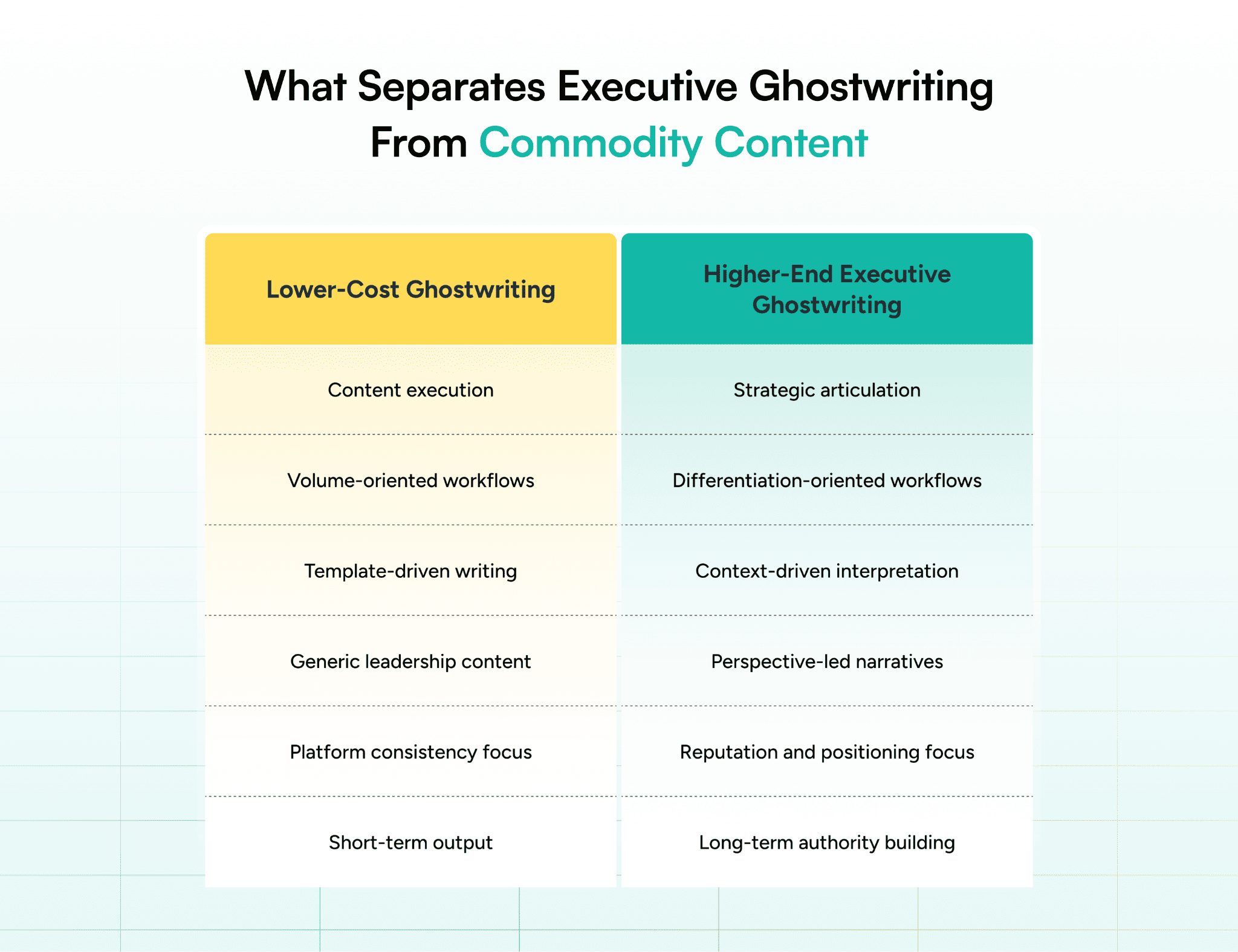
The difference between a low-cost freelancer and a high-end executive ghostwriter is not grammar, formatting, or posting cadence. It is the level of strategic involvement required to accurately represent someone’s thinking in public.
At the lower end of the market, ghostwriting often functions as content production: repurposing ideas, following templates, maintaining posting consistency, or generating platform-friendly content quickly.
At the higher end, the work becomes significantly more interpretive and strategic.
The ghostwriter is expected to
- Understand how the executive thinks
- Identify perspectives worth developing
- Extract insights from conversations and experiences
- Shape long-term positioning
- Maintain narrative consistency
- Communicate expertise without flattening it into generic leadership content
This is one reason pricing varies so widely across the industry.
The cost is often influenced less by word count and more by factors like:
- How much strategic collaboration is involved
- How research-intensive the subject matter is
- Whether the industry requires precision and contextual nuance
- How differentiated the content needs to feel
- How closely the ghostwriter participates in the positioning and communication strategy
A healthcare executive communicating around regulation and trust, for example, requires a very different level of contextual sensitivity than a creator-focused personal brand posting productivity content.
Similarly, writing occasional LinkedIn posts is fundamentally different from helping a founder build recognizable thought leadership over several years. The value of executive ghostwriting increasingly lies in strategic articulation rather than content volume alone.
A useful way to think about it is this:
This also explains why evaluating ghostwriting purely through per-post pricing can be misleading.
The more relevant question is how important clear, credible communication is to the way the executive is perceived publicly.
For senior operators, visibility increasingly influences:
- Investor perception
- Hiring quality
- Partnership opportunities
- Media credibility
- Speaking invitations
- Overall professional positioning
Which means the return on investment is often reputational rather than purely transactional.
Not every professional needs a deeply strategic ghostwriting engagement. In some cases, lightweight editorial support is enough.
But for executives building long-term authority, the work gradually becomes less about publishing content and more about building coherent public narrative infrastructure over time.
That is usually where pricing changes most significantly.
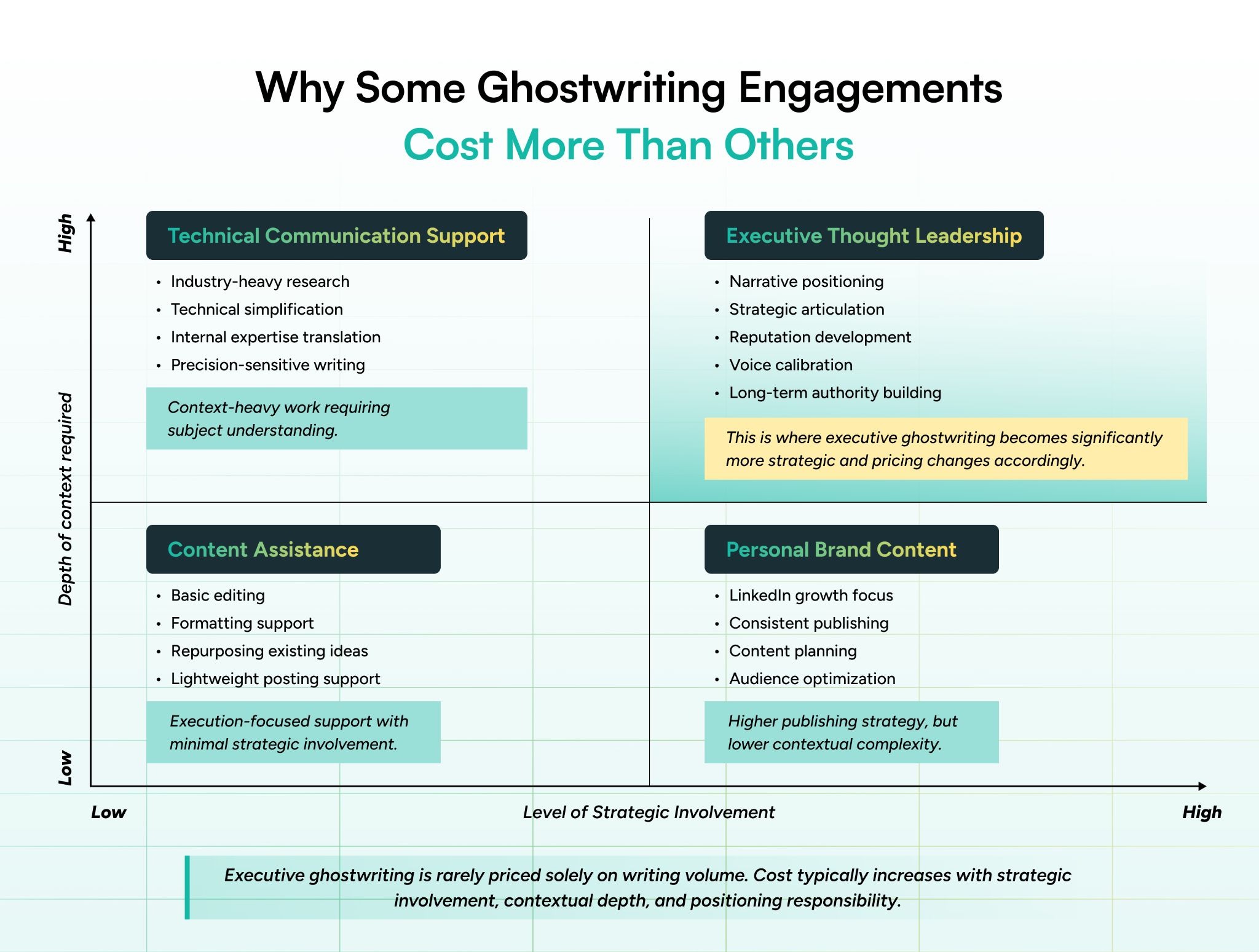
Market rates for executive ghostwriting typically range from approximately USD 1,000 to USD 15,000+ per month, depending on the scope of work, level of strategic involvement, and the experience of the ghostwriter or agency.
However, final pricing ultimately depends on the specific nature of the engagement and the service provider.
When Ghostwriting Is NOT a Good Fit
Ghostwriting is often positioned as a universal solution for building executive visibility. In practice, it only works well under specific conditions.
The most effective ghostwriting relationships are not defined by the writer’s ability to produce content, but by whether there is something coherent and meaningful to articulate in the first place.
Ghostwriting amplifies clarity. It cannot replace conviction, expertise, or original thinking.
When those foundations are missing, even well-executed writing tends to feel hollow.
1. When There Is No Clear Point of View Yet
Ghostwriting assumes that thinking already exists in some form, even if it is unstructured. The role of the writer is to extract, refine, and translate that thinking into a coherent public voice.
But in some cases, that internal structure is still forming. Founders or executives may have experience, but not yet a stable way of interpreting it. Their perspectives may shift frequently or remain too broad to translate into distinct narratives.
In these situations, ghostwriting often becomes a substitute for thinking rather than a vehicle for expression. The content may look polished on the surface, but it tends to rely on generic frameworks or widely accepted industry language because there is not yet a strong internal signal to build from.
The result is usually content that feels interchangeable: technically sound, but lacking differentiation.
2. When the Work Is Deeply Personal and Unprocessed
Some ideas are not meant to be mediated. This is particularly true for emotionally significant experiences, identity-shaping moments, or stories where the impact depends on direct voice rather than structured interpretation.
In these cases, ghostwriting can unintentionally create distance between the experience and its expression. Even if the narrative is accurate, it may lose emotional texture because the writing process inherently introduces structure, abstraction, and refinement.
This matters because certain forms of communication derive their power from immediacy. Leadership reflections that are deeply personal or emotionally charged often resonate more when they are expressed directly, even if they are less polished.
The key distinction is not about the quality of writing, but about the role of authenticity in the message itself.
3. When the Executive Is Unwilling to Collaborate
Ghostwriting is frequently misunderstood as a fully outsourced service. In reality, it functions more like a structured interpretation process built on access to thinking, not just instructions.
When there is limited willingness to engage in conversation, share experiences, or clarify intent, the ghostwriter is forced to rely on assumptions. That almost always results in content that is generic or misaligned.
The strongest outcomes emerge when collaboration is lightweight but consistent. Even short conversations or informal voice notes can significantly improve the depth of interpretation over time.
Without that input loop, ghostwriting becomes execution without context. And context is what gives executive content its credibility.
4. When Authenticity Depends Heavily on Direct Writing
In some environments, audiences place a high value on unfiltered communication. The expectation is not refinement, but immediacy. In these cases, overly structured or heavily edited content can feel disconnected from the voice people expect.
This is especially true when an executive’s brand is built around transparency, spontaneity, or directness. If the audience is accustomed to raw, in-the-moment thinking, highly polished content can unintentionally reduce perceived authenticity, even if the ideas themselves are strong.
The underlying issue is whether the mode of expression aligns with the audience’s expectations of credibility.
5. When Visibility Is Not Strategically Necessary Yet
Ghostwriting becomes most valuable when visibility is tied to a clear outcome, such as hiring, fundraising, deal flow, or category positioning. Without that anchor, content creation often operates in isolation from business strategy.
In those cases, publishing may generate activity, but not necessarily leverage. Attention without direction rarely compounds into meaningful outcomes.
For some professionals, the higher-value work at earlier stages is not communication, but building stronger operational foundations or refining domain expertise. Visibility becomes powerful only when it is aligned with a broader strategic objective.
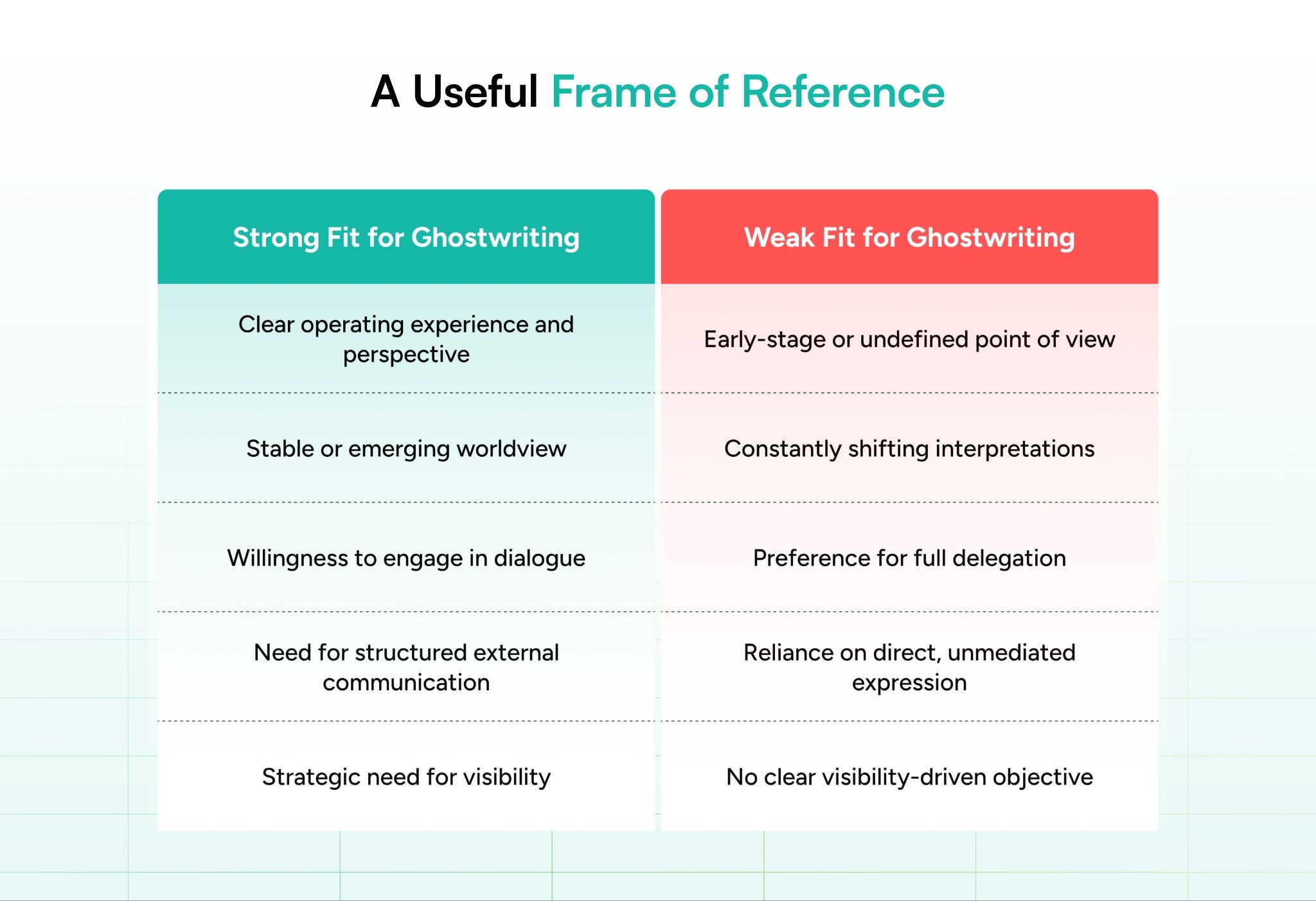
Ghostwriting is most effective when it refines existing clarity. It is least effective when it is expected to create that clarity from scratch.
In executive communication, conviction is not something that can be manufactured. It has to exist first; everything else is articulation.
The Biggest Mistakes People Make When Hiring Ghostwriters
Not all ghostwriters operate the same way. Some focus on producing high volumes of generic content, while others take the time to understand your expertise, positioning, and audience.
Before hiring a ghostwriter, look beyond pricing and posting frequency. The right fit should strengthen your personal brand, not dilute it.
Here are a few red flags to watch for during the evaluation process.
1. They Focus on Pricing Before Understanding Your Goals
A strong ghostwriter should spend the early conversations learning about your business, audience, positioning, and long-term objectives.
If the discussion immediately jumps to packages, deliverables, or pricing tiers without meaningful discovery, that is often a sign of a transactional content service rather than a strategic branding partner.
When someone is responsible for representing your voice publicly, curiosity and research matter.
2. Their Service Is Entirely Productized
Packages like “20 posts for $1,000” or “30 posts per month” may sound straightforward, but they can also signal a one-size-fits-all approach.
Effective ghostwriting is rarely standardized because every founder, executive, or consultant has different audiences, communication styles, business goals, and levels of industry expertise. The best ghostwriters adapt their process to the individual instead of forcing every client into the same content system.
3. They Have Not Reviewed Your Existing Presence
Before the first call, a good ghostwriter should already have reviewed your LinkedIn profile, existing content, and positioning.
They should arrive with observations, suggestions, or questions about:
- Your profile
- Your messaging
- Your audience positioning
- Gaps in your current content strategy
If they have done no preparation beforehand, that may indicate they are more focused on closing clients than producing meaningful long-term results.
4. Their Process Removes You Completely
Many professionals hire ghostwriters because they lack time, not because they lack ideas or expertise.
A good ghostwriting process should still involve extracting your opinions, stories, experiences, industry insights, and communication style
If the process is entirely hands-off, such as filling out a brief questionnaire and disappearing, the result is often generic content with little personality or differentiation.
The goal of ghostwriting is to help articulate it more consistently and effectively.
3 Best Practices for Working With Ghostwriters
Most ghostwriting relationships fail because of how the collaboration is structured. The difference between average output and strong executive thought leadership usually comes down to a few operational habits that shape the entire process.
1. Treat Conversations as Source Material
The most valuable input in any ghostwriting relationship is rarely a brief or a content idea. It is usually a conversation that was never intended to be content in the first place.
Strong ghostwriting systems treat everyday discussions as raw material. The way you explain a decision in a meeting, the way you frame a tradeoff on a call, or the way you respond to an unexpected problem often contains far more signal than a structured writing exercise.
The key shift is to stop trying to come up with content and start treating your natural thinking as the input.
2. Build a Feedback Loop Early
One of the most underestimated parts of ghostwriting is calibration. Early alignment on tone, positioning, and vocabulary determines how quickly content becomes recognizably yours.
This is not just about correcting drafts. It is about clarifying patterns:
- How you prefer to frame ideas
- What language feels accurate vs. performative
- What level of assertiveness suits your voice
- How your audience typically interprets your perspective
The faster this feedback loop is established, the faster content moves from well-written to distinctively yours.
3. Prioritize Signal Quality Over Content Volume
There is a persistent temptation to optimize for consistency and frequency, especially in platform-driven environments like LinkedIn. But for executives, volume rarely correlates with authority.
A small number of posts grounded in real experience, clear perspective, and specific thinking build far more credibility than frequent generic posting.
The compounding effect comes from clarity, not cadence. Over time, audiences do not remember how often you posted. They remember whether your ideas consistently felt sharp, relevant, and distinct from everything else in their feed.
That is the real leverage of good ghostwriting: not more content, but better signal density per piece.
Conclusion
As AI makes content easier to generate, most of what floods professional platforms is becoming structurally similar: well-formed, but interchangeable in perspective. In that environment, the advantage is shifting away from output and toward clarity of thought: what you actually believe, how you see your industry, and how consistently that thinking is communicated.
Ghostwriting, when done well, is not about producing more content. It is about translating real experience into clear, consistent, and credible communication without diluting its substance.
If you’re exploring ghostwriting support to build a more intentional and differentiated executive presence on LinkedIn, schedule a discovery call with GrowedIn to see what that could look like in practice.

Frequently Asked Questions
What exactly does a ghostwriter do for executives?
A ghostwriter helps executives turn their ideas, experience, and strategic thinking into clear, high-quality content that accurately reflects their voice and perspective.
Is ghostwriting just about writing LinkedIn posts?
No. At the executive level, ghostwriting is primarily about shaping narrative, positioning expertise, and building long-term thought leadership, not simply producing social media posts.
How is ghostwriting different from content writing?
Content writing focuses on producing text. Ghostwriting focuses on extracting thinking, interpreting it accurately, and aligning it with an executive’s voice and positioning.
How long does it take to see results from ghostwriting?
Early clarity can appear within a few weeks, but meaningful authority and narrative consistency typically compound over several months.
Do executives need to write anything themselves?
Not necessarily. However, strong ghostwriting still depends on active collaboration through conversations, feedback, voice notes, and sharing real experiences, decisions, and perspectives.
Can AI replace ghostwriters?
AI can generate content quickly, but it cannot reliably replicate lived experience, contextual judgment, or executive perspective, which are the foundations of credible thought leadership.
When should someone NOT hire a ghostwriter?
If there is no clear point of view, limited willingness to collaborate, or no strategic need for visibility, ghostwriting is unlikely to be effective.
How To Find and Hire a Ghostwriter in 2026 [Bonus: 3 Best Practices for Working With Ghostwriters]
- Ghostwriting is not content production; it is a structured translation of executive thinking into public narrative.
- Strong ghostwriting amplifies existing clarity but cannot replace conviction or experience.
- Executive visibility is increasingly playing a direct role in trust, hiring, fundraising, and business opportunities.
- Most weak content fails due to a lack of specificity, not a lack of writing skill.
- The real value of a ghostwriter lies in interpretation, positioning, and narrative consistency over time.
- AI has increased content volume but made original thinking and lived experience more valuable.
- The best ghostwriting relationships function as long-term thought partnerships, not transactional services.


Insights Hub

LinkedIn Analytics: Metrics to Track and How to Use Them
Employer Branding on LinkedIn