 Claude
 ChatGPT
 Gemini
Download The State of LinkedIn: Spring 2026
LinkedIn now has over 1 billion registered members. The number that actually tells you something, though, is a different one: users spend an average of 17 minutes on the platform per month.
Professional, purposeful, brief. That's the window content that actually lives in, and the system deciding what fills those 17 minutes has fundamentally changed how it works.
How Distribution Actually Works Now
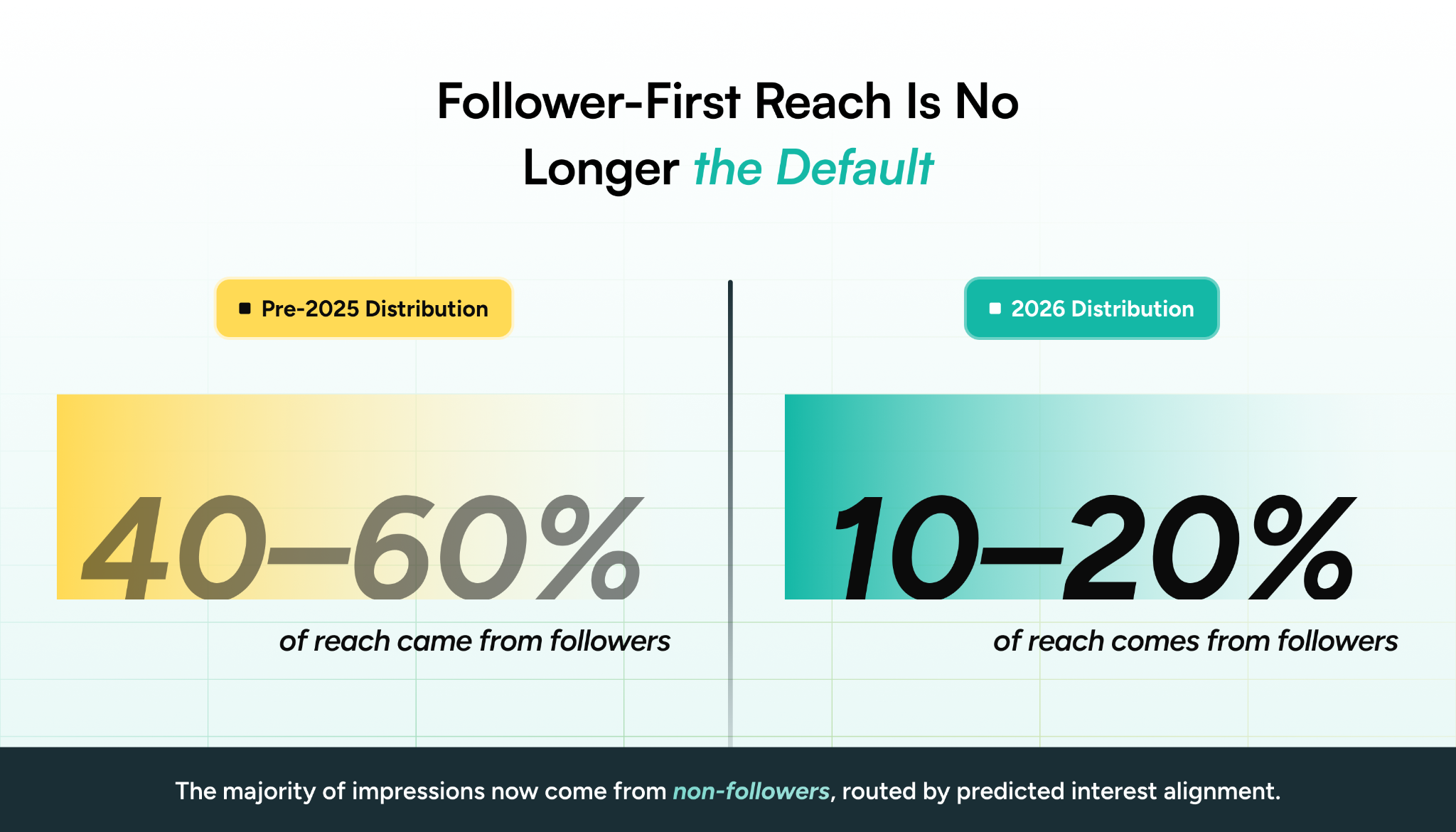
For years, LinkedIn distributed content based on who you were connected to. The logic was simple: post, reach your followers, hope it spreads from there. In 2026, that's no longer the underlying mechanic. The feed now maps users into interest cohorts based on dwell time, saves, engagement history, and topic affinity, then routes content based on predicted relevance, regardless of connection status. Data from the platform shows that follower-first reach has dropped from roughly 40–60% in the pre-2025 era to 10–20% today. The majority of a post's reach now comes from people who don't follow the account at all.
What LinkedIn Is Actually Measuring
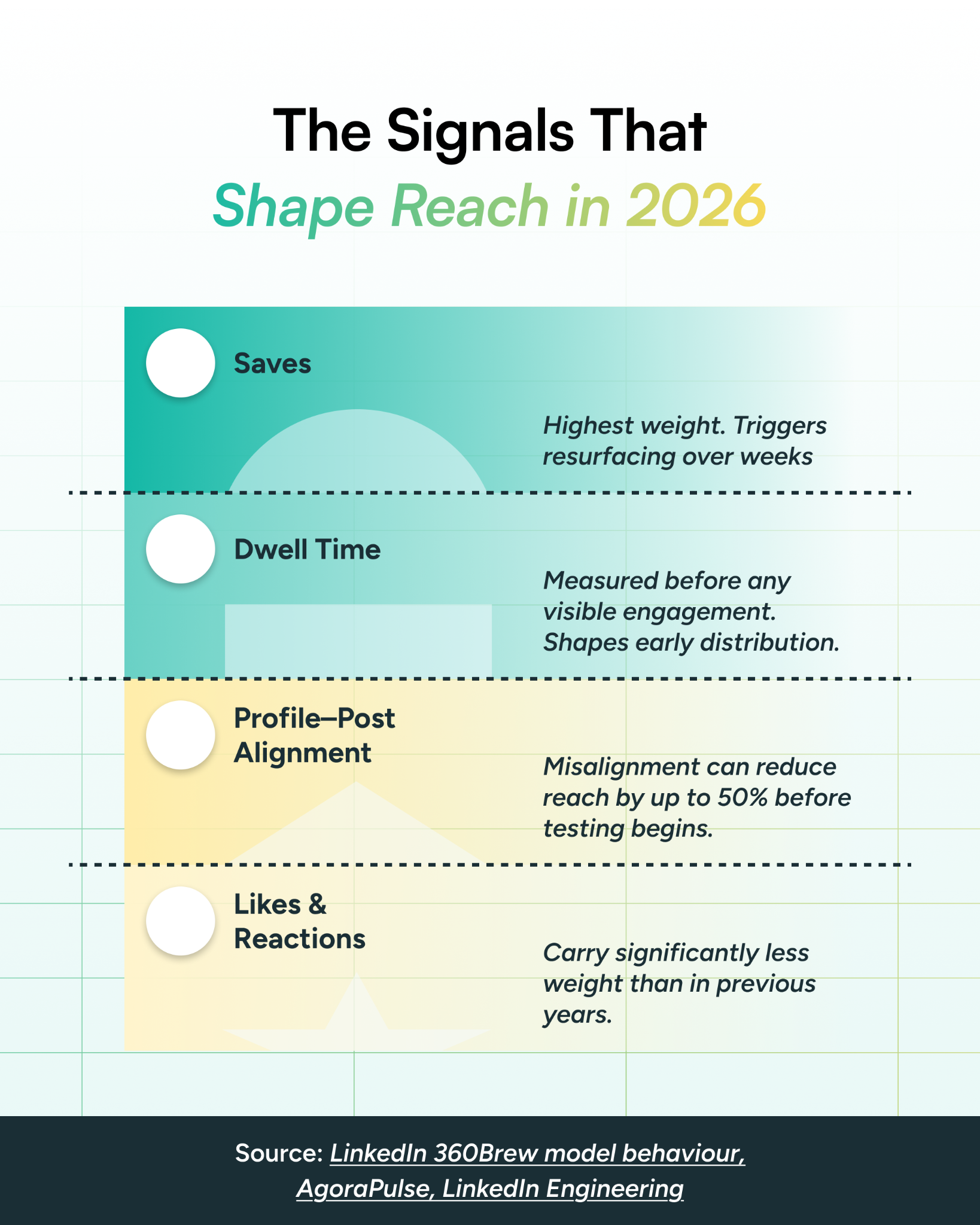
Saves have overtaken likes as a meaningful signal; a save tells the system the post had lasting value, and triggers resurfacing over weeks rather than hours.
Dwell time shapes distribution before any visible engagement is recorded; how long someone pauses, whether they expand the text, whether they read through a carousel, all of this is being measured and weighted.
Profile alignment has become a gating mechanism: LinkedIn's model now cross-checks what your profile communicates against what you post, and when the two diverge, distribution weakens before the post is even tested. Reach drops of up to 50% have been observed following poor profile-content alignment.
These are documented patterns in how the platform's AI model evaluates and routes content.
What the Full Report Covers
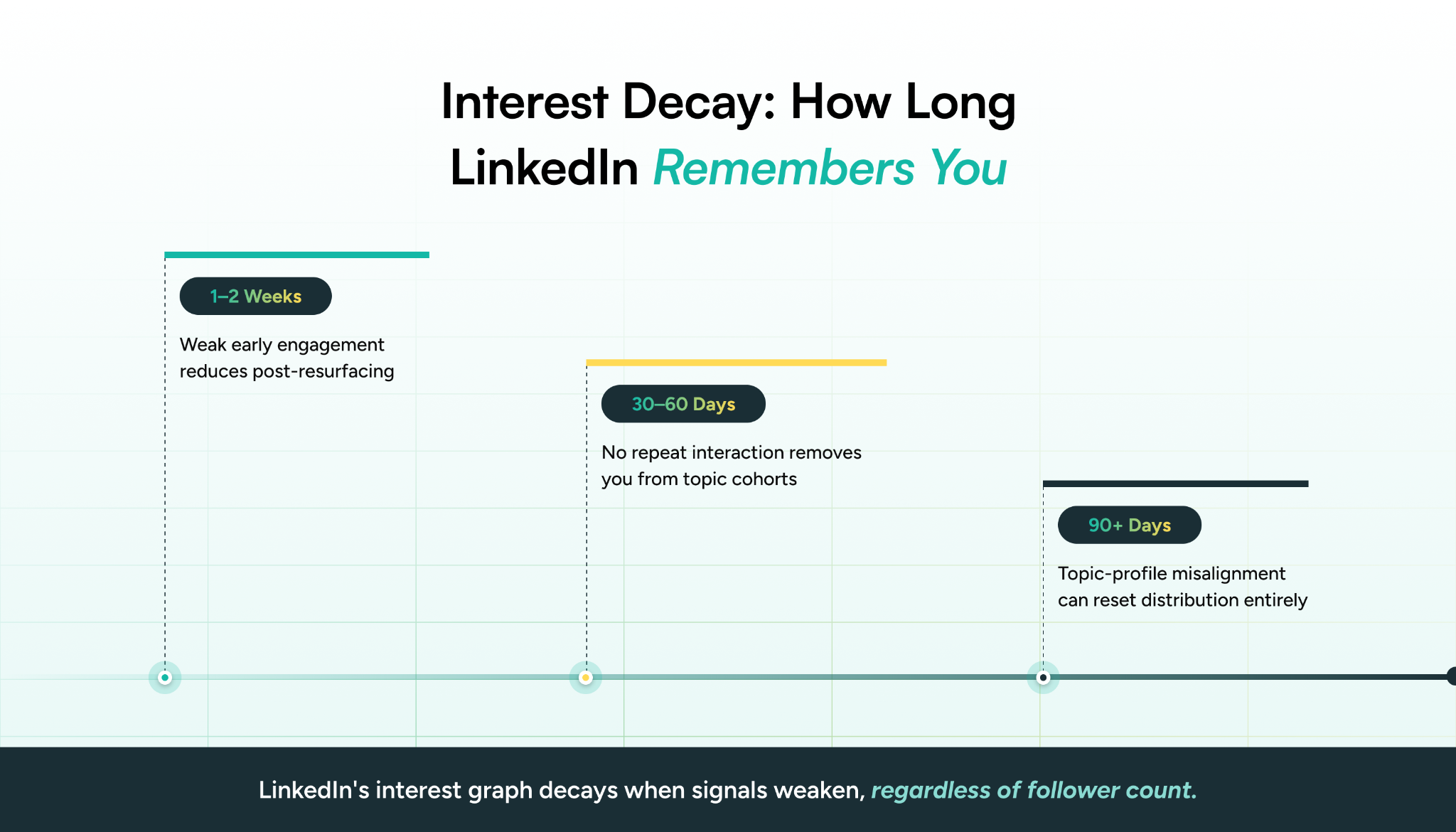
The Spring 2026 report covers all of this in depth, including how 360Brew, LinkedIn's large-scale AI ranking model, processes posts semantically rather than through surface signals, and how interest decay operates on rolling windows where 1-2 weeks of weak early engagement reduces resurfacing, 30-60 days without interaction removes a creator from topic cohorts, and 90+ days of topic-profile misalignment can reset distribution almost entirely.
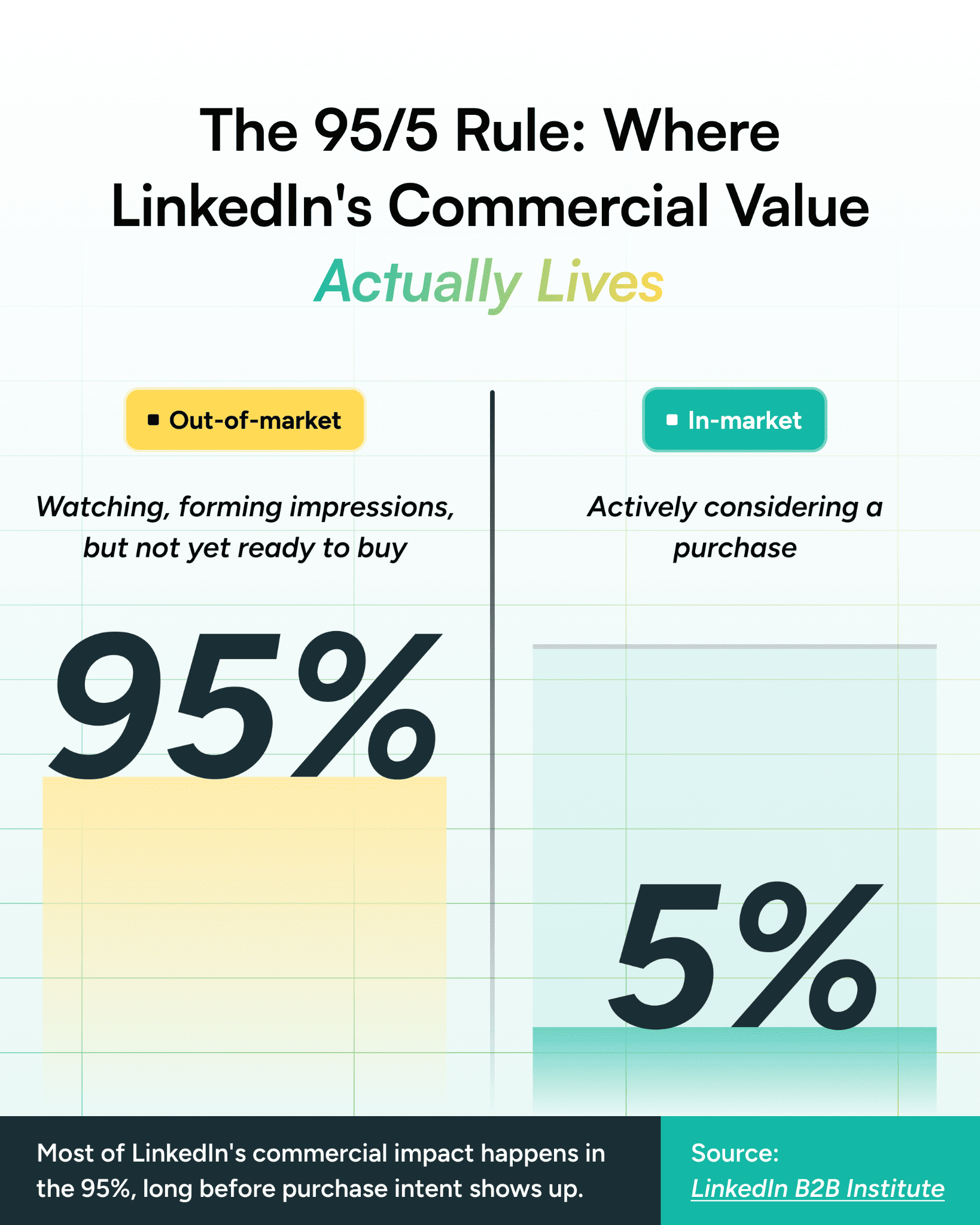
There's also a detailed look at what the data shows about personal profiles versus company pages: a Refine Labs analysis found personal profiles driving 2.75x more impressions and 5x more engagement than the equivalent company page. And there's the commercial layer: how LinkedIn's B2B Institute research on the 95/5 rule reframes what content is actually doing on the platform. Roughly 5% of buyers are in-market at any point, and the other 95% are watching, forming impressions, and building associations long before any purchase intent shows up. Content-influenced revenue is real, but it operates well upstream of where attribution tools are looking.
What We'd Do Starting Over
Near the end of the report, we wrote a section about what GrowedIn would do if we were starting from scratch today. It covers what we'd ignore: follower milestones, viral formats, surface-level engagement, and what we'd focus on instead: topical depth, the quality of who's engaging rather than how many, and building the kind of presence the platform gradually learns to trust. It's one of the more direct things we've put in writing.
Reach on LinkedIn in 2026 is something the algorithm decides, week to week, based on signals most people aren't measuring. Reputation is what accumulates through consistent, specific, behaviorally aligned content over months. The two have effectively decoupled, and the professionals building something durable right now are the ones working on the second, without mistaking the first for a shortcut to it.
This report is meant to help you make sense of that shift and use it intentionally for your advantage.
If you found the insights useful, it’s worth noting that these aren’t theoretical. They come from years of testing and refining with executive profiles, understanding what consistently drives meaningful outcomes. If you’re thinking about how this might translate to your own LinkedIn presence, happy to explore it together. Feel free to reach out, and we can set up a time to discuss.

Frequently Asked Questions
Who is this report for?
Founders, executives, marketers, and professionals who want to understand how LinkedIn actually distributes content in 2026, and what it takes to build visibility that compounds over time rather than fluctuating post by post.
What's different about the Spring 2026 edition?
This edition focuses more closely on platform mechanics, specifically, how the shift from a social graph to a behavioural interest graph has changed the underlying rules of distribution. It also covers the commercial and hiring layer in more depth: how content shapes the B2B pipeline, what the 95/5 rule means for demand strategy, and why cold outreach is getting harder structurally.
My reach dropped and hasn't recovered. What does the report say about that?
The report covers this. Most cases of sudden reach decline are interest decay or profile-content misalignment. The platform removes creators from topic cohorts when behavioural signals weaken and reach contracts as a result. The report explains the decay windows and what actually reverses the pattern.
Does the report cover company pages or just individual profiles?
Both. It covers why company pages have shifted into credibility anchors rather than distribution channels, what the performance data shows between personal profiles and pages, and what a practical content governance model looks like for teams posting at scale.
Is AI-generated content a problem on LinkedIn now?
The platform applies early-stage filters for templated phrasing, generic advice, and patterns associated with low-effort AI output. Posts that pass those filters but earn low dwell time then face additional suppression signals. The report covers what gets flagged and what survives, including why edited, perspective-led content continues to work.
Do I need to pay to access the full report?
No, the report is completely free.
How long before a credibility-first approach produces results?
Behavioural signals build within weeks. The 60–90 day window is where meaningful compounding becomes visible, where distribution stabilises, resurfacing increases, and inbound quality improves. The report explains the mechanics of this in the authority compounding section.
Can teams use this for planning a LinkedIn strategy?
Yes. The sections on employee advocacy, founder visibility, content governance, and paid distribution are directly relevant to organisations building LinkedIn as a demand generation or employer brand channel.
The State of LinkedIn: Spring 2026
- LinkedIn has passed 1 billion registered members. Users spend an average of 17 minutes per month on the platform. The feed deciding what fills those minutes has shifted from follower-first delivery to a behavioural interest graph.
- Follower-first reach has dropped from roughly 40-60% to 10-20%. The majority of a post's impressions now come from non-followers, routed based on predicted interest alignment.
- Saves have overtaken likes as a core ranking signal, dwell time shapes distribution before visible engagement is recorded, and profile-post misalignment can reduce reach by up to 50% before a post is even tested.
- Personal profiles drive 2.75x more impressions and 5x more engagement than company pages. People distribute, and pages validate. Employee advocacy and founder visibility are the highest-leverage organic channels available.
- The 95/5 rule reframes LinkedIn's commercial value: 95% of buyers are forming impressions long before they act. Content-influenced revenue is real but operates upstream of attribution tools.
- Reach on LinkedIn is what the algorithm decides week to week. Reputation is what accumulates over months of consistent, specific, behaviorally aligned content. In 2026, the two have effectively decoupled.


Insights Hub
LinkedIn Analytics: Metrics to Track and How to Use Them
Employer Branding on LinkedIn