 Claude
 ChatGPT
 Gemini
Your LinkedIn headline gives you 220 characters to make a first impression. It sits unobtrusively under your name and profile photo, yet it is some of the most valuable real estate you control online. For many founders, executives, and senior leaders, that space is either overlooked or left untouched for years. Old job titles or outdated skills stop reflecting who you are and the value you offer today.
A strong headline increases visibility. Better visibility attracts the right people. The right people create opportunities that move your business forward.
This article shares a practical framework to help you write a LinkedIn headline that speaks to the audience you want to reach and positions you as the leader they want to engage with.
Why LinkedIn Headlines Matter
When someone lands on a LinkedIn search results page or sees your name in a feed, the headline is the first line of your professional story, and in many cases, it’s the deciding factor in whether someone clicks, engages, or scrolls past. Think of it as a micro-ad for your professional brand: succinct and strategic.
LinkedIn headlines influence visibility and engagement in measurable ways. Profiles that use clear, optimized headlines appear more frequently in search results and attract meaningful interactions, rather than random profile views.
Keywords in your headline also influence search relevance, directly impacting how often your profile is surfaced to the people you want to reach.
From a performance perspective, real-world data and optimization tests show that headline tweaks can change outcomes:
- LinkedIn headline optimization has been shown to increase click-through rates (CTR) by 28%–54% and profile views by up to 40% when outcome-focused language is used.
- Optimizing headlines and About sections can lead to 28%–52% more inbound connection requests.
This happens because LinkedIn’s algorithm weighs headline keywords heavily when matching profiles to search queries. Unlike a resume, which is static and private, your headline is public search metadata, and it’s indexed every time someone searches for professionals like you.
Visibility is just part of the story. Generic headlines like “Marketing Professional” or “Experienced Manager” bury you alongside hundreds of others competing for attention. By contrast, specificity in your headline, such as “B2B SaaS Marketing Leader | Helping Tech Startups Scale Revenue,” improves the relevance of who sees your profile, boosting not just views but also engagement from your target audience.
Example:
A senior leader evaluating potential collaborators will skip generic titles like “Operations Specialist.” However, a headline that conveys both who you help and what you deliver signals relevance in seconds, increasing the odds that they will click through, connect, or initiate a conversation.
This is why strategic thinking matters. Your headline must be more than a summary of your job title; it must act as a signal to both algorithms and humans that your profile deserves attention. The rest of this article breaks down how to think about headlines with this dual purpose in mind: visibility through smart keywords and engagement through clear value and audience alignment.
CEO Insights:
What “Attracting the Right People” Means on LinkedIn
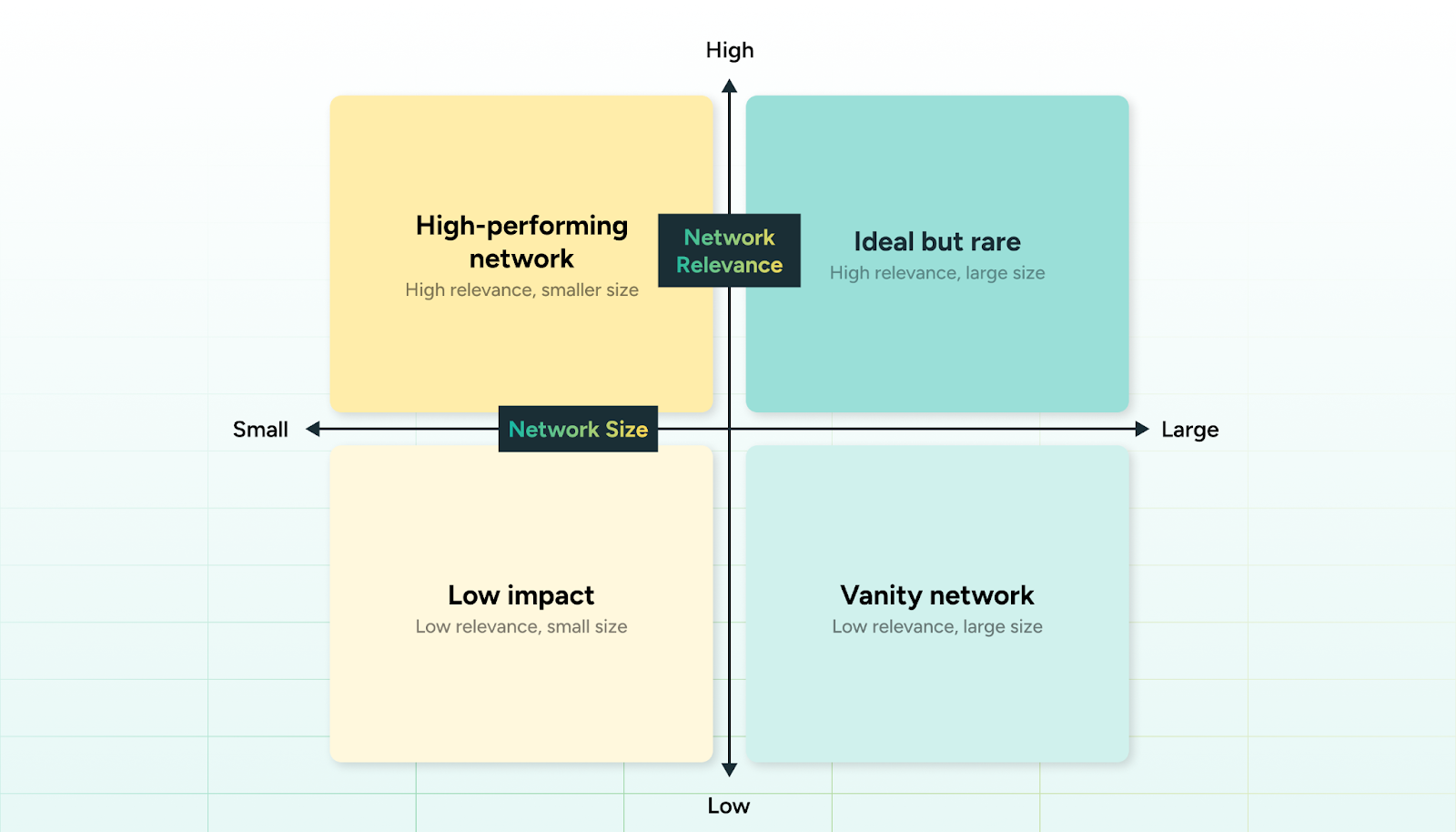
With more than a billion members worldwide on LinkedIn, it connects an extraordinary range of professionals, but not all of them matter equally to your goals. Accumulating connections or chasing visibility metrics can feel productive until you realize most of those connections don’t engage, interact, or convert into opportunities that matter.
Intentional networking delivers far more value. Building a network filled with professionals who share your goals, industry, and interests leads to meaningful dialogue and higher engagement rates, all of which are far more likely to translate into real opportunities.
One LinkedIn network analysis suggests that profiles with 500–999 connections often outperform much larger networks in engagement, because their networks tend to be tighter, more relevant, and more active.
Here’s why this distinction matters in practice:
Engagement Beats Impressions
A well-curated network is more likely to like, comment, or share your posts; actions that signal authority to both humans and LinkedIn’s algorithm. Quality engagement tends to drive future visibility, whereas vanity metrics like connection count do not necessarily produce meaningful interaction.
Relevance Sharpens Conversion
A network full of irrelevant connections, for example, people outside your target industry, may inflate your numbers but deliver few conversations that lead to business outcomes. The more relevant your network, the higher the likelihood that profile visits translate into inbound conversations or opportunities.
Signal Fidelity Over Noise
A large but dispersed network can dilute your feed and attention, making it harder to spot who actually matters to your objectives. High-value connections help surface insights, referrals, and introductions.
A founder with 800 carefully selected connections, including industry decision-makers, potential clients, and senior peers, is more likely to get meaningful business inquiries from profile views than a founder with 3,000 connections made without a process.
With LinkedIn, the right connections serve as pathways to opportunities, insights, and trusted introductions. When your network aligns with your goals, your headline becomes a beacon for the people who matter most.
The Three Questions Every Effective LinkedIn Headline Answers
The highest-performing LinkedIn headlines highlight relevance to the right audience, clarify value, and create urgency or context that invites engagement. When every word matters, asking the right questions becomes essential.
Across platforms, messaging that clearly identifies an audience and frames outcomes consistently outperforms generic statements. The same principle applies to LinkedIn. Below are three fundamental questions every effective headline should answer, along with why each one matters.
Question 1: Who Are You Speaking To?
A LinkedIn headline that tries to speak to everyone often ends up resonating with no one. The first task of a powerful headline is to tell the right people that your profile is meant for them. That could be industry leaders, founders in a specific vertical, talent acquisition professionals, founders of early-stage startups, or another distinct group.
Why it matters:
LinkedIn’s algorithm, much like search engines, uses text relevance to match profiles with search queries and feed placement. Headlines that include terms related to a specific audience group, for example, “SaaS Founders,” “B2B Marketers,” or “Healthcare Tech Leaders,” are more likely to appear in searches connected to those groups.
Example:
- Before: “Marketing Professional”
- After: “Growth Marketing for SaaS Founders & Startups”
The second version signals exactly who it is for, which increases the likelihood of relevant clicks, messages, and connections.
Relevant audiences are more likely to respond, connect, or message, which, in turn, signals stronger engagement to LinkedIn’s algorithm.
Question 2: What Problem Do You Solve or What Outcome Do You Deliver?
Responsibilities don’t move people to act; outcomes do.
Once you’ve signaled who you’re speaking to, the next element is why they should pay attention. Many professionals fall short here: they list job titles (“CEO,” “Consultant”) or broad descriptions without articulating what problem they solve or what benefit they deliver.
According to principles of messaging psychology, framing roles around outcomes rather than duties improves persuasion and engagement because it answers the reader’s unspoken question: “What’s in it for me?”
Example:
- Before: “Operations Manager at Acme Corp.”
- After: “Scaling Operational Efficiency for Fast-Growth Tech Teams”
The second version tells the reader the value delivered, operational scaling, rather than merely stating a title.
When your headline communicates an outcome, it becomes a value proposition rather than a job description, making it easier for the right prospects to stop, engage, and initiate a conversation.
Question 3: Why Should They Care Now?
Urgency or context increases engagement.
Even though headlines don’t need dramatic hooks, the best ones give a reason to engage now, rather than later. This could be framed through context (e.g., market relevance), specificity (e.g., a current initiative or trend), or positioning (e.g., an active area of focus).
Psychological studies on decision-making show that people are far more likely to act when a message includes a clear context or relevance cue; for example, a time frame, trend, or specific challenge, rather than when it feels general and passive.
Example:
- Before: “Helping Companies Grow”
- After: “Helping B2B SaaS Teams Accelerate ARR Growth”
The latter version communicates why this matters right now. It uses a defined time frame to make the message specific and timely.
This element doesn’t always need to be overt if your headline already implies specificity, but it helps prevent headlines from feeling generic or static.
Putting the Three Together
A strong LinkedIn headline doesn’t need to be long, but it needs to be strategic. Answering these three questions helps ensure that your headline is not just visible, but relevant:
- Who are you speaking to? (Audience signal)
- What problem do you solve / what outcome do you deliver? (Value signal)
- Why should they care now? (Context signal)
When you make every character count toward clarity, your headline attracts the people you most want to engage and is less likely to attract those who add no value to your goals.
CEO Insight:
LinkedIn Headline Formats That Work
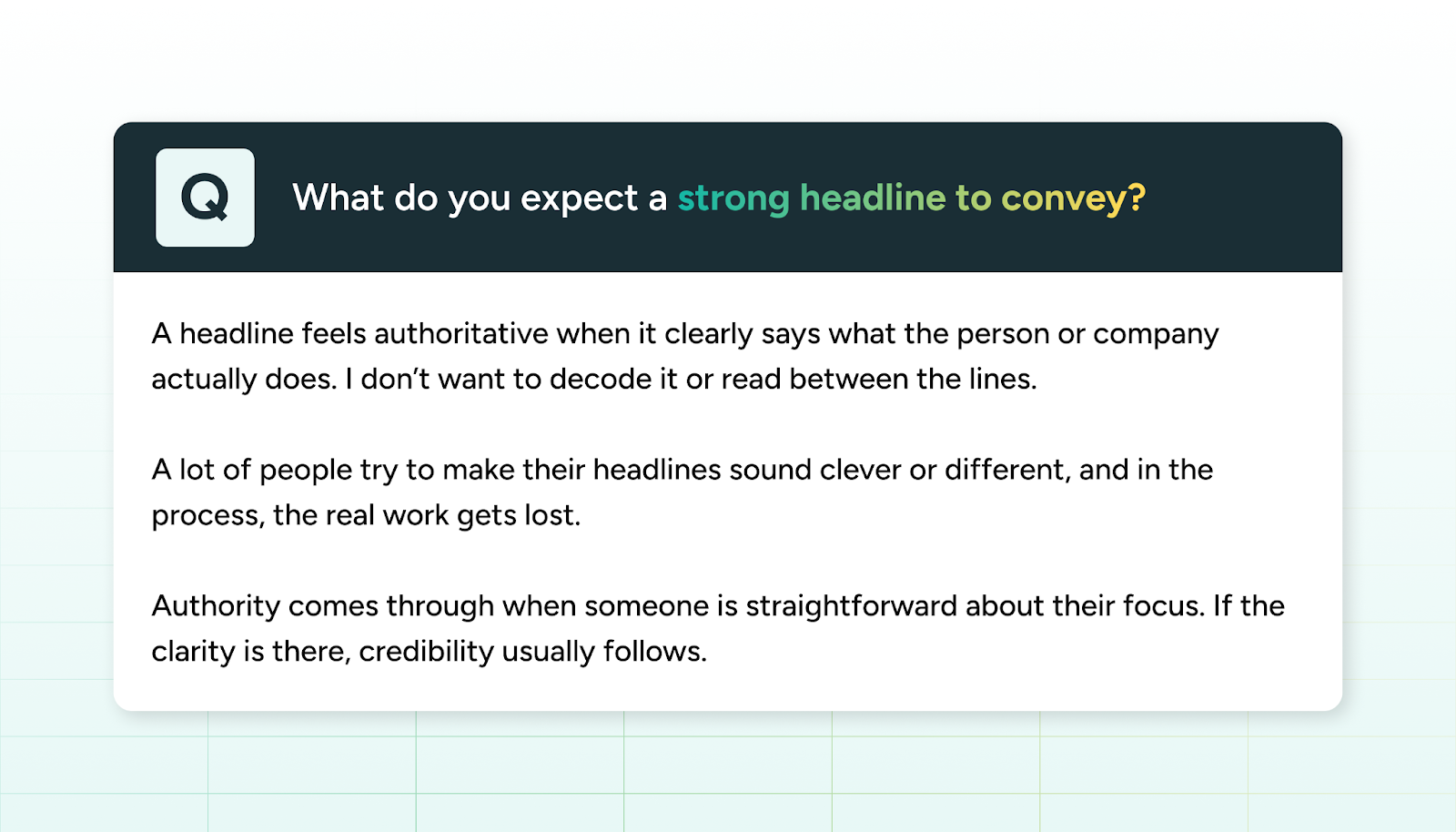
There isn’t a single “best” LinkedIn headline format, but there are formats that work consistently when they’re aligned with intent. The strongest headlines aren’t clever for the sake of it. They choose a structure that reinforces positioning, credibility, and relevance for the audience they’re meant to attract.
Effective LinkedIn headlines broadly tend to fall into three formats.
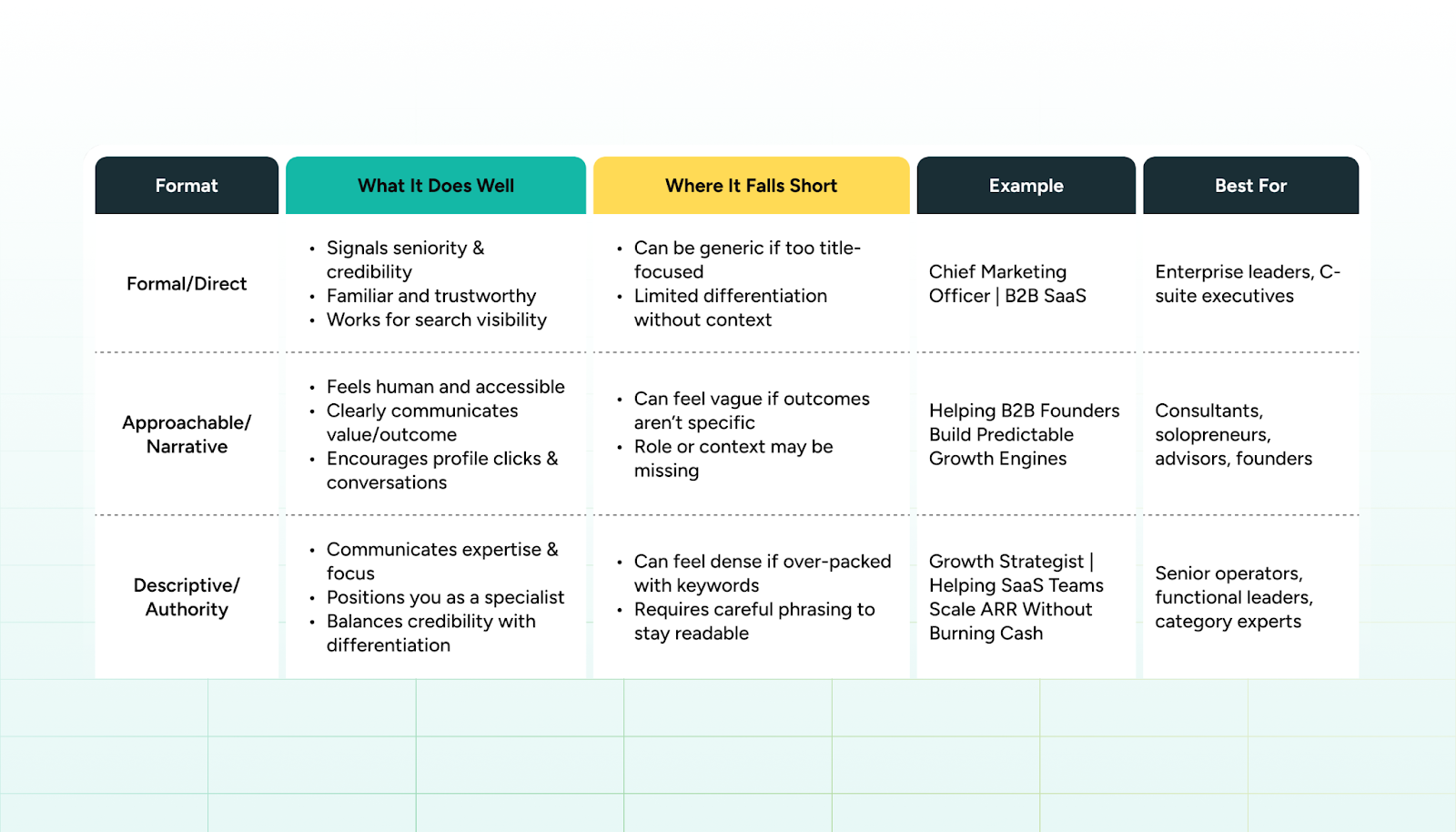
1. Formal/Direct
This is the most commonly used and the most misused format.
A formal headline clearly states role, seniority, and organizational context. When done well, it signals credibility and authority instantly, especially in executive, enterprise, or regulated environments where clarity matters more than personality.
What it does well
- Establishes seniority and legitimacy
- Works effectively for search visibility
- Feels familiar and trustworthy to recruiters, boards, and large organizations
Where it falls short
- Easily becomes generic if it relies only on a title
- Offers little differentiation if value or scope isn’t clarified
Example
- Chief Marketing Officer | B2B SaaS
- Founder & CEO, XYZ Technologies
When this format works best
- Enterprise leaders
- C-suite executives
- Professionals whose credibility is closely tied to the role and organization
The key difference between an average and a strong formal headline is precision. The more specific the role and context, the stronger the signal.
2. Approachable/Narrative
This format shifts the focus from who you are to how you help. It’s written in natural language and often reads like a sentence rather than a label.
Narrative headlines are especially effective for professionals who rely on inbound conversations. These could be consultants, solopreneurs, coaches, and founders building a personal brand alongside their business.
What it does well
- Feels human and accessible
- Clearly communicates value or outcome
- Encourages profile clicks and conversations
Where it falls short
- Can feel vague if outcomes aren’t specific
- May reduce clarity if the role or context is missing
Example
- Helping B2B Founders Build Predictable Growth Engines
- I Work with Sales Leaders to Improve Pipeline Quality
When this format works best
- Consultants and advisors
- Solopreneurs and fractional leaders
- Founders using LinkedIn as a primary growth channel
The strongest narrative headlines still anchor themselves in credibility either through outcomes, audience specificity, or implied experience.
3. Descriptive/Authority
This format combines role clarity with positioning. It’s neither purely formal nor purely narrative; instead, it blends authority with differentiation.
Descriptive headlines are particularly effective when you want to be seen as a subject-matter expert or category leader, not just a job title holder.
What it does well
- Communicates expertise and focus
- Positions you as a specialist rather than a generalist
- Balances credibility with differentiation
Where it falls short
- Can feel dense if over-packed with keywords
- Requires thoughtful phrasing to stay readable
Example
- Growth Strategist | Helping SaaS Teams Scale ARR Without Burning Cash
- Customer Success Leader | Driving Retention & Expansion in B2B SaaS
When this format works best
- Senior operators
- Functional leaders
- Professionals positioning for advisory, leadership, or niche roles
This is often the most effective format for attracting the right opportunities without sacrificing clarity.
How to Choose the Right Format
The right headline format depends less on trends and more on intent. Before choosing a structure, ask yourself:
- Do I want to be hired, consulted, or discovered?
- Is my credibility tied more to my title or my outcomes?
- Am I optimizing for authority, approachability, or differentiation?
A simple rule of thumb:
- If credibility and seniority matter most, go Formal/Direct
- If conversations and inbound leads matter most, go Approachable/Narrative
- If positioning and expertise matter most, go Descriptive/Authority
Here’s a quick overview:
LinkedIn Headline Rules: Character Limits, Visibility, and Search
Optimizing your LinkedIn headline properly requires understanding three intertwined rules: length, keywords, and readability.
1. Character Limits: What You Can and Should Use
LinkedIn currently allows up to 220 characters in your headline, which is more space than most people realize. This is your lever for including both search signals (keywords) and engagement cues (value and context).
However, context matters:
- Search previews in feed or search results display only the first ~60–80 characters, meaning your front-loaded messaging matters most.
- On mobile, truncation happens even earlier; what shows under your name may be considerably shorter.
- Desktop views can reveal the full 220 characters, but many people never click through unless the initial snippet delivers clarity and relevance.
Essentially, a headline that is the full 220 characters isn’t a guarantee of visibility if the first 60–80 characters don’t signal relevance to your audience.
Practical rule:
- Primary message (who + what) in the first ~80 characters
- Secondary keywords and context after, up to the character limit
This structure ensures maximum search visibility and human comprehension before truncation.
2. Keywords: Weighted Signals in LinkedIn Search
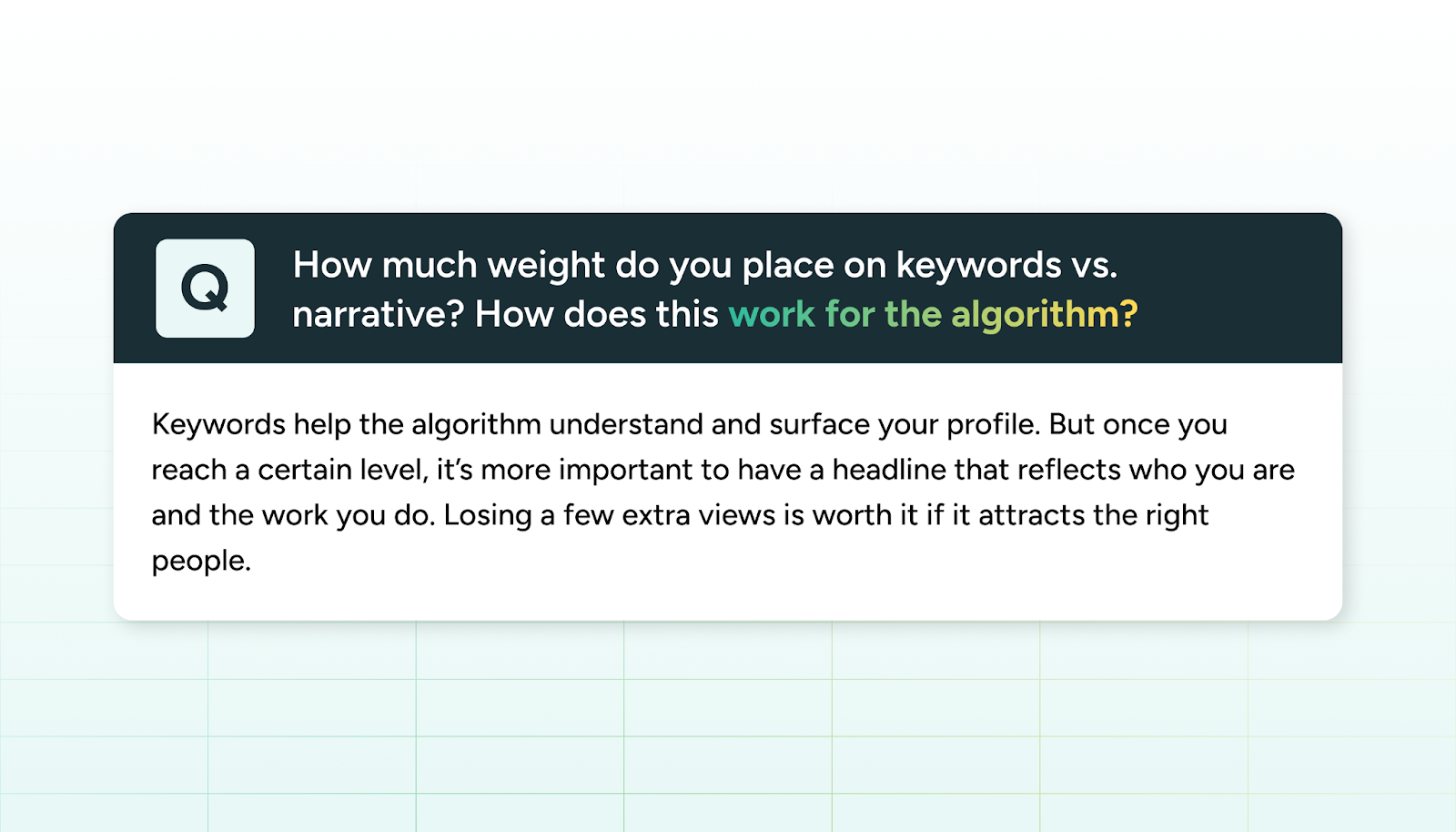
LinkedIn’s internal search algorithm treats your headline as one of the heaviest-weighted metadata fields when matching search queries. Third-party analyses suggest that headlines may carry ten times more search weight than profile sections, such as the About section summary.
Why this matters:
- Recruiters and sales professionals often search by industry terms, roles, skills, and tools, not just job titles.
- Without those terms in your headline, your profile often won’t surface for relevant searches, no matter how strong your experience section is.
- Strategic keyword placement is more about contextual signal matching than keyword stuffing. Algorithms use your headline’s language to decide whether your profile is relevant to search filters.
What to include (and where):
- Front-load primary role and audience terms (e.g., “B2B SaaS Growth Leader”)
- Follow with key skills or differentiators (e.g., “Product Strategy | Go-to-Market”)
- Optional value signals (e.g., quantified outcomes or credibility cues) toward the end
All should be woven naturally, not as an unreadable keyword list.
Example:
“Chief Product Officer | SaaS Go-to-Market & Growth Strategy | 3x ARR Expansion”
Here, terms like Chief Product Officer, SaaS, Go-to-Market, and Growth Strategy are all searchable signals that match the way hiring managers and decision-makers query LinkedIn.
3. Readability: Humans Still Decide First
Even with the algorithm indexing your keywords, humans judge and decide whether to click. LinkedIn search results show:
- Your photo
- Your headline
- Your location
If your headline is dense with clichés (“Experienced”, “Passionate”, “Strategic”), it slows cognitive processing and lowers clicks even if your keywords are accurate.
Readability best practices:
- Use separators (e.g., vertical bars, bullets) sparingly to segment ideas without clutter.
- Avoid lists of keywords with no relational context (e.g., “Python Java AWS SQL DevOps Full Stack”). That pattern reads as noise, not a coherent narrative.
- Keep language simple but specific: clarity trumps cleverness.
Example:
Instead of “Engineer Python AWS DevOps Leadership”, use “Senior Software Engineer | Building Scalable Python Systems | AWS & DevOps.”
What This Means Strategically
LinkedIn’s headline is a search-driven interface and a first-impression asset:
- Short enough that you must prioritize signals
- Long enough to communicate audience, value, and expertise
- Indexed heavily by LinkedIn’s matching logic
- Seen and judged by humans
The real challenge lies in balancing both visibility and credibility. A headline with strong keywords but poor readability may get indexed, but won’t convert views into actions. Conversely, a headline that sounds good but omits core search terms will show up for no one.
CEO Insights:
A Quick Checklist to Review Your LinkedIn Headline
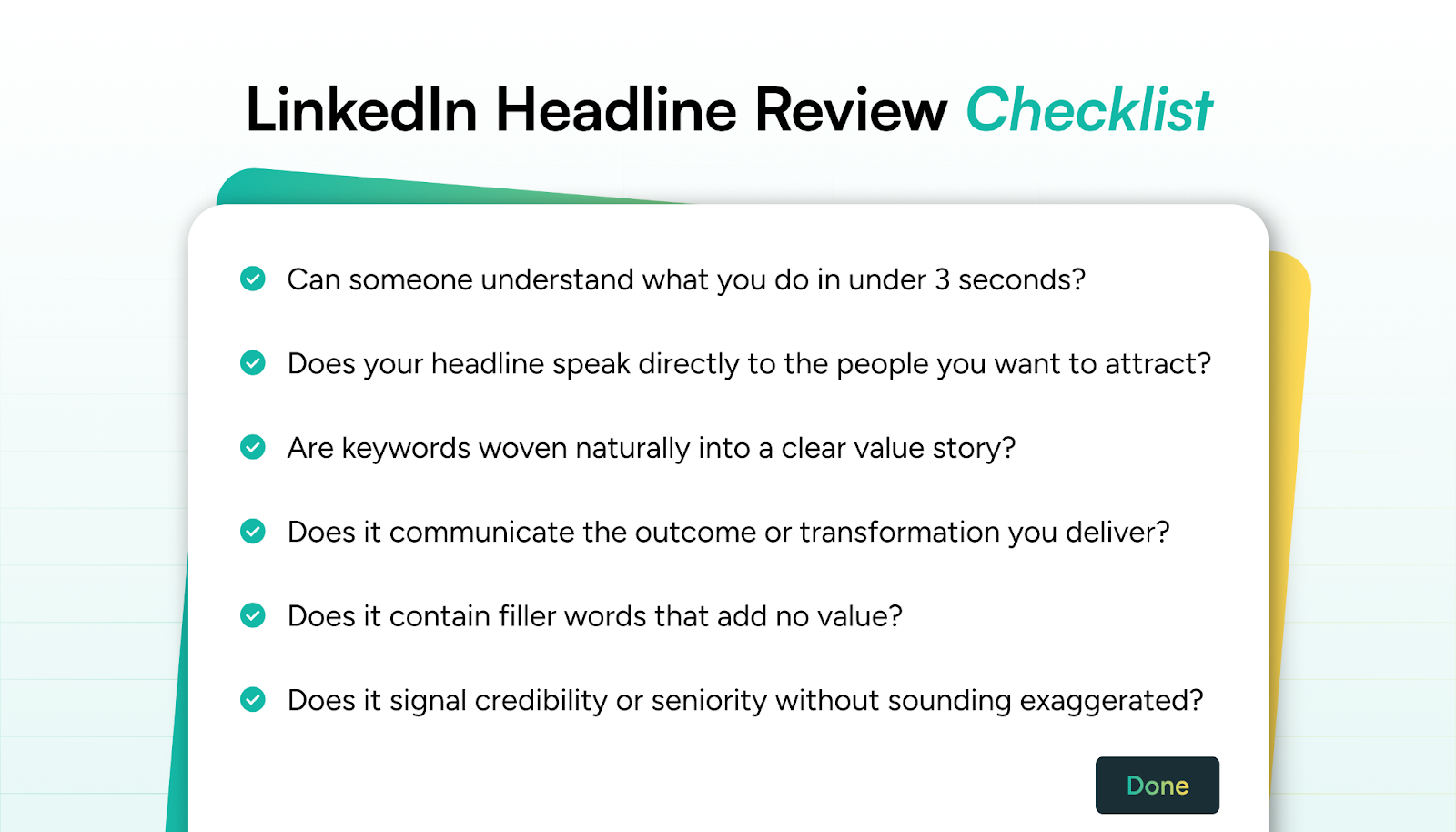
Even the most painstakingly created headline benefits from a systematic review. Use this checklist to ensure your headline is clear, relevant, and strategically positioned:
- Clarity first: Can someone understand what you do in under 3 seconds? Avoid jargon or generic terms that dilute meaning.
- Audience alignment: Does your headline signal directly to your target audience? Make sure it speaks to the decision-makers, clients, or collaborators you want to attract.
- Narrative vs. keywords balance: Are you weaving searchable keywords naturally into a story of value, rather than just listing skills or titles?
- Unique Value Proposition (UVP): Does your headline communicate the outcome or transformation you deliver? Highlight what sets you apart in your space.
- No fluff: Remove filler words like “experienced,” “passionate,” or “strategic” unless paired with concrete value. Every word should justify its place.
- Leadership positioning: If relevant, does your headline signal authority or seniority in your domain, reinforcing credibility without sounding boastful?
Tip: After reviewing your headline against this checklist, read it aloud. If it feels natural, communicates value, and clearly addresses the right audience, you’re ready to deploy.
Example:
Original: “Experienced Marketing Professional at XYZ Corp”
Checklist-optimized: “B2B SaaS Marketing Leader | Driving ARR Growth & GTM Strategy for Tech Startups”
The revised version communicates audience, outcome, and authority while remaining concise, scannable, and search-friendly.
Common LinkedIn Headline Mistakes
Even seasoned professionals can inadvertently write headlines that either attract the wrong audience, dilute positioning, or reduce visibility. Below are the most common pitfalls and why you should steer clear of them.
Mistake 1: Default/Unedited Headline
Leaving LinkedIn’s auto‑generated default (e.g., “Marketing Manager at XYZ Co.”) is the most pervasive and costly mistake. It tells people nothing beyond your title and hides you into a sea of similar profiles, reducing both search relevance and interest to click. Recruiters and decision‑makers scroll fast; a generic headline fails to signal relevance in the first few seconds.
When you do not customize your headline, you default to invisibility. Profiles that intentionally include role, niche, and value tend to see stronger engagement and better-quality profile visits.
Mistake 2: Overstuffing Achievements
Listing too many accomplishments without context creates noise rather than a signal. A headline like:
Top Sales Performer 2019–2023 | $8M+ in Revenue | 10x Quota | Best Trainer | MVP Award
reads like a resume headline crammed into a short space. Too many metrics without an audience signal or coherent value hurts readability and dilutes focus. Headlines with keyword density above ~15% tend to significantly drop in engagement, as they become harder to parse and less distinctive.
Mistake 3: Emojis/Fancy Fonts
Emojis and non‑standard characters are popular, but in headlines, they only create visual noise. Mobile screens and search previews prioritize the first ~40–50 characters; extra symbols can push actual signals out of view before a human even reads them.
Unless an icon adds specific meaning (e.g., a location pin for geo‑specific professionals), it’s usually better to save space for words that signal role, value, and audience.
Mistake 4: Overly Technical Jargon
Using overly niche or internal jargon (e.g., “synergistic optimization engine for distributed IoT pipelines”) may impress a small group of peers, but it’s opaque to recruiters, business partners, or cross‑industry decision‑makers. A LinkedIn headline must satisfy search logic and human clarity.
Technical jargon kills both readability and recall.
A headline that reads like a complex engineering spec may surface in fewer relevant searches and also convert fewer impressions into click actions than one that speaks plainly about the value delivered.
Mistake 5: Typos and Abbreviations
In high‑stakes professional contexts, even minor typos or obscure abbreviations signal carelessness or insider framing that excludes external audiences. For executives, consultants, or founders, this can reduce inbound engagement and even recruiter reach.
As a rule, spell out terms that aren’t universally understood.
Mistake 6: Verbose Headlines
Some professionals react to the default headline problem by writing very long headlines that ramble:
“Experienced marketing leader passionate about growth, strategy, agile teams, storytelling, customer experience, analytics, transformation, and culture.”
LinkedIn may allow 220 characters, but the actual impact comes from prioritization, not length. Generic or overly long headlines tend to attract surface-level views rather than meaningful conversations. Your headline should communicate value, not a paragraph of loosely connected interests.
Mistake 7: Listing Past Roles Instead of Current Focus
Rehashing old job titles or previous career stops in your headline creates confusion about where you are now. Headlines should reflect current expertise and intent, not past CV stops. Outdated framing leads to mismatched traffic and often to the wrong audiences clicking through.
Example:
Instead of: “Former CMO | Startup Advisor | Ex‑Head of Growth”, use: “Driving Scalable Go‑to‑Market Strategies for Tech Startups.”
The latter signals current positioning, which boosts relevance and subsequent engagement.
Mistake 8: Including Information That Belongs Elsewhere
Your headline isn’t a dumping ground for everything about you. Contact details, personal quirks, certifications, or background history belong in About, Experience, or Featured sections; not in the limited headline real estate.
Move these items to the right places:
- Degrees and certifications: About section
- Personal mottos: Featured or posts
- Contact details: Contact info section
Your headline’s job: visibility + relevance + clarity in the first 3 seconds.
Filler information occupies valuable characters and dilutes search and human signals.
“According to LinkedIn’s own data, profiles with strong, keyword‑rich headlines can receive more profile views than those without clear headlines. The difference between a mediocre and an excellent headline lies in precision of signal, audience alignment, and clarity of value.
Done right, your headline attracts the right opportunities; done wrong, it turns your most visible professional asset into a blind spot.”
Examples of LinkedIn Headlines That Attract the Right People
Here are real-world examples that demonstrate different ways a strong LinkedIn headline can signal clarity, personality, and relevance.
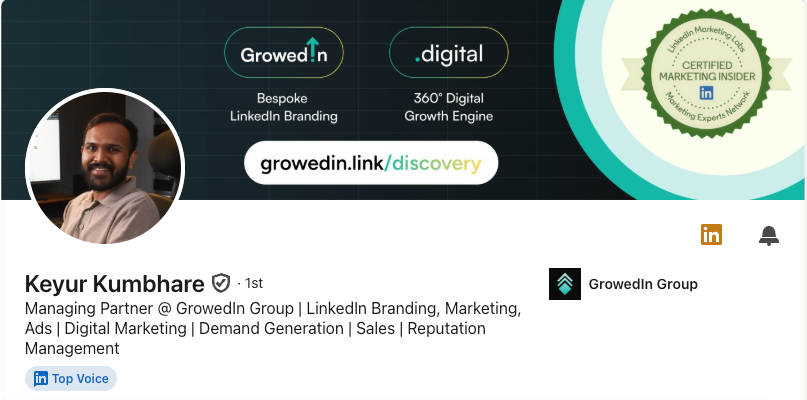
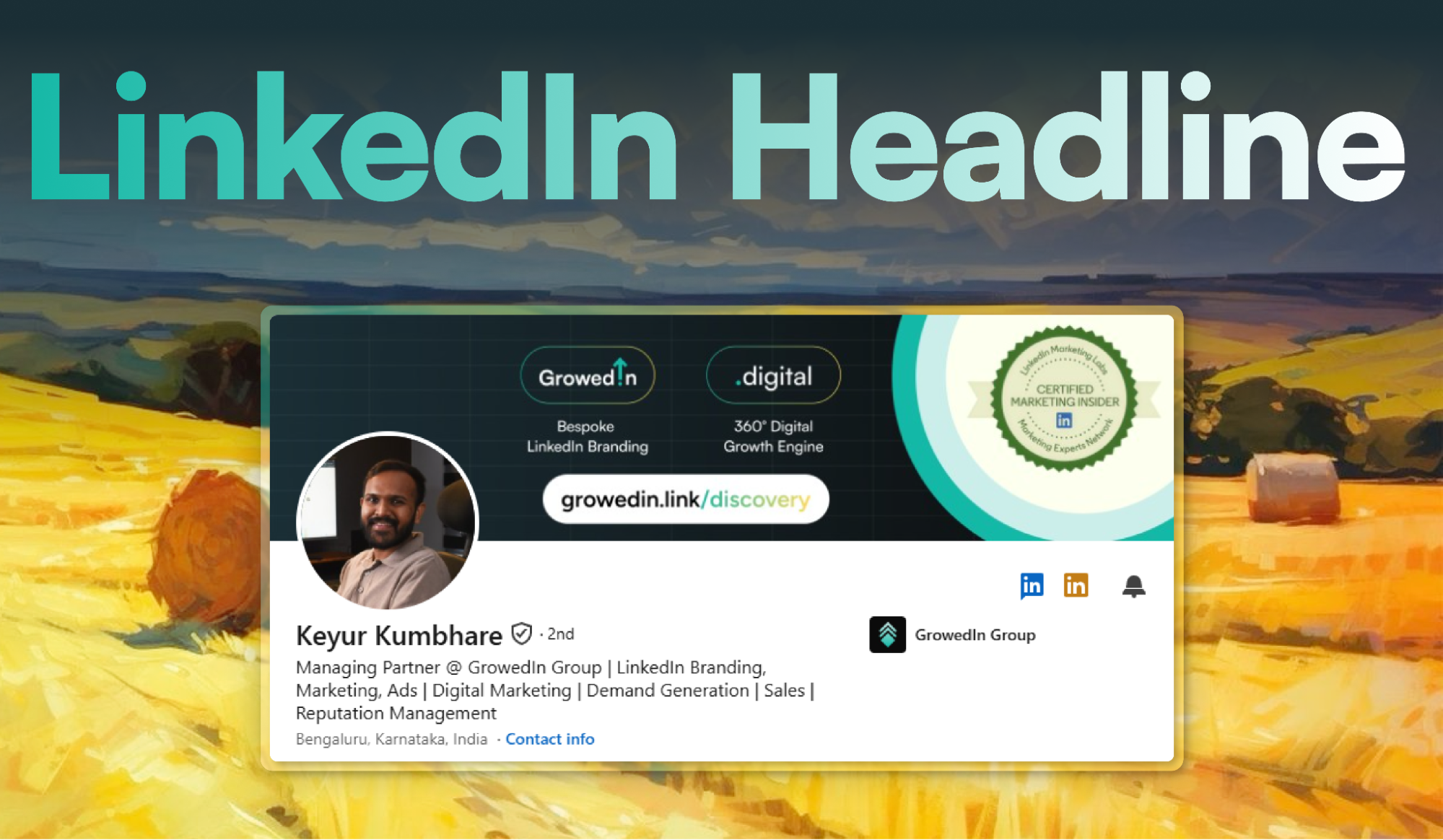
This headline is clear and authoritative without overcomplicating things. “Managing Partner @ GrowedIn Group” signals seniority, while the areas that follow, such as LinkedIn branding, marketing, ads, demand generation, sales, and reputation management, show expertise and value. It’s scannable, human, and keyword-friendly, giving the right people a quick sense of both role and capability.
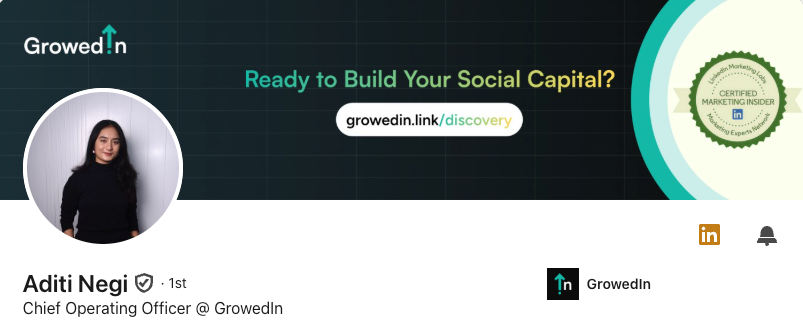
This headline is intentionally effective in its simplicity. “Chief Operating Officer @ GrowedIn” leaves no ambiguity about role or seniority, which is often exactly what decision-makers and collaborators look for. In contexts where credibility is closely tied to position, this kind of clarity does the work on its own and avoids unnecessary framing or embellishment.
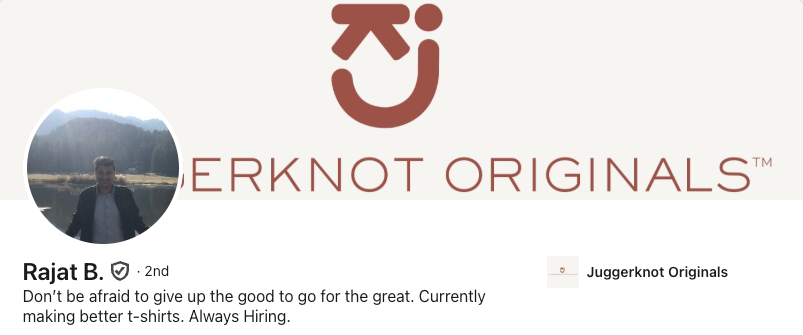
This headline works because it leads with personality and intent rather than a formal title. The opening line signals a point of view, which makes the profile feel human and distinct, while “currently making better t-shirts” grounds it in a clear, tangible focus. “Always hiring” adds immediacy and context, letting the right people know exactly why they might want to engage. It’s a good example of how a non-traditional headline can still be clear, purposeful, and effective when it reflects real work and intent.
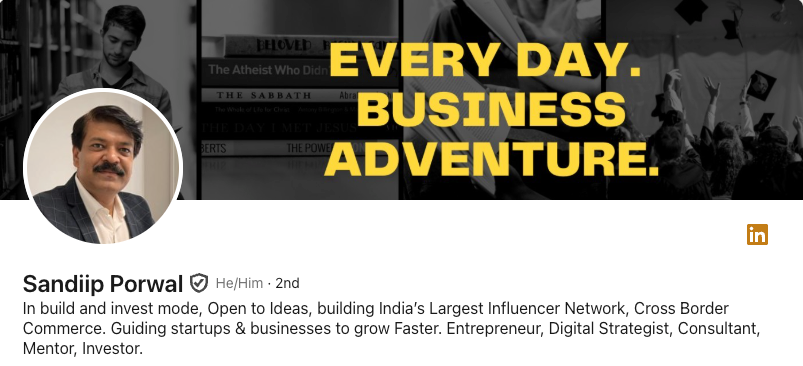
This headline works because the opening line pulls you in. “In build and invest mode, open to ideas” feels active and current, and it invites curiosity before you even get to the specifics. The ambition around building India’s largest influencer network and cross-border commerce adds scale, while the rest of the line provides context. The hook in the first part does the job of stopping the scroll and encouraging a closer look.
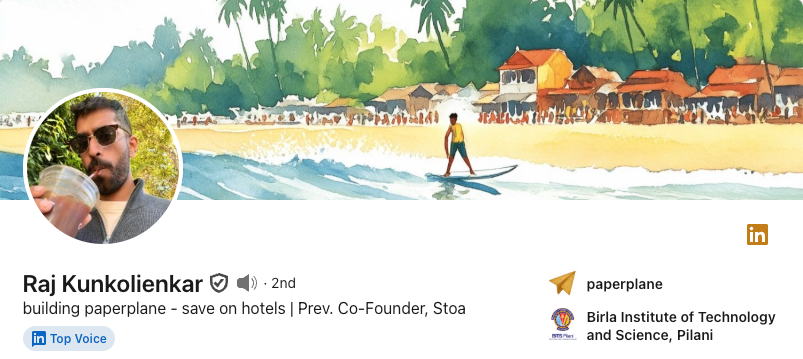
This headline is effective because it’s grounded and specific. “Building paperplane – save on hotels” tells you what’s being worked on and the value it delivers, which makes it easy to understand and remember. Mentioning a previous role at Stoa adds credibility without overwhelming the message. It’s a good example of how current focus, clear value, and light context can work together without overexplaining.
Updating Your LinkedIn Headline Over Time
Your LinkedIn headline shouldn’t be a set-and-forget asset. Careers evolve, business models pivot, and AI-driven discovery affects visibility. Timely headline updates keep your profile relevant.
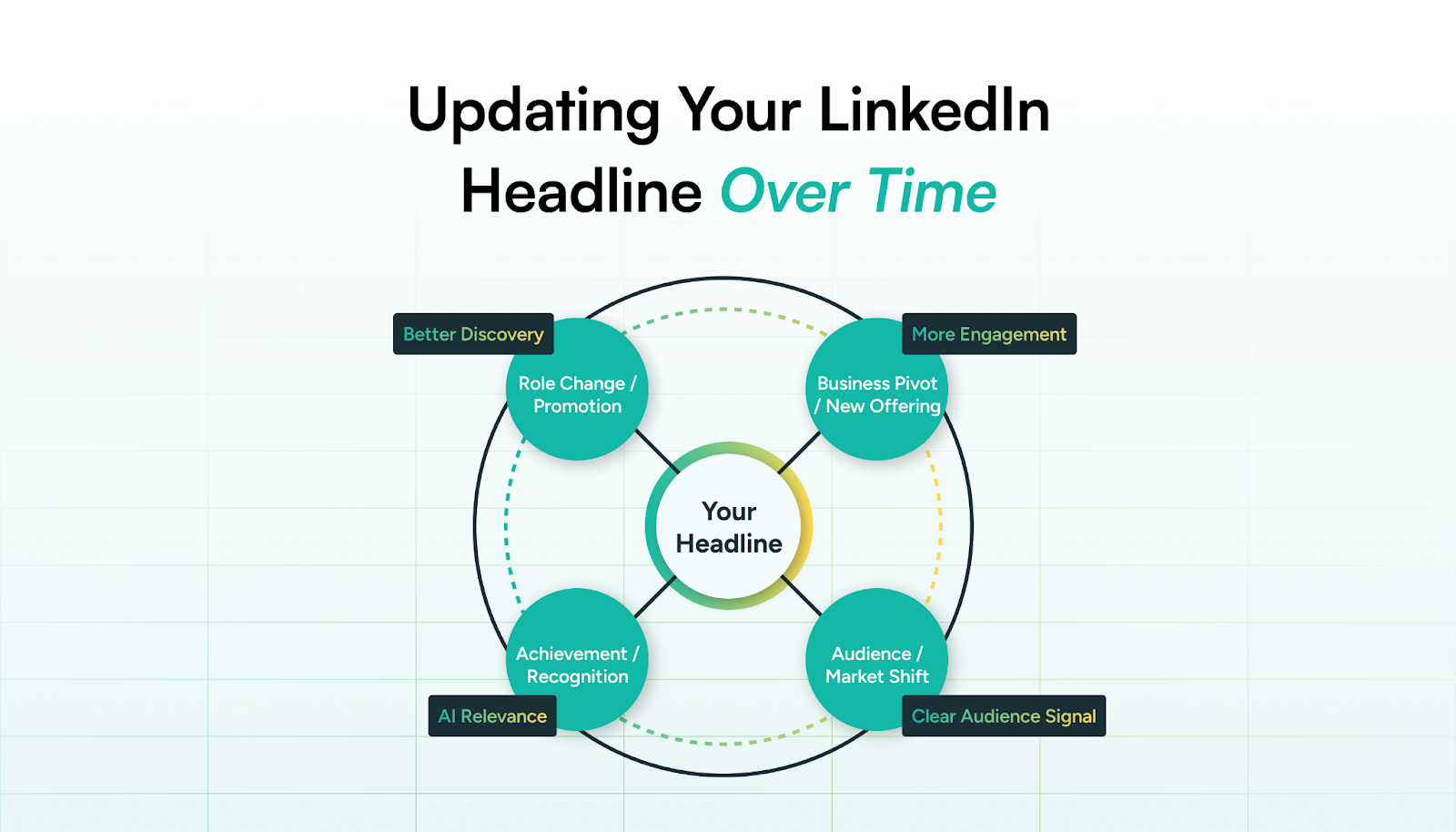
When to Review and Update
1. Role or Career Transitions
Whenever your professional focus shifts, such as a new role, a promotion, a pivot to a new function, or a sector change, it’s time to revisit your headline. Updating after a role change aligns your profile with what people are currently searching for and reduces mismatches in discovery. Profiles that explicitly optimize headlines after transitions see noticeable uplift in visibility and recruiter engagement.
Example: After moving from product management into go-to-market leadership, change
“Product Manager at X” to “Go-to-Market Leader | Driving B2B SaaS Growth & Commercial Strategy”.
This reframing tells both the algorithm and your audience exactly what you now do and who you help.
2. Business Updates or New Offerings
If your company launches a new product, service line, or consulting offering, update your headline to reflect it. Headlines that include current go-to-market language and offerings surface more often for relevant client searches.
Example: A founder adding a consulting vertical might refresh:
“CEO, ABC Tech” → “Helping SaaS Founders Scale ARR Through Go-to-Market Strategy & Coaching”.
This shifts the headline from a title to a value narrative that aligns with evolving business priorities.
3. Major Recognition, Certifications, or Achievements
Milestones like new certifications, published research, and high-impact awards can refresh your positioning and credibility, but only if they signal value to your target audience rather than clutter it. A headline updated with recent achievements can increase recruiter or client interest, especially when those achievements tie directly to market goals.
4. Shifts in Target Audience or Market Demand
If you’re pivoting from one audience segment to another (e.g., from enterprise hiring to consulting startups), your headline must shift accordingly. AI and search systems increasingly categorize profiles based on linguistic signals, so audience language matters for discoverability.
Rule of thumb: Reevaluate your headline whenever your target audience, value framework, or positioning evolves.
Future-Proofing LinkedIn Headlines for AI-Driven Visibility
In 2026 and beyond, AI systems increasingly influence:
- Search matching (determining relevant profiles for queries)
- Content recommendations (suggesting your profile to potential connections)
- Insight generation (AI writing tools generating personalized outreach scripts or summaries based on your headline language)
This changes how you should think about your headline: it’s both SEO real estate and semantic context for AI.
1. Use Outcome-Led Language
AI systems look beyond job titles and prioritize headlines that signal intent and value. Profiles that emphasize who you help and the impact you deliver perform better in algorithmic matches.
Example:
“SaaS Consultant” vs “Helping SaaS Teams Scale ARR by 30%+ with GTM Strategy”
The latter provides clearer semantic cues for both AI and humans about outcomes and relevance.
2. Prioritize Conversational, Human-Centric Phrasing
LinkedIn’s algorithm updates increasingly reward language that mirrors searcher intent, not corporate labels. Headline phrasing that mirrors common search terms recruiters and buyers use helps both classic search ranking and newer AI interpretations of relevance.
3. Establish a Testing Cadence
AI thrives on data patterns. If you update your headline too frequently without measuring impact, you undermine the system’s ability to learn and favor your profile. Most optimization frameworks recommend a headline review every 3–6 months or after any strategic shift to allow both search and AI systems to stabilize around your signals.
4. Balance Keywords with Narrative Context
AI systems will increasingly judge relevance not just by keyword density, but by semantic context and coherence. Headlines that read like word lists may score poorly compared to those that tell a concise, value-oriented story.
A Simple Review Rhythm to Stay Ahead
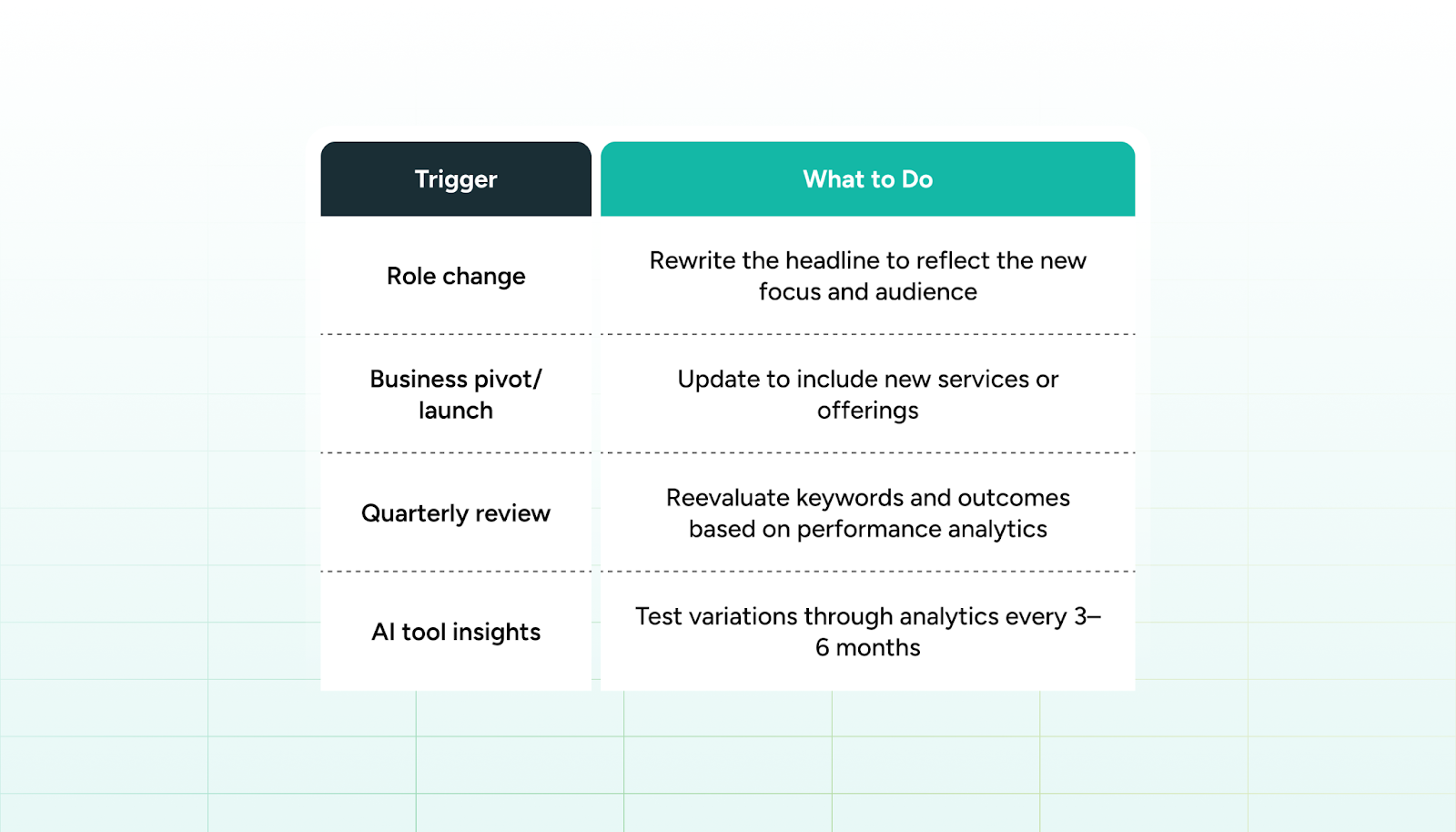
Static headlines get static results. Headlines that evolve with career state, audience intent, and algorithmic context continue to surface and drive meaningful discovery even as LinkedIn’s AI systems become more sophisticated.
Conclusion
A strong LinkedIn headline isn’t about clever wording or optimization gimmicks. It’s about making intentional choices about who you want to attract, what you want to be known for, and how clearly you signal that intent in a crowded, fast-moving environment.
The frameworks and checklists in this article can guide you the next time you review your profile. Pressure-test your headline against real scenarios: a potential client deciding whether to click, an industry peer evaluating your credibility, or a founder scanning profiles to identify collaborators or thought partners.
Your headline is one of the few professional assets that works for you every day. Treat it with the same strategic intent you apply to any other high-leverage decision.
A second perspective can help too. An external review often reveals blind spots such as vague positioning, unclear audience signals, or missed opportunities to lead with value. If you would like support in reviewing or refining your LinkedIn positioning, feel free to schedule a discovery call.

Frequently Asked Questions
How often should I update my LinkedIn headline?
Review your headline whenever something material changes: a new role, a business pivot, a product launch, or a shift in who you want to attract. Outside of that, a light review every 3–6 months is sufficient. Frequent cosmetic changes rarely help; intentional updates tied to real changes do.
Can my team use the same LinkedIn headline?
They shouldn’t. Even within the same company or function, each person’s headline should reflect their individual scope, focus, and seniority. Shared language can work at a thematic level, but identical headlines dilute differentiation and weaken authority signals.
Should I include achievements or awards in my LinkedIn headline?
Only if they add immediate context or credibility for your target audience. One strong, relevant signal can work. A list of awards usually doesn’t. If an achievement needs explanation, it doesn’t belong in the headline.
How do I write a LinkedIn headline for multiple businesses?
Anchor the LinkedIn headline to your primary focus or the work you most want to be discovered for. Secondary ventures can be implied through positioning or explored in the About section. Trying to represent everything equally often results in a headline that feels unfocused.
What if someone else has the same LinkedIn headline as mine?
Exact duplication is rare at a positioning level. Even if the structure is similar, specificity in audience, outcomes, or context usually creates differentiation. If your headline accurately reflects your work and intent, minor overlap isn’t a problem.
How long should my LinkedIn headline be?
Use enough characters to communicate clarity and value, but prioritize the first 60–80 characters, which are most visible in search and feeds. A strong headline doesn’t need to use all 220 characters; it needs to use the right ones.
How to Write a LinkedIn Headline That Attracts the Right People
- Your LinkedIn headline is a positioning signal, not a job description.
- Visibility alone isn’t the goal; relevance to the right audience is.
- Strong headlines balance algorithmic discoverability with human clarity.
- The best LinkedIn headlines clearly signal audience, value, and current focus.
- Generic titles and formulaic frameworks are easy to ignore.
- Specificity improves both search visibility and engagement quality.
- Your headline should evolve as your role, business priorities, or audience shifts.
- A well-thought-out LinkedIn headline compounds value over time by attracting aligned opportunities.


Insights Hub
Employer Branding on LinkedIn
The Best Time To Post on LinkedIn In 2026