
The AI Slop Era Is Great News for Executives

What You’ll Learn in this Issue
- Lead with your own thinking, experiences, and voice before using AI for refinement.
- Reinforce authenticity with personal photos and visuals that add context and credibility.
- Build relationships through genuine engagement and conversations, not AI-generated interactions or templated content.
The rant posts about AI slop are now starting to look sloppier than the actual AI slop itself.
No one can undo the advent of technology, nor can most people go without it simply because they dislike it.
Yes, the LinkedIn feed is crowded with AI-generated posts. And in this issue of North Star, let's explore how executives can make the best of the situation.
Easier to be Unique
The golden rule on LinkedIn to be distinguished, authentic, and stand out is now easier than ever: write in your original POV and language.
Your choice of topics and your unique perspective can make a post stand out from the crowd.
Without AI, your topic can be one of a kind because you are not picking it from the same generic list that your peers are picking from.
Without AI, your language and content can immediately show effort. And once people build trust around your name, they are more likely to stay for everything that comes after.
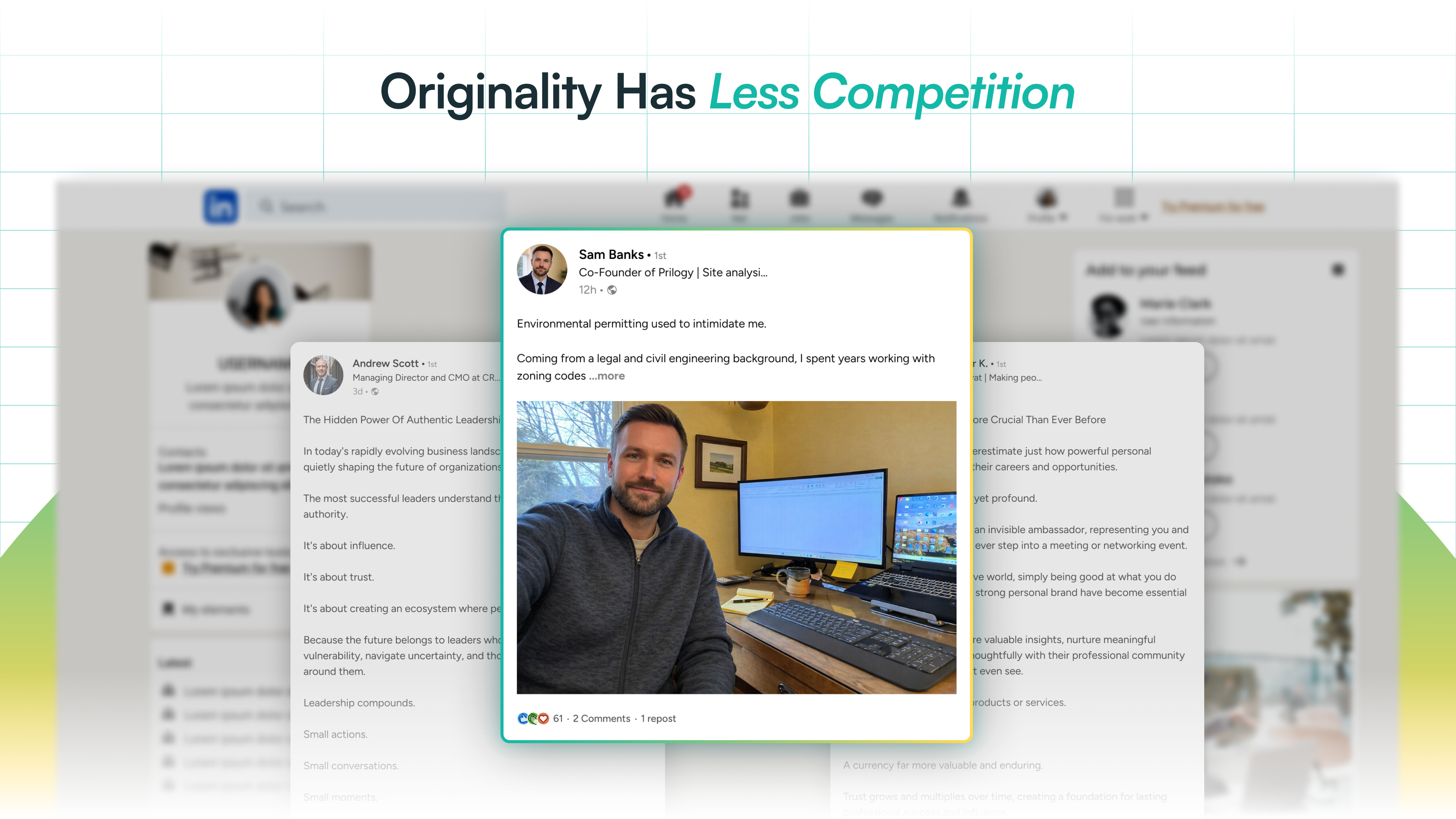
Personal Pictures Now Work Better
Personal photos, work-related images, or visuals that are genuinely relevant to your post can feel even more refreshing in a feed increasingly filled with AI-generated visuals and content.
They add context, personality, and credibility while making your content feel more human and less templated. They also help reinforce that there is a real person, experience, or story behind the ideas being shared.
.png)
The Desire To Stay Non-AI
When you do not want to blend into the crowd of AI-generated content, you naturally strive to write original drafts and think through your ideas yourself.
Staying away from AI-written content encourages you to preserve your own reading, thinking, and writing abilities. That may become a significant advantage in the coming decade.
Your communication remains authentic, your ideas remain your own, and your ability to connect with people naturally stays intact.
Why Content Interview Systems Have an Advantage
When we work with clients on their LinkedIn profiles, we don't start with AI. We start with conversations.
The content is built from their voice, values, experiences, and point of view, making it naturally more distinctive than generic AI-generated posts.
The interview process creates a level of depth that AI alone can’t replicate. It uncovers stories, opinions, and nuanced insights that are uniquely theirs while filtering out the generic filler that has become increasingly common.
How to stand out amidst the AI slop:
• Don't let AI write the first draft.
• Lead with original ideas and opinions.
• Use personal pictures wherever relevant.
• Write the way you naturally speak.
• Engage more with organic content like yours.
The easiest way to stand out today is simply to sound and interact like a real person.
Executive Spotlight
Paula Simpson is a science communicator, writer, and founder of NeonTrumpet.
With a background that spans everything from prison rehabilitation to dance teaching, she has built a reputation for explaining complex topics in ways that anyone can understand.

On LinkedIn, Paula writes about science, technology, marketing, parenting, and culture with a direct and simple language. In one post, she explores declining birth rates through the lens of women's lived experiences, arguing that the conversation is often framed around the wrong causes.
If you're looking for thoughtful contrarian perspectives, strong opinions, and someone unafraid to challenge popular thinking, Paula is a voice worth following.

Resource of the Week
Awesome Screenshot is a handy tool that goes beyond the default screenshot features built into most devices.
It lets you capture full-page screenshots, annotate images with highlights, arrows, and blur effects, and even record your screen when needed.
If screenshots are a regular part of your work, it makes feedback, tutorials, and collaboration much quicker and clearer.

Coming Up Next…
Posting frequency on LinkedIn has always been an evolving conversation, even within our own team. In the next issue of North Star, we'll explore posting frequency and how to find the cadence that makes sense for you.
Till then, remember, the more artificial the feed becomes, the more valuable genuine thinking becomes.


