 Claude
 ChatGPT
 Gemini
Your LinkedIn Company Page may be getting impressions without giving prospective buyers a compelling reason to trust your business.
A visitor might see your logo, browse your posts, and read your company description, yet leave without a clear understanding of what sets your business apart, what makes it credible, or why they should take the next step.
These gaps can affect how your business is perceived and how effectively your Page turns interest into action. Simply posting more frequently won't necessarily address them.
According to LinkedIn, Company Pages with complete information receive 30% more weekly views than incomplete Pages, but visibility is only one part of the whole picture. The more consequential question for a business leader is whether the right people find the Page, get a clear picture of the business, and take meaningful action.
This audit will help you evaluate your Company Page across positioning, brand presentation, discoverability, content, audience relevance, conversion paths, and performance measurement. You can then compare your Page against relevant competitors, score its performance, and identify the improvements worth prioritizing.
Why Is a LinkedIn Company Page Audit Important for Business Leaders
For a founder or C-suite executive, a LinkedIn Company Page should be evaluated as more than a corporate social media presence. It is one of the digital touchpoints through which prospective customers, business partners, candidates, and other stakeholders can assess what a company does, what it stands for, and whether its expertise warrants further consideration.
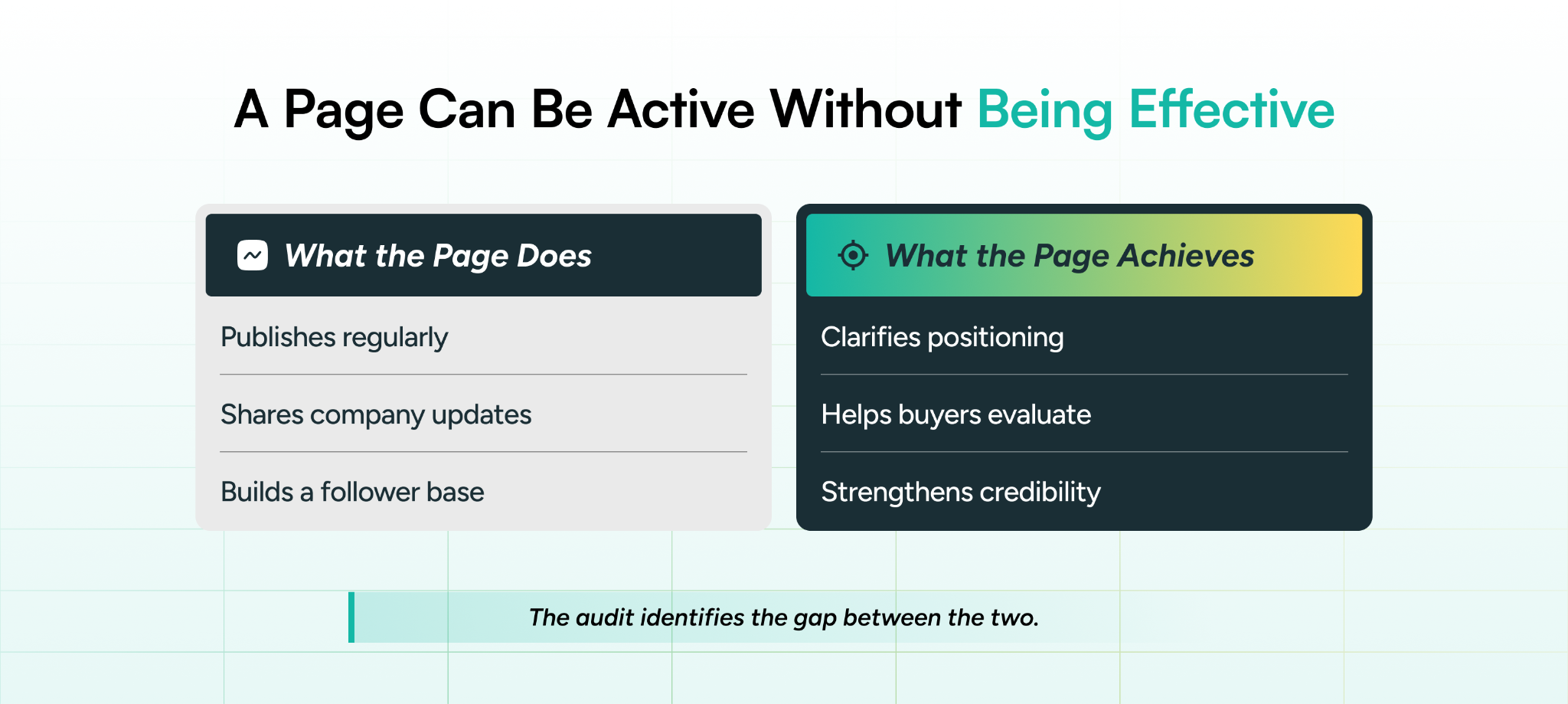
A company can maintain an active LinkedIn presence without communicating a compelling market position. Its Page may be complete, its posts may generate engagement, and its follower count may be growing, yet visitors may still struggle to understand what differentiates the business, what evidence supports its claims, or why they should take the next step.
An audit helps identify these gaps. Rather than focusing exclusively on profile completeness or publishing frequency, it examines whether the Page communicates a clear position, demonstrates credible expertise, reaches relevant audiences, and supports the business objectives it is intended to serve.
What Prospective Buyers, Partners, Candidates, and Investors Look for When Evaluating a Company
Different stakeholders visit a company's LinkedIn Page with different priorities. Prospective buyers want to know if the business can address their needs. Potential partners may assess strategic fit, complementary capabilities, and opportunities for collaboration. Candidates may look for insights into the company's mission, culture, and working environment, while investors may be interested in its market positioning and strategic direction.
A LinkedIn Company Page may not provide every answer, but it can offer valuable context. Through its company description, content, and updates, visitors can develop a clearer understanding of the business and decide if it warrants further consideration.
For B2B companies, the audience can also include people who influence purchasing decisions without directly engaging with sales. The 2025 Edelman–LinkedIn B2B Thought Leadership Impact Report covers the role of “hidden buyers”, stakeholders in functions such as finance, procurement, legal, compliance, and operations who may influence a purchase without being the primary users or the people in direct contact with sales. The report found that 63% of surveyed hidden buyers spent more than an hour a week consuming thought leadership content, and 95% said high-quality thought leadership made them more receptive to sales and marketing outreach.
This is exactly why corporate communication needs to consider the wider buying group. Content that explains an industry challenge, demonstrates subject-matter expertise, or presents a well-supported point of view may help stakeholders evaluate a provider even before a direct sales conversation takes place.
The Difference Between Having a LinkedIn Presence and Communicating a Credible Market Position
Having a LinkedIn Company Page makes a business visible on the platform, but the information it presents should also help visitors understand what the company offers, who it serves, and what distinguishes it from competitors.
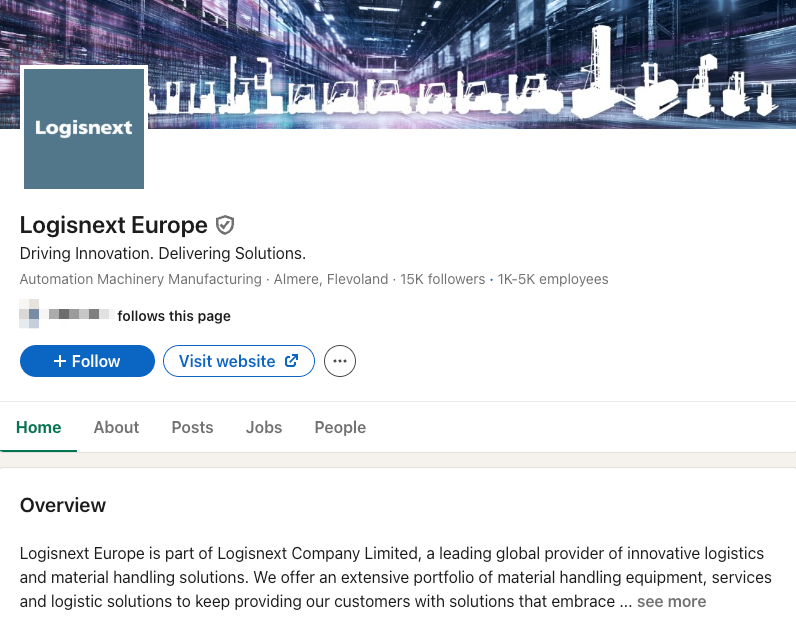
Consider Logisnext Europe, whose LinkedIn tagline reads, “Driving Innovation. Delivering Solutions.” While professional-sounding, the tagline offers little insight into the company's expertise in material handling equipment, warehouse automation, and logistics solutions. These capabilities are explained in its About section, but a more descriptive tagline could communicate its specialization to visitors immediately.
A credible market position brings together four elements: the audience a company serves, the problems it addresses, its distinctive approach, and evidence supporting its claims. These should be communicated consistently across the tagline, About section, content, company website, and relevant leadership communications.
When auditing your LinkedIn Company Page, consider two questions: Can your intended audience easily find and understand your business? And does the information they encounter give them a compelling reason to explore further?
How a Company Page Contributes to Brand Perception, Demand Generation, and Reputation
A LinkedIn Company Page can serve several related functions within a broader marketing and communications strategy.
First, it contributes to brand perception by communicating what the company does, which problems it understands, and the perspectives it brings to its market. Its description, visual presentation, published content, and supporting evidence all influence the picture a visitor can form of the business.
Second, it can support demand generation by helping potential buyers understand a challenge, explore a possible solution, or evaluate a provider. Educational content and well-substantiated points of view may be particularly useful when stakeholders are researching independently or comparing several potential suppliers.
Third, the Page can contribute to reputation by making expertise and company activity easier to evaluate. Consistent messaging, credible examples, and useful insights can reinforce the company's wider reputation. Outdated details, generic claims, or content that conflicts with other company communications may instead create uncertainty.
However, these contributions do not always translate into the same outcomes. A Page might attract considerable attention without building trust or generate meaningful interest without producing immediate inquiries. A thorough audit should examine each area individually to understand where the Page performs well and where improvements are needed.
What a Company Page Can Influence, and What It Cannot Prove on Its Own
A LinkedIn Company Page can help communicate your company's positioning, showcase its expertise, direct visitors to relevant resources, and encourage engagement. These are valuable contributions, but they do not automatically translate into measurable business results.
Impressions tell you how often content was displayed, not necessarily who saw it or how much attention they paid. Engagement indicates that people interacted with your content, but it does not always signal buying interest. Website clicks show that visitors took action, although they cannot tell you if those visitors eventually became qualified prospects. Even when a conversion is recorded, other marketing and sales interactions may have influenced the decision.
For business leaders, evaluating Page performance requires looking at several sources of information. LinkedIn analytics can provide insights into visibility, audience characteristics, and engagement. Website analytics can help track referral traffic and visitor behavior. When the necessary tracking systems are in place, CRM and sales data can offer a clearer view of how LinkedIn activity relates to qualified conversations, sales opportunities, and revenue.
However, attribution is rarely straightforward in B2B marketing. Purchasing decisions often involve multiple stakeholders, research channels, and interactions that are not fully captured by analytics. The goal is to understand how your Company Page contributes to business outcomes without overstating its influence.
A useful audit should therefore go further than assigning a performance score. It should help you identify where your Page is performing well, where it is falling short, and which improvements are most likely to strengthen its contribution to your business goals.
What Is a LinkedIn Company Page Audit, and What Should It Reveal?
A LinkedIn Company Page audit is a systematic review of how well your Page represents your business and supports its marketing objectives. It examines everything from profile information and brand presentation to content performance, audience relevance, and the actions visitors can take.
While checking the completeness of your logo, banner, tagline, About section, and website link is a useful first step, a thorough audit also evaluates how effectively these elements work together to communicate your company's value.
The findings should help you answer practical questions: Is your Page attracting the intended audience? Does your content reflect your company's expertise and priorities? Can interested visitors easily find relevant information or take the next step? And where should your team focus its efforts to improve performance?
The outcome should be a clear understanding of your Page's strengths, its shortcomings, and the specific improvements worth prioritizing.
A Profile-Completeness Check Versus a Strategic Performance Audit
A profile-completeness check focuses on the basics: Is your company information accurate, up to date, and consistent? Does your Page have the appropriate logo, banner, tagline, About section, industry classification, location, website link, and relevant features? These details help visitors identify your business and find essential information.
A strategic performance audit examines how well your Page works as a business and marketing asset. It assesses the clarity of your positioning, the credibility of your claims, the relevance of your content, the audiences you're reaching, and the opportunities visitors have to engage further. It also considers what performance data reveals about the Page's contribution to your broader objectives.
A Page can be complete without being particularly effective. A strategic audit helps you understand not only what needs to be updated, but also what needs to improve and why.
The Eight Aspects of a Commercially Useful Audit
A comprehensive LinkedIn Company Page audit should examine eight interconnected dimensions, each offering a different perspective on how effectively the Page supports your business.
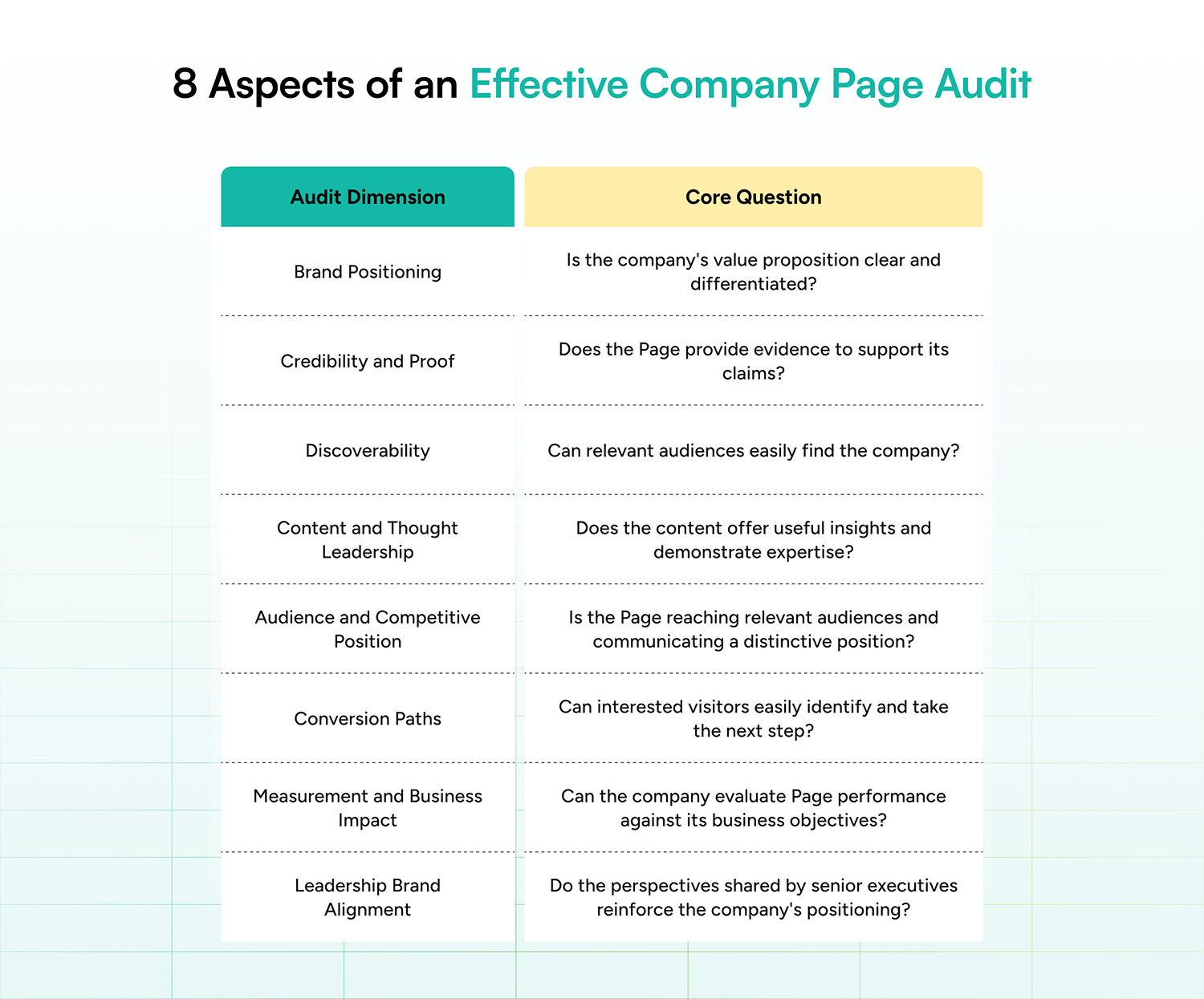
While each dimension evaluates a specific aspect of your Page, their effectiveness often depends on how well they work together.
For example, a company might publish insightful content that attracts engagement, but if its positioning is unclear, visitors may struggle to understand how that expertise relates to their needs. Similarly, a Page might communicate a compelling value proposition but fail to provide a clear way for interested prospects to explore its offerings or initiate a conversation.
Leadership communication also plays a role. When executives share perspectives that complement the company's messaging, they can help reinforce its expertise and give audiences a more personal understanding of the people behind the business.
The audit should examine these relationships and identify improvements that strengthen the Page as a whole, instead of treating each dimension as an isolated checklist item.
What To Collect Before Starting Your Audit
Before scoring the page, assemble the information needed to evaluate it consistently.
Start with Page admin access so you can inspect analytics, confirm current settings, and review the features available to the organization. Use the most recent 90 days of performance data as an initial baseline, examining visibility, engagement, audience information, and relevant metrics available in the account. A 90-day window is a practical starting point, not a universal benchmark; seasonality, campaign timing, and changes in publishing activity may require a longer comparison period.
Next, gather website analytics to understand referral traffic from LinkedIn and, where tracking permits, what visitors do after arriving. Document the company's primary business objectives, such as strengthening category awareness, supporting demand generation, attracting talent, or building executive credibility.
Finally, identify three to five relevant competitor Pages. Choose businesses that compete for similar customers or occupy comparable positions in the market over selecting competitors solely because they have the largest followings.
LinkedIn provides several Page analytics categories, including content, followers, visitors, search appearances, and competitors, although the data and features available may vary.
With these resources in place, you'll be better prepared to assess your Page against business priorities and identify areas for improvement.
How to Score Your LinkedIn Company Page
A consistent scoring framework helps you evaluate your LinkedIn Company Page objectively and track improvements over time. Without clear criteria, one reviewer might prioritize visual presentation, while another focuses on posting frequency, engagement, or follower growth.
The Weighted Scoring Methodology
Each of the eight audit dimensions receives a weight based on its relative importance to the Page's overall effectiveness.
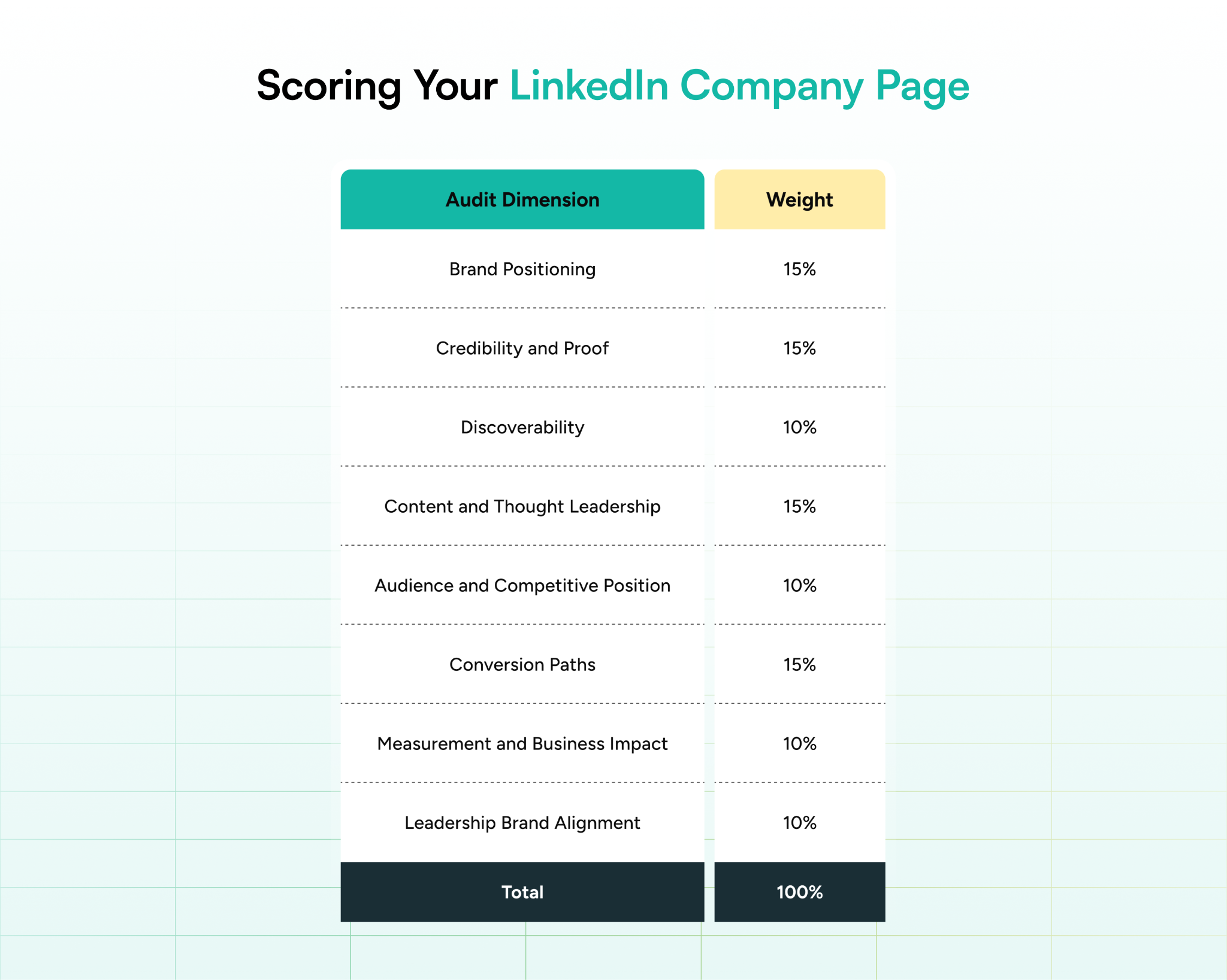
These weights provide a starting point, but you can adjust them to reflect your company's priorities. For example, a business focused on recruitment and employer branding may place greater emphasis on content that attracts prospective employees and communicates its workplace culture.
Next, score each dimension on a scale of 0 to 4 using the following criteria.
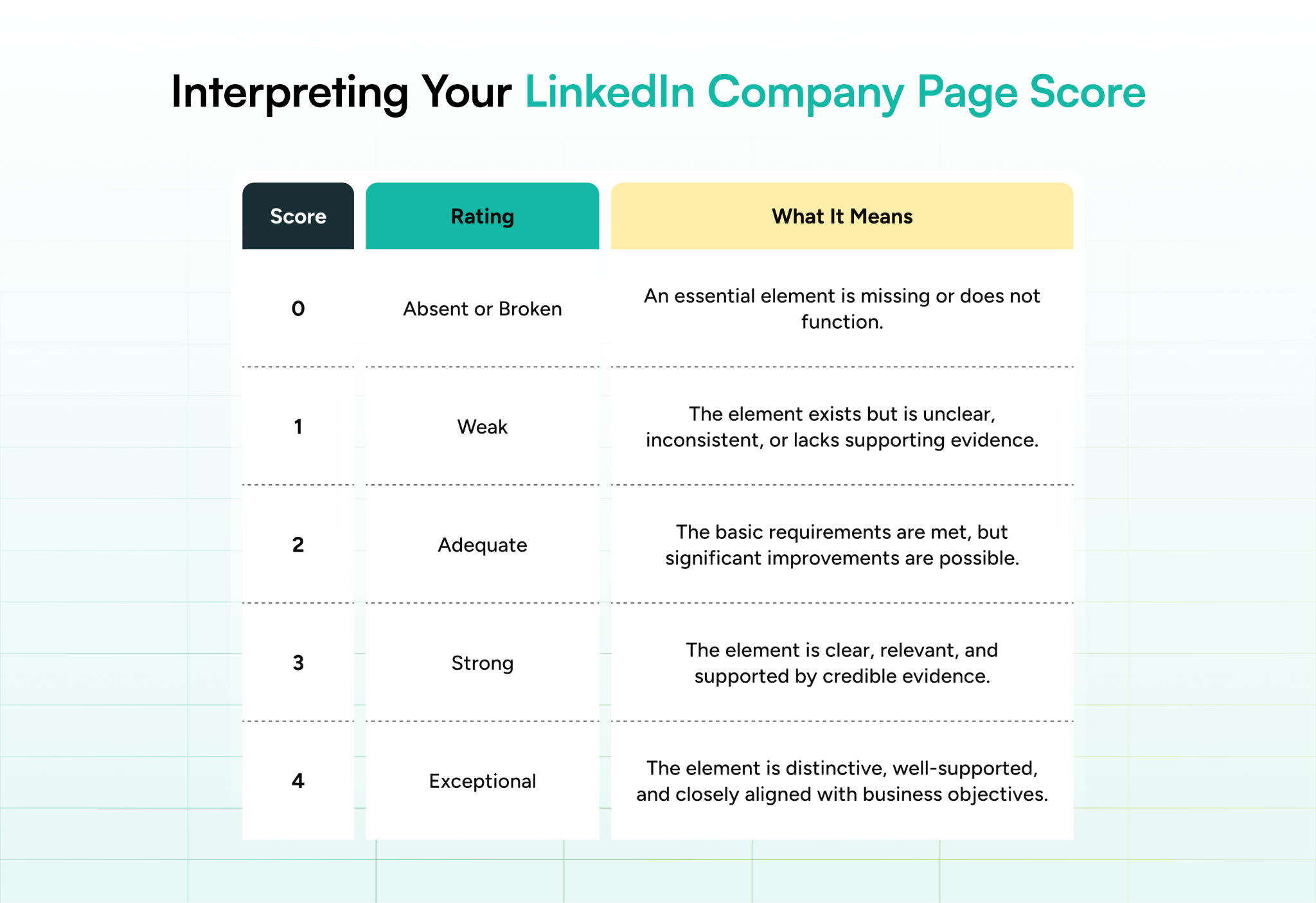
To calculate your overall score, divide each dimension's rating by 4 and multiply the result by its assigned weight. Add the weighted scores across all eight dimensions to get a final score out of 100.
For example, if your Brand Positioning score is 3 out of 4, its contribution would be:
(3 ÷ 4) × 15 = 11.25 points
Repeat this calculation for each dimension to determine your Page's overall audit score.
The goal here is to establish a reliable baseline for your own Page, not to rank it against every other company on LinkedIn. The framework above is designed for an internal audit. It should not be treated as an official LinkedIn scoring system or a proven measure of business performance.
How to Distinguish a Missing Element From an Ineffective One
The scoring process should distinguish between absence and poor execution. A missing website URL is a straightforward completeness issue. A website URL that leads to a generic homepage with no clear connection to the Page's message is a more strategic problem.
Likewise, a company may publish regularly and still score poorly on content quality if its posts lack original insight, buyer relevance, or supporting evidence. A Page may attract many visitors but score less strongly on audience quality if those visitors do not resemble its intended audience.
Document the evidence supporting each rating so that future audits can use the same criteria. If essential information is unavailable, mark the relevant dimension as Not Assessed (N/A) instead of automatically assigning a zero.
When calculating the overall score, exclude any unassessed dimensions and adjust the remaining weights proportionally to total 100%. Clearly disclose these exclusions so that the result is not mistaken for a complete assessment.
How to Interpret the Final Score
The total score is most useful when accompanied by the category-level results. Two companies might receive 70 out of 100 for very different reasons: one could have strong positioning and weak measurement, while another might have excellent analytics but generic content.
A high score indicates that the Page performs well against the selected criteria; it does not prove that the Page generates revenue or has a positive return on investment. A lower score indicates opportunities for improvement, but the severity and commercial relevance of those gaps still need to be assessed.
The final output should therefore include three things: the overall score, the evidence behind the weakest categories, and a prioritized list of corrective actions.
Audit 1: Brand Positioning and First-Impression Clarity
The first audit examines whether the Page communicates a clear, differentiated picture of the business. Before a visitor evaluates the company's expertise or explores its content, they need to understand what the organization does, whom it serves, and why its offering is relevant.
This is particularly important for businesses operating in crowded categories. When several providers use similar descriptions, publish identical content, and make generic claims, a prospective buyer has little reason to distinguish one from another.
Does the Banner Communicate a Differentiated Market Position?
Being one of the most prominent visuals on a Company Page, a banner that contains only a logo or a generic slogan misses an opportunity to communicate the organization's core value. Depending on the business, the space might instead emphasize its audience, its area of specialization, a clear point of view, or a concise statement of the problem it helps solve.
For example, a cybersecurity consultancy could use a banner that says “Securing your digital future.” The message is understandable but generic. A more specific direction might emphasize helping regulated businesses manage cloud security risks and compliance complexity. The second communicates more about the company's focus, although the claim must accurately reflect its services.
The banner should also work alongside the logo and headline. Avoid cramming several services, statistics, and calls to action into the image. A visitor should be able to understand its primary message quickly.
What to check: Message clarity, relevance to the intended audience, visual consistency, legibility across devices, and alignment with the company's actual positioning.
Does the Headline Explain the Business’s Value?
A company headline should help visitors understand what the organization does, not merely state its category or aspirations.
Phrases such as “Your trusted business partner,” “Driving innovation,” and “Delivering excellence” are common, but they offer little differentiation without supporting context. A stronger headline communicates the audience served, the problem addressed, or the distinctive outcome the business is equipped to deliver.
You don't need to fit your entire value proposition into a single line. The aim is to communicate enough information to help the right visitors recognize your relevance.
Test the tagline against three questions:
- Can someone unfamiliar with the business understand its broad offering?
- Does it signal the audience or problem the company specializes in?
- Does it communicate something more useful than a generic category description?
If your tagline fails to address these questions, consider revising it to better reflect your positioning.
Does the About Section Explain the Audience, Problem, Approach, and Evidence?
Your About section gives you the space to explain your business in greater detail and support the claims introduced in your tagline.
A lengthy company history or an extensive list of services may not be particularly helpful to someone evaluating your business for the first time. Visitors should be able to understand the challenges you address, how you approach them, and what qualifies your company to deliver.
Review your About section to see if it covers:
- Customer Challenges: The problems your business helps solve.
- Target Audience: The customers, industries, or markets you serve.
- Approach and Capabilities: Your methodology, specialization, or relevant expertise.
- Supporting Evidence: Experience, client examples, or documented outcomes that substantiate your claims.
- Next Steps: Where interested visitors can find more information or explore your offerings.
The emphasis will naturally differ across industries. A consulting firm might highlight its methodology and client experience, while a software company may focus on product capabilities, use cases, and implementation.
Do the Company Details and Website Reinforce the Same Positioning?
Your LinkedIn Company Page should present a consistent picture of your business across other channels.
Compare your tagline and About section with your website homepage, service pages, and relevant executive communications. Are they communicating the same core offering, target audience, and areas of expertise?
The wording doesn't need to be identical. What counts is that visitors encounter a coherent message as they move between your LinkedIn Page and other company resources.
Executive Test: After briefly reviewing your Company Page, could a prospective buyer explain what your business does, who it serves, and why it deserves consideration?
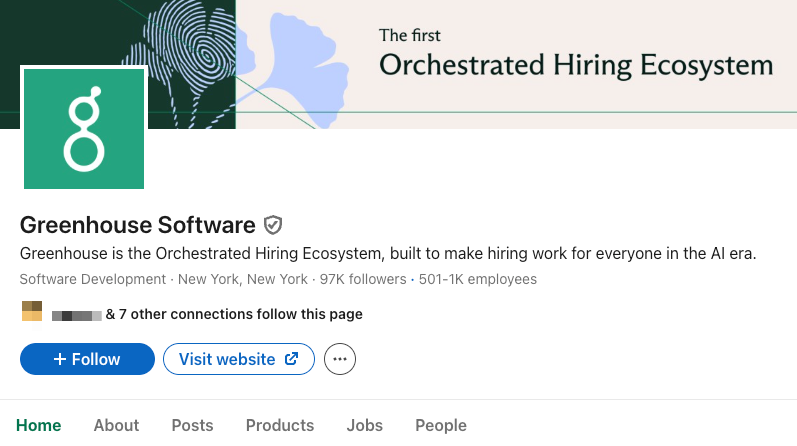
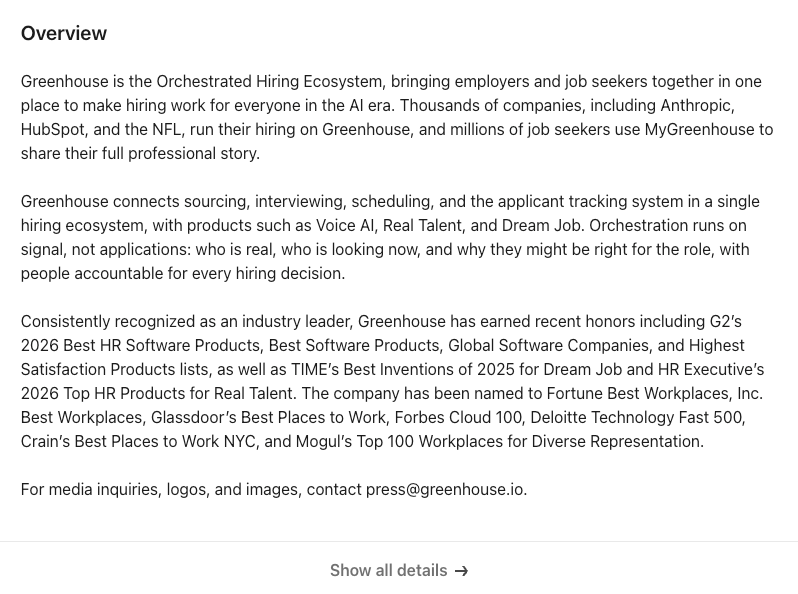
Banner: Uses branded visuals to create a recognizable identity and reinforce the company's focus on hiring.
Headline: Clearly positions Greenhouse in the recruiting software space, helping visitors quickly understand its core offering.
About Section: Provides context on the company's approach to hiring and the value it offers, helping potential customers understand its relevance.
Audit 2: Credibility and Proof of Expertise
Clear positioning tells visitors what a company claims to do, but credibility helps them decide whether those claims deserve consideration.
Buyers look for evidence of relevant experience, customer outcomes, technical competence, original thinking, or a track record of solving problems similar to their own.
The audit should examine whether the Page supports its claims with information that helps a visitor evaluate the organization, or whether it relies exclusively on promotional language.
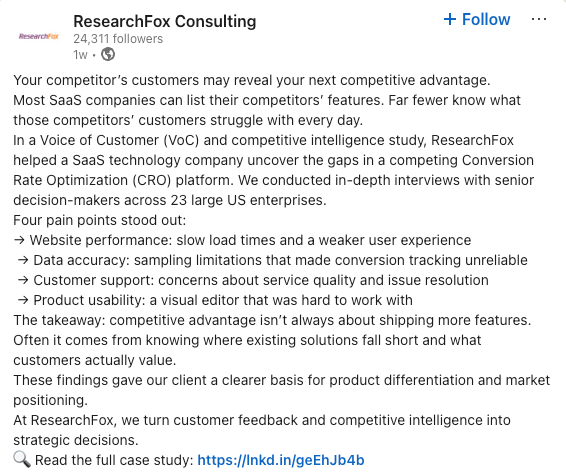
Are the Company’s Claims Supported by Evidence?
Review statements about leadership, capabilities, results, and market position. If the Page claims to be an industry leader, what supports that description? If it promises measurable business improvement, does it provide an example of how that improvement was achieved?
Useful evidence may include documented case studies, customer testimonials, relevant certifications, original research, published work, or specific examples of the company's approach. The appropriate evidence depends on the claim being made.
For example, a statement such as “We help enterprises improve operational efficiency” becomes more informative when supported by a case study explaining the initial problem, the intervention, the context, and the outcome.
Be careful with statistics. A result from one client engagement should not be presented as a universal outcome, and customer names or testimonials should only be used with appropriate permission.
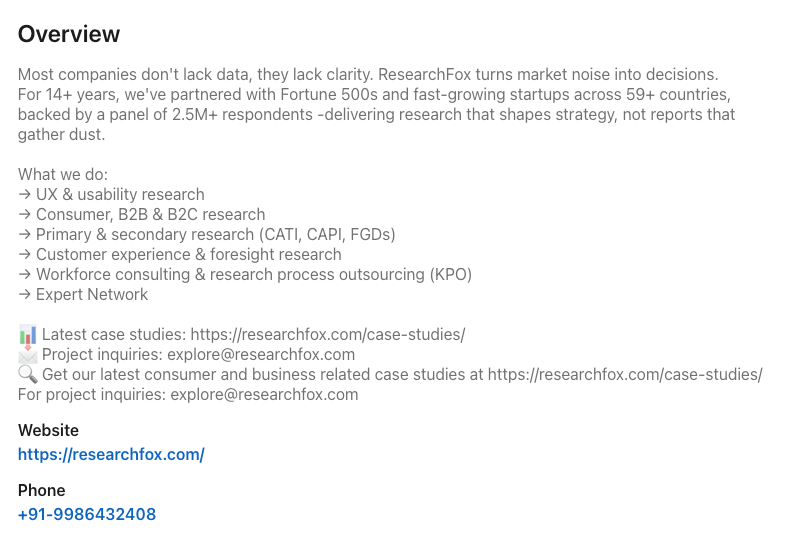
Does the Content Demonstrate Expertise or Simply Announce It?
There is a difference between telling audiences that a company has expertise and showing them how that expertise is applied.
Posts that repeat familiar industry advice or announce generic business lessons may create activity without providing much evidence of distinctive thinking. Stronger content explains why a problem occurs, challenges a common assumption, draws lessons from experience, or offers a defensible perspective supported by data. This does not mean that your Page needs frequent long-form posts or provocative opinions. Substantive expertise can give audiences a reason to consider a company beyond its size or familiarity.
Does the Page Reinforce the Company’s Broader Reputation?
Prospective customers may consult several sources when evaluating your business, including your website, executive profiles, customer reviews, industry publications, and independent coverage.
Review how the claims and evidence presented on your LinkedIn Page compare with these other sources.
For example, does your website highlight a specialization that is barely mentioned on LinkedIn? Are the case studies featured on your Page still relevant to your current offerings? Do your executives communicate perspectives that support the expertise your company claims?
Some differences are natural because each channel serves a different audience and purpose. Focus on inconsistencies that could create confusion about your company's capabilities, experience, or credibility.
What to Record: Document your company's major claims, the evidence available to support them, how recent and relevant that evidence is, and any gaps that require attention.
Audit 3: Discoverability and Search Visibility
Even a well-positioned LinkedIn Company Page can struggle to attract relevant audiences if people cannot easily find it. Discoverability depends on how accurately your business is represented, the language you use to describe it, and how your Page appears across LinkedIn and external search engines.
However, optimizing your LinkedIn Page is not identical to optimizing a website for search engines. Each platform has its own discovery mechanisms, so your audit should focus on relevant information, recognizable terminology, and available performance data.
Are the Company Details Complete and Accurate?
Check the company name, website, industry, company size, location, description, specialties, and other relevant fields. Inaccurate details can create confusion, while missing information may reduce the usefulness of the Page for people evaluating the organization.
LinkedIn recommends completing key Page information, including the logo, description, website, industry, company size, and location. Certain fields are also mandatory to use specific Page features, such as inviting members to follow the Page.
Check that the information reflects your current business and is consistent with your website and other official channels. Avoid adding keywords or descriptions that have little relevance to your actual offerings.
Does the Page Use the Language Its Audience Recognizes?
The terminology or jargon your company uses internally may not always match how prospective customers describe their needs.
Review your tagline, About section, specialties, and published content. Do they use terms your intended audience would recognize when researching companies, products, or solutions?
For example, an enterprise software provider might describe its offering through technical product categories. While these terms may be accurate, explaining the business challenges those capabilities address can make the Page more accessible to decision-makers who are less familiar with the technology.
Aim for language that reflects your expertise while remaining understandable to the people you want to reach.
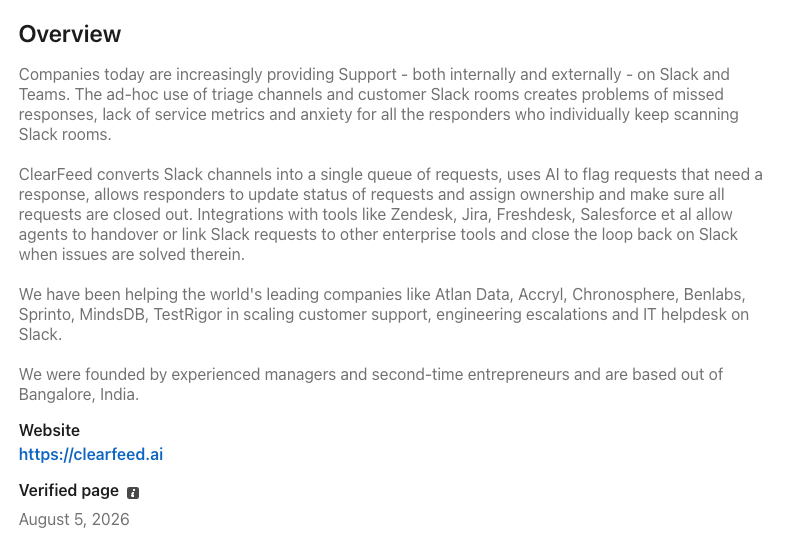
What Do Search Appearances Reveal?
LinkedIn's Search Appearances analytics can help you understand how frequently your Company Page appears in LinkedIn search results.
The reporting includes search appearance counts, top keywords associated with discovery, and available demographic information about people searching for your Page.
Review these insights to identify patterns:
- Are people finding your Page through terms relevant to your business?
- Do the search keywords reflect your offerings and areas of expertise?
- Are the available audience demographics consistent with the people you want to reach?
- Have search appearances increased or declined over time?
Relevant search terms may reveal topics worth exploring in your content. Unexpected terms could also prompt a closer review of your Page's descriptions and positioning.
Remember that appearing in search results does not necessarily mean someone visited your Page or expressed interest in your business. Consider these metrics alongside visitor analytics and other available performance data.
Can the Page Be Found and Understood Outside LinkedIn?
Your Company's LinkedIn presence should be easy to locate from other relevant digital channels.
Check that your website links to the correct LinkedIn Page and that your Page directs visitors to the appropriate company website. Review the consistency of your company name, descriptions, and core offerings across these channels.
You can also search for your company name and relevant industry terms using external search engines to see how your LinkedIn Page appears in the results.
Keep in mind that LinkedIn and external search engines use different ranking systems, and search results can vary.
What to Measure: Search appearances, relevant discovery keywords, Page visitors, audience demographics, and website referral traffic where tracking is available.
Audit 4: Content Quality and Thought Leadership
Your LinkedIn Company Page offers an opportunity to share your company's expertise, demonstrate its understanding of industry challenges, and contribute perspectives that your audience finds valuable.
However, consistent publishing alone does not guarantee meaningful engagement or business results. A Page filled with company announcements, familiar industry advice, or topics disconnected from customer priorities may remain active without offering much value to prospective buyers.
This part of the audit evaluates what your company publishes, who the content serves, and how effectively it supports your broader marketing objectives.
Does the Content Answer Questions Buyers Need Answered?
Consider the questions prospective customers typically ask when researching solutions or evaluating providers. They may want to understand the cost of an unresolved problem, compare different approaches, anticipate implementation challenges, or determine which capabilities are most relevant to their needs.
Review how well your content addresses these questions throughout the buying process. Some posts might help audiences recognize an emerging challenge, while others could explain possible solutions, clarify misconceptions, or provide evidence that supports a purchasing decision. Aim to offer useful information that helps prospective customers make informed decisions, without turning every post into a sales pitch.
Does the Page Demonstrate Original Thinking?
Review a couple of recent posts to understand what your company contributes to industry conversations.
Does the content offer informed perspectives, interpret research, share lessons from practical experience, or explain issues in ways that help readers see them differently? Repeating widely available advice may keep your publishing schedule full, but it does little to distinguish your company's perspective.
Original thinking does not always require proprietary research or entirely new ideas. It can come from applying experience to familiar challenges, questioning common assumptions, or explaining the trade-offs behind different business decisions.
Does the Content Mix Serve Different Purposes?
A commercially useful content mix may include educational posts, industry analysis, original research, case studies, customer evidence, company developments, and perspectives from subject-matter experts.
The right balance depends on the business. An early-stage company building category awareness may need more educational content than an established firm with a strong referral network. A regulated business may need to place greater emphasis on substantiated claims and approved communications.
Which Topics and Formats Perform Best Against Their Objectives?
Use a sample of posts from the last 90 days, or a longer period if publishing has been irregular. Record the topic, audience, format, evidence, objective, impressions, engagement, and any available downstream action.
LinkedIn's content analytics can help you identify performance patterns, although the available metrics and reporting options may vary.
Do not rank content solely by likes or comments. A highly shared industry observation might build awareness, while a detailed case study could attract fewer reactions but generate more relevant website visits. The metrics need to match the purpose of the post.
Audit 5: Audience Quality and Competitive Position
A growing follower count can be encouraging, but it doesn't necessarily tell you if your LinkedIn Company Page is reaching people who are relevant to your business.
Consider a company that provides technology solutions to large financial institutions. Thousands of followers from unrelated industries may contribute to its visibility, but they offer limited insight into its ability to reach potential customers. Meanwhile, a smaller Page followed by decision-makers at relevant organizations could create valuable opportunities for engagement and relationship-building.
Do Followers and Visitors Resemble the Intended Audience?
Before reviewing the numbers, establish who your company wants to reach. Depending on your business, this could include people from specific industries, company sizes, job functions, seniority levels, geographic markets, or purchasing roles.
Review your LinkedIn follower and visitor analytics to understand the composition of your audience. Available data may include demographic characteristics, follower growth, and information about how people discover or interact with your Page.
Compare these findings with your company's intended audience. If there are significant differences, examine possible explanations. Your content may be attracting people outside your target market, your positioning may be too broad, or your messaging may not reflect the interests of the people you want to reach.
Keep in mind that a relevant audience includes more than potential customers. Employees, prospective hires, industry peers, partners, and other stakeholders can also contribute to your company's visibility and reputation.
How Does the Page Compare With Competitors?
Identify three to five companies that compete for similar customers or operate in comparable markets. Review their positioning, follower growth, content themes, engagement patterns, and communication styles.
LinkedIn's competitor analytics allow Page admins to compare follower metrics and organic content performance. The platform also provides trending competitor posts, with the depth of comparison varying by Page subscription.
Use these features as inputs to the analysis, not as a definitive ranking of competitors. Differences in company size, audience maturity, publishing volume, paid activity, and industry can affect results.
Where Is the Company Differentiated?
Competitor research is most useful when it reveals an opportunity to communicate something distinctive. If several competitors discuss the same broad themes, consider which issues your company has the expertise to explore in greater depth.
A company should not imitate a competitor simply because a post has performed well. Instead, ask what audience needs the post addresses, what makes the perspective compelling, and whether your company can contribute something genuinely useful.
Evidence to Record: Follower growth, available follower and visitor demographics, organic content performance, competitor activity, and examples of differentiated messaging.
Audit 6: Conversion Paths and Commercial Relevance
A Company Page should give interested visitors an easy way to continue exploring the business. The appropriate next step depends on the visitor's needs and the company's sales process.
A prospective customer researching a complex enterprise solution may want to read a case study before speaking with sales. Someone evaluating a specialist consultancy may prefer to explore its services or request an introductory conversation. The Page should make relevant next steps easy to identify.
Does the Page Offer a Logical Next Step?
Review the Page's calls to action, website links, service information, and any other routes available to visitors. Ask whether the next step follows naturally from the content and the visitor's likely stage of evaluation.
A generic “Visit website” button may be appropriate for some organizations, while another may benefit from a more specific action. The decision should be based on the business objective, not on the assumption that every visitor should immediately book a demo.
LinkedIn supports custom Page CTA options such as “Visit website,” “Contact us,” “Learn more,” and “Request demo,” with button visibility and availability differing between free and Premium Company Pages. Verify the current features before making recommendations.
Do the Destination Pages Carry the Message Forward?
Click through every important link. Check whether the destination is functional, relevant, mobile-friendly, and consistent with the promise made on LinkedIn.
If a Page promotes a specific service but directs visitors to a generic homepage, the visitor may need to search again for the information that prompted the click. A relevant landing page can reduce that friction by making the offering, supporting evidence, and next action clear.
The same principle applies to case studies, reports, events, and other resources. The destination should fulfill the expectation created by the original post or CTA.
Can Meaningful Actions Be Measured?
Where possible, use tracked links and website analytics to examine referrals and subsequent behavior. If the company uses a CRM, connect relevant inquiries and opportunities to the available source information without assuming that the first recorded touchpoint explains the entire purchase journey.
Separate the number of clicks from the quality of the resulting interactions. A CTA that receives fewer clicks may still be valuable if it attracts more relevant inquiries.
Evidence to Record: Page CTA, destination URLs, mobile experience, landing-page copy, and available conversion data.
Audit 7: Analytics and Business Impact
A Company Page audit should not end with an assessment of how the Page looks or how much engagement its posts receive. It should examine whether the business can evaluate performance against its objectives and use the findings to make better decisions.
Founders and senior executives in particular need to understand how marketing activity supports the business.
Are Visibility, Engagement, Audience Quality, and Conversion Measured Separately?
Organizing metrics into distinct categories makes it easier to interpret performance and identify areas that need attention.
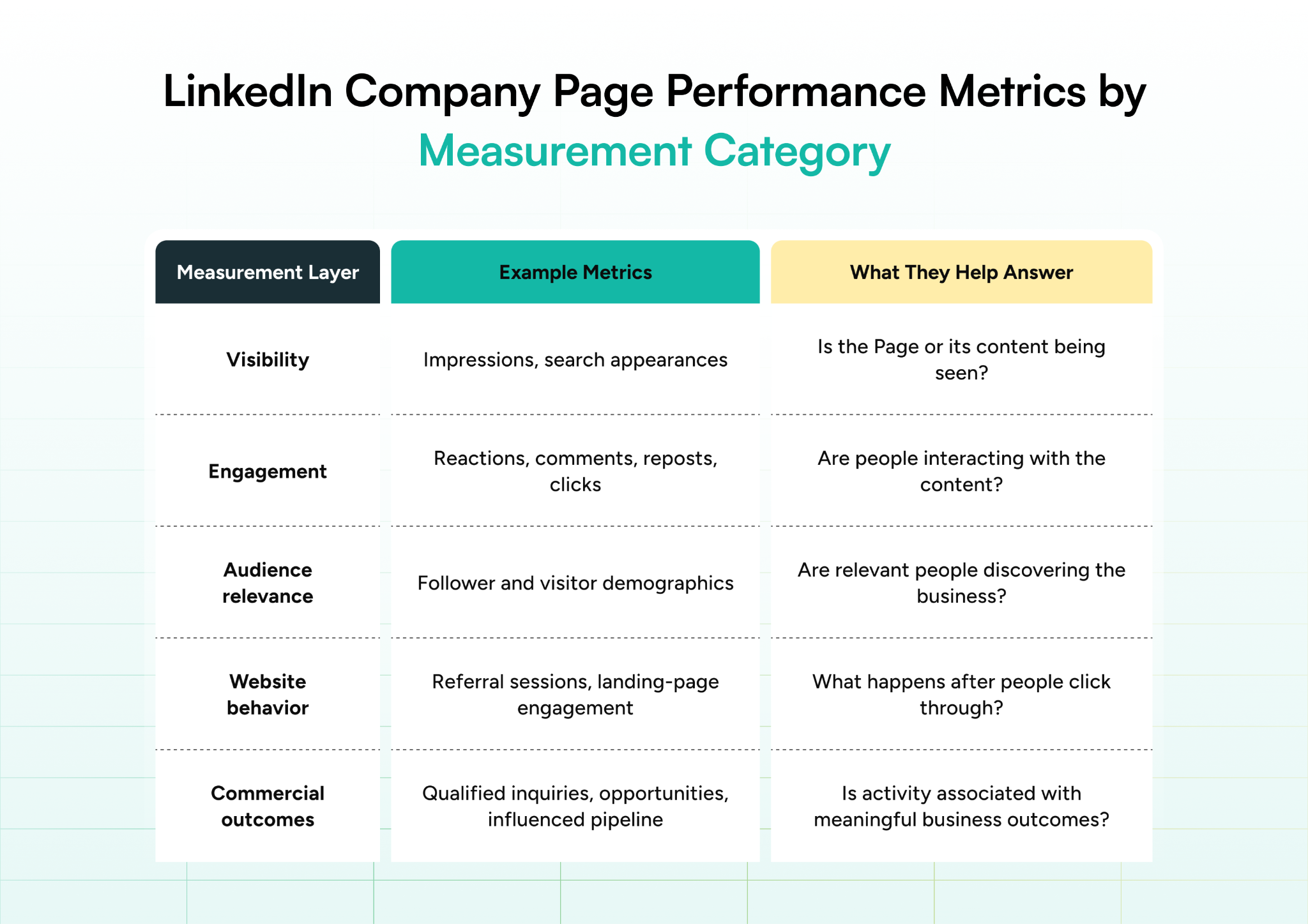
Review these metrics together, but interpret each according to what it measures. Strong impressions or engagement may indicate that content is attracting attention, while website and CRM data can provide additional insight into the actions visitors take afterward.
For example, an increase in referral traffic is encouraging, but examining the quality of those visits can help determine if the Page is attracting people who are genuinely interested in the company's offerings.
Which Content Attracts the Right Audience?
Review individual posts alongside aggregate metrics. Identify whether certain themes attract more relevant audiences, generate substantive discussions, encourage website visits, or support other intended outcomes.
Look beyond total reactions and impressions. Are certain posts encouraging meaningful discussions with industry professionals? Do specific topics generate visits to relevant service pages? Which content helps communicate your company's expertise to prospective customers?
Can Page Activity Be Connected to Business Outcomes?
LinkedIn's native analytics provide useful information about Page activity, but evaluating commercial outcomes usually requires additional data.
Website analytics can help you understand referral traffic and visitor behavior, while CRM records may reveal how LinkedIn interactions relate to inquiries, sales opportunities, and customer relationships.
For companies with longer B2B sales cycles, these connections can be difficult to trace. A prospective customer might first encounter an executive's LinkedIn post, visit the Company Page several weeks later, read a case study, and eventually contact the company through another channel. Review the available touchpoints to understand LinkedIn's potential contribution.
Audit 8: Leadership Brand Alignment and Employee Advocacy
Your company's LinkedIn presence includes the perspectives shared by the people who lead and represent it. Founders, executives, and employees can help audiences understand the expertise, experience, and thinking behind the business.
Review how these individual voices complement your Company Page. A founder might share lessons from strategic decisions, an engineering leader could discuss technical challenges, and a commercial executive may offer insights into customer needs. Each brings a different perspective while contributing to a broader understanding of the company's capabilities.
Do Executive Profiles Provide Useful Context?
An executive's LinkedIn profile gives prospective customers, partners, and other stakeholders an opportunity to learn about their professional background, experience, and areas of expertise.
Review the headline, About section, work experience, Featured section, and recent activity. Do these elements communicate a clear professional identity? Can visitors understand the executive's expertise and its relevance to the company's work?
An effective executive profile should reflect the individual's experience and perspective. It can reinforce the company's positioning without reading like an extension of its marketing materials. Look for opportunities to highlight relevant accomplishments, industry experience, and insights that help establish the executive's credibility.
Is Employee Advocacy Authentic and Relevant?
Employees can help extend the reach of company ideas, contribute specialist perspectives, and bring individual experience into the conversation. But advocacy is most useful when people have something meaningful to contribute.
Assess whether employees are sharing relevant content, offering their own observations, or participating in industry discussions. Do not judge advocacy solely by the number of employees who reshare a corporate post. Repetitive, scripted activity can make the company's communication feel less credible rather than more.
Any advocacy program should be voluntary, respectful of employee autonomy, and consistent with the organization's communication policies.
How Well Do Company and Leadership Content Work Together?
Compare your Company Page content with posts published by relevant executives. Look for complementary perspectives that help audiences understand both the company's capabilities and the experience behind them.
For example, your Company Page might share a case study highlighting the results of a client engagement, while the CEO discusses a strategic lesson from the project. A technical leader could offer further insight into an implementation challenge, provided the details are appropriate to share.
These contributions give audiences different ways to explore the company's expertise without requiring everyone to communicate the same message.
Also review any significant inconsistencies. If the Company Page emphasizes one specialization while executive content consistently presents a different focus, prospective customers may find it difficult to understand the business's priorities.
How to Interpret Your Score and Prioritize Improvements
A score is useful only if it leads to better decisions. The lowest-scoring category may be an obvious area for improvement, but it may not be the most urgent.
Rank Actions by Impact, Effort, Confidence, and Dependencies
Review each finding against four factors to determine where your team should focus its efforts.
- Impact: How significantly could addressing this issue support your company's objectives?
- Effort: What time, budget, resources, or internal coordination would the improvement require?
- Confidence: How reliable is the evidence behind the finding, and how likely is the proposed change to address the issue?
- Dependencies: Does implementation depend on positioning decisions, supporting evidence, technical changes, or leadership approval?
Some improvements will be relatively straightforward. A broken CTA, for instance, may be easy to correct and could be preventing interested visitors from reaching your website.
Other issues require more consideration. If your Page struggles to communicate what differentiates your company, improving its positioning may involve discussions across several teams. A minor banner adjustment might be quick to implement, but it may deserve less attention than changes that could improve how prospective customers understand your offerings.
What Your Score Tells You, and What It Doesn’t
A high score indicates that your Page performs well against the criteria used in this audit. It does not establish commercial success, just as a lower score does not necessarily indicate poor business performance.
The individual category scores can help identify where further investigation or improvement would be most useful. For example:
- Strong Visibility, Weak Positioning: Review how clearly your Page communicates the company's offerings, expertise, and differentiation before increasing publishing activity.
- Strong Content, Poor Audience Alignment: Examine your content topics, messaging, and discovery patterns to understand why the Page may be attracting people outside your intended audience.
- Strong Positioning, Weak Conversion: Review your CTAs, destination pages, and tracking setup to identify possible barriers between initial interest and meaningful action.
Once you have identified your priorities, create an action plan that assigns responsibility, sets realistic timelines, and defines how progress will be measured.
Turn Your Audit Into a Prioritized 90-Day Action Plan
Your LinkedIn Company Page audit should lead to a clear set of improvements, with responsibilities, timelines, and measurable priorities.
Some issues, such as outdated company information or broken links, can be resolved quickly. Others, including positioning, content quality, and leadership alignment, may require deeper work across teams.
A 90-day roadmap gives your company time to address immediate gaps, implement strategic improvements, and gather initial evidence of their effectiveness.
Days 1–30: Address Immediate Gaps and Establish a Baseline
Begin with issues that affect the accuracy, clarity, and usability of your Company Page. Correct outdated company information, incomplete fields, broken links, and inconsistent messaging. Review the tagline, banner, and About section together to ensure they communicate a coherent market position.
Identify any unsupported claims or outdated examples that could weaken credibility. Where supporting evidence is already available, update the Page or relevant website resources.
Confirm the Page's primary business objectives and document its current performance across visibility, engagement, audience relevance, and available conversion metrics.
Record these baseline figures before introducing substantial changes so your team has a reference point for future evaluations.
Days 31–60: Strengthen Positioning, Content, and Leadership Alignment
Use the findings from your audit to improve how your company communicates its expertise and differentiation. Review your positioning against relevant competitors and refine messaging where necessary. Strengthen supporting evidence through updated case studies, clearer service descriptions, and examples of specialist capabilities.
Examine recent content to identify topics that should receive greater attention, questions your audience is asking, and opportunities to share insights grounded in your company's experience.
Develop a focused content plan and begin publishing against those priorities. Also review relevant executive profiles and content alongside the Company Page. Identify opportunities for leaders to contribute their expertise through distinct perspectives that complement the company's broader communication.
Days 61–90: Refine Conversion Paths and Evaluate Early Results
Review how interested visitors move from your Company Page to relevant website resources, service information, and contact options. Test important links and CTAs, assess the quality of destination pages, and address any friction that could prevent visitors from finding the information they need.
Where tracking is available, examine referral traffic, visitor behavior, and relevant inquiries. Compare current performance with your initial baseline, accounting for changes in publishing activity, campaigns, and other factors that may influence results.
Review which improvements have been completed, which require additional work, and what the available evidence suggests about their effectiveness.
It is recommended to assign responsibility for ongoing Page maintenance, content reviews, and performance reporting. Establish a regular review schedule so that future decisions are informed by current data.
Some improvements may show early results within 90 days, while changes to brand perception, audience quality, and commercial outcomes may require a longer period of observation.
Conclusion
A LinkedIn Company Page audit gives you a clearer picture of how your business is represented, who it reaches, and where improvements could make a meaningful difference. Reviewing these areas regularly helps keep your positioning, content, and communication aligned with your company's evolving priorities.
At GrowedIn, we help businesses strengthen their LinkedIn presence through strategic positioning, relevant content, and leadership visibility. If your Company Page is active but isn't clearly communicating your business's value, we can help identify the gaps, develop a strategy, and put it into action. Feel free to schedule a call to discuss how we can help.

Frequently Asked Questions
What is a LinkedIn Company Page audit?
A LinkedIn Company Page audit evaluates how clearly your Page communicates your business's positioning, demonstrates expertise, reaches relevant audiences, and supports business objectives. It can cover several aspects, such as brand presentation, credibility, discoverability, content, conversion paths, analytics, and leadership alignment.
How often should you audit your LinkedIn Company Page?
A comprehensive quarterly audit is a practical starting point, supported by monthly performance reviews. You may also need to review your Page following significant changes to your company's offerings, positioning, target audience, or marketing strategy.
How do you score a LinkedIn Company Page?
Assess the following areas: brand positioning, credibility, discoverability, content, audience relevance, conversion paths, measurement, and leadership alignment. Rate each on a scale of 0 to 4, apply the assigned weights, and calculate a total score out of 100.
Does completing a LinkedIn Company Page improve visibility?
Company Pages with complete information receive 30% more weekly views than incomplete Pages, according to LinkedIn reports. Keeping your information accurate and complete can support discoverability, although it does not guarantee higher engagement, qualified inquiries, or business growth.
How can a LinkedIn Company Page audit generate more leads?
An audit can identify gaps in positioning, credibility, content relevance, and conversion paths that may be limiting inquiries. Addressing these issues can help prospective customers understand your offerings, evaluate your expertise, and find appropriate ways to contact your business.
Which metrics should you track during a LinkedIn Company Page audit?
Review impressions, Page views, search appearances, follower growth, engagement, and audience demographics. Website referral traffic, CTA interactions, and relevant conversion data can provide additional insight into how LinkedIn activity contributes to your broader marketing objectives.
LinkedIn Company Page Audit
- A LinkedIn Company Page audit evaluates how effectively your Page represents your business and supports its objectives.
- Assess eight areas: brand positioning, credibility, discoverability, content, audience relevance, conversion paths, analytics, and leadership alignment.
- Use a weighted scoring framework to identify strengths, diagnose gaps, and prioritize improvements.
- Improve brand positioning through a clear value proposition, relevant terminology, and consistent messaging across digital channels.
- Demonstrate credibility through original thought leadership, supporting evidence, customer examples, and executive expertise.


Insights Hub
LinkedIn Analytics: Metrics to Track and How to Use Them
Employer Branding on LinkedIn