 Claude
 ChatGPT
 Gemini
Two Executives, Two Different Strategies
Two executives are trying to solve the same problem: visibility.
The first appears in a major business publication. The article is well-written, the publication is respected, and for a few days, there is a noticeable spike in attention. Colleagues congratulate them, and their company shares the coverage. Then the news cycle moves on.
The second executive doesn't appear in any major publication. Instead, they spend six months sharing insights, lessons, and observations on LinkedIn. Their audience grows gradually. Prospects begin mentioning their posts on sales calls. Industry peers start engaging with their ideas. Recruiters, investors, and potential hires become familiar with their perspective long before they ever speak.
A year later, which executive has more influence? The answer isn't as obvious as it once used to be.
For decades, journalists, editors, and industry publications played a significant role in determining which business leaders gained widespread visibility. Today, LinkedIn gives executives direct access to many of the same audiences they once relied on intermediaries to reach.
This doesn't mean PR is obsolete; far from it. But it does mean that LinkedIn personal branding and traditional PR are not interchangeable approaches to executive visibility.
Being Known vs Being Trusted
Both LinkedIn personal branding and PR can introduce you to new audiences, but they build credibility in different ways.
Say you come across a founder featured in a respected business publication. The coverage carries weight partly because of where it appears. The founder benefits from the publication’s reputation, editorial standards, and established audience.
Now consider another founder you follow on LinkedIn. Over several months, you see how they think about industry trends, hiring decisions, leadership challenges, and market shifts. You watch them engage with comments, answer questions, and share lessons from both successes and setbacks.
In the first scenario, you trust the publication. In the second, you begin trusting the person.
PR can provide powerful third-party validation, while personal branding builds familiarity through repeated, direct exposure to the person behind the name.

One common misconception is that personal branding and PR compete with each other. They don't.
PR answers the question: Why should people pay attention to this person?
Personal branding answers the follow-up question: Now that I'm paying attention, why should I continue listening?
It is extremely rare for trust to develop through a single interaction. Media coverage can create awareness quickly, but lasting trust is earned through repeated exposure to a founder or executive’s ideas, expertise, and way of thinking.
A feature in a major publication can put your name in front of thousands of people. But once they look you up, what do they find? If there is little that shows how you think, what you know, or what you have to say about your industry, much of that initial attention has nowhere to go.
A strong personal brand provides a natural progression to that attention. It allows someone who first encountered you through an article, interview, event, or even a referral to keep hearing from you, become familiar with your thinking, and decide for themselves whether you are someone worth continuing to follow.
For example, let’s consider Melanie Perkins, co-founder and CEO of Canva. Someone encountering her through her Forbes profile gets a detailed look at the company she has built, her career, and the scale of her success, all through the lens of an established business publication.

Look her up on LinkedIn, however, and you get something different.

One of her posts has little to do with Canva itself. She writes about imagination and how easily new ideas can be dismissed as unrealistic. This kind of content builds familiarity and emotional resonance over time, helping audiences understand how a leader thinks, over just what they do.
The Forbes profile and the LinkedIn post are doing different jobs. One gives you an independent view of what Perkins has built and accomplished. The other gives her an ongoing space to share her own views.
How Executive Visibility Has Changed
For much of the last few decades, building an executive reputation at scale usually meant going through someone else. Journalists, editors, conference organizers, industry publications, and other established institutions decided who received a platform and, to some extent, how their story was told.
The process was fairly predictable:
- A company milestone or leadership development would become the basis for a story
- A journalist or publication would interpret and distribute it
- Audiences would encounter the executive through the resulting coverage
In that model, visibility was episodic. It appeared in spikes when something newsworthy happened, and then faded as the news cycle moved on.

Today, that structure has changed. Executives are no longer dependent on intermediaries to reach their audience.
An executive can now publish an idea on LinkedIn and put it directly in front of customers, employees, investors, peers, and other people in their industry. They can respond to questions, join discussions, and continue sharing their perspective without waiting for a newsworthy event or an invitation from a publication.
The result looks quite different:
- Leaders can share ideas and experiences alongside company news
- Communication can continue between major announcements or media appearances
- Audiences can engage directly with the people running the business
Instead of visibility arriving only around particular events, an executive can build it gradually through hundreds of smaller interactions over time.
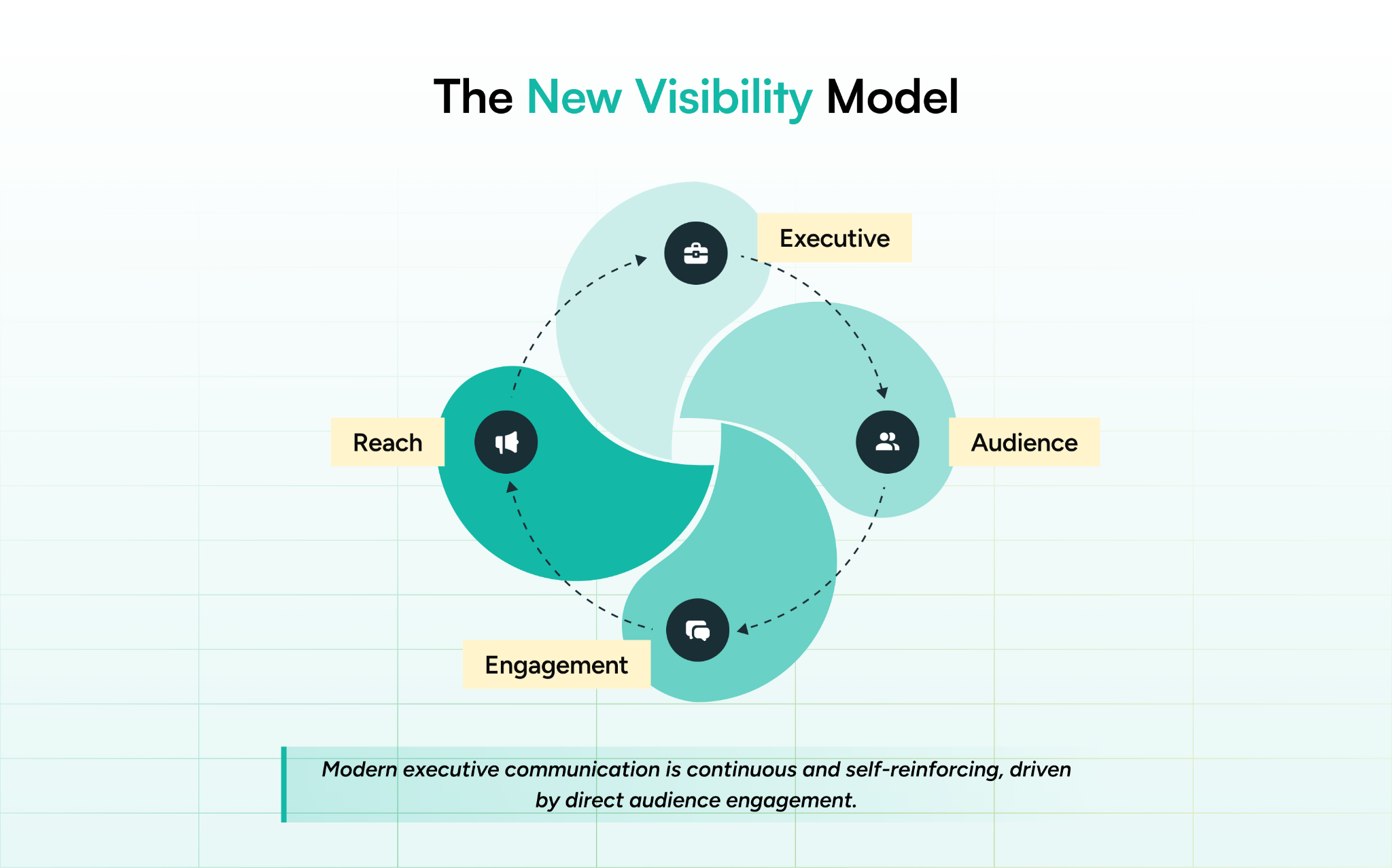
This phenomenon is reflected in broader audience behavior as well. Today, 85% of B2B CEOs and VPs use social media when making purchase decisions. In other words, the people executives want to reach are not necessarily encountering them only through traditional media. Social platforms are already part of how many senior decision-makers gather information when considering a purchase.
What Personal Branding Is Built For
Unlike PR, personal branding is built around consistency. A media feature, interview, or announcement can introduce a leader to a new audience. Personal branding helps the audience stay connected long after the announcement has been forgotten.
That's why many of today's most influential founders and executives invest in personal branding alongside traditional media efforts, with a view to not just being seen but also building trust and authority.
It Builds Familiarity Before Opportunity Appears
Think about how many business relationships actually begin. A potential client might see one of your posts today, come across another a few weeks later, hear you on a podcast months from now, and eventually visit your profile when a relevant need arises.
By the time they contact you, you may be new to each other, but your ideas aren't.
People often have a tendency to develop a preference for things they encounter repeatedly. In a business context, consistent visibility gives people more opportunities to encounter your thinking and develop a sense of what you know before there is ever a reason to speak to you.
A media feature can be one of those encounters. Personal branding makes sure it doesn't have to be the only one.

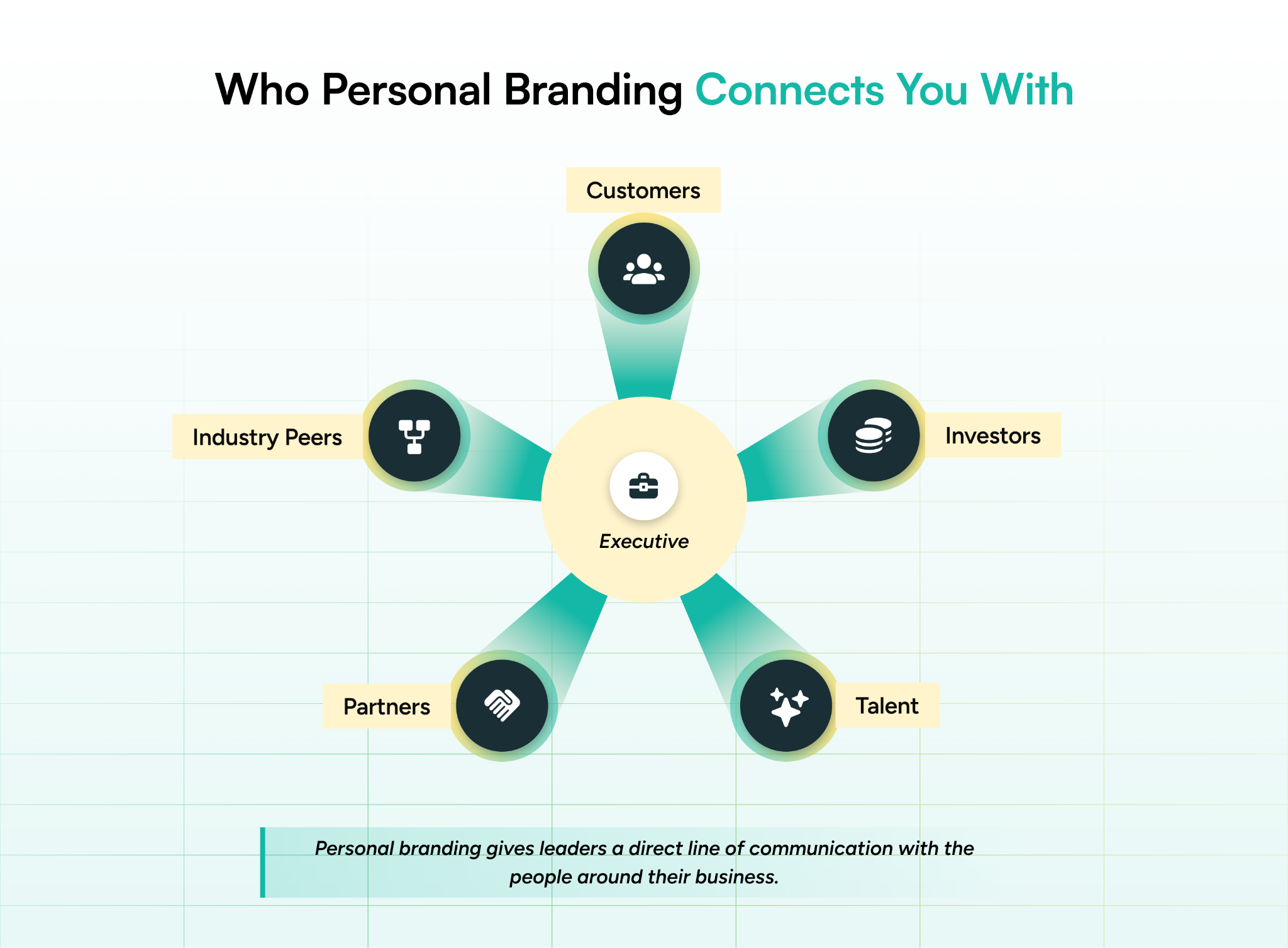
It Creates a Direct Line to the People Around Your Business
Traditional media gives executives access to an audience, but the communication is largely one-way. LinkedIn gives them the chance to participate in the conversation themselves.
That audience can include:
- Prospective customers
- Existing clients
- Investors
- Strategic partners
- Industry peers
- Potential hires
Each interaction becomes an opportunity to reinforce credibility and build trust, which in turn increasingly influences business decisions.
It Shows the Person Behind the Expertise
Impressive credentials can tell you that someone is accomplished, but they don't necessarily tell you what makes their perspective worth following.
Personal branding gives executives room to show more of that. They can explain why they made a particular decision, share an opinion that goes against conventional thinking, talk about something they got wrong, or unpack an industry change based on what they have seen firsthand.
Over time, people begin to recognize where a particular executive stands on important issues, and what experience they draw on before forming an opinion.
For an executive trying to become known for their expertise, this kind of recognition is far more memorable than another summary of their credentials.
It Compounds Over Time
A strong personal brand is usually the result of months or years of useful ideas adding up. Someone who discovers an executive today may find an article they wrote six months ago, scroll through several recent posts, listen to a podcast they appeared on last year, and then follow them to see what they say next. None of those pieces has to do all the work on its own.
This also means that you are not starting from zero every time you publish. Older ideas can remain useful and discoverable, while each new contribution gives people another reference point for understanding what you know and how you think.
What PR Is Meant For
An executive can spend years demonstrating their expertise through their own content, but there is a different kind of weight that comes with a respected publication deciding that their story, experience, or opinion is worth covering.
PR is particularly valuable when the goal is to reach audiences beyond an executive’s existing network, establish credibility quickly, or bring wider attention to a company, leader, or significant moment.
It Provides Third-Party Validation
One of PR's greatest strengths is that it borrows credibility from trusted institutions. When an executive is featured in a respected publication, quoted as an industry expert, or invited to contribute to a well-known media platform, the endorsement carries weight precisely because it comes from an independent third party.
Consequently, a founder featured in Forbes, Fortune, or The Wall Street Journal often receives immediate attention. Audiences may not know the founder personally, but they trust the publication's editorial standards and reputation. Before audiences engage with a leader's ideas, they often need a reason to believe those ideas are worth their attention. PR provides that reason.
It Accelerates Awareness
Building a personal brand takes time. Media coverage can create initial awareness almost immediately.
A single interview, feature article, or keynote announcement can introduce a leader to audiences they might otherwise never reach through their own channels.
This can be extremely useful when organizations need to communicate with multiple stakeholder groups at once. Investors, customers, employees, partners, and industry analysts often pay attention to major media announcements because they serve as trusted signals of significance.
While personal branding compounds gradually, PR can compress attention into a much shorter timeframe.
It Works Well for Major Business Moments
Not every communication challenge can be solved through LinkedIn posts. Certain moments require broad reach, coordinated messaging, and institutional credibility.
These include:
- Funding announcements
- Acquisitions and mergers
- IPOs
- Leadership appointments
- Major product launches
- Market expansions
- Strategic partnerships
In these situations, media coverage not only generates attention but also an official avenue that stakeholders can reference, share, and trust.
For example, Collate's recent $95 million funding announcement was covered by Forbes. Apart from sharing news, the article also signalled the company's momentum, market relevance, and investor confidence to a much wider audience than the founders could have reached through their own channels alone. Existing customers, prospective buyers, investors, partners, and industry observers all received the same message through a trusted third-party publication.

It Remains Essential When Reputation Is on the Line
Perhaps the clearest advantage of PR appears when something goes wrong. Personal branding is powerful when leaders want to build trust. PR becomes indispensable when organizations need to protect it.
During crises, regulatory challenges, public controversies, leadership transitions, or periods of uncertainty, companies need coordinated messaging, media expertise, and stakeholder management.
These situations demand strategy more than topical expertise and perspective. A well-managed PR function helps organizations communicate consistently across multiple audiences, respond to scrutiny, and ensure that important messages are understood accurately.
Therefore, PR remains a core function even in companies led by highly visible founders and executives. When reputation is at stake, third-party relationships, media expertise, and disciplined communication become critical.
GrowedIn’s School of Thought: The Best of Both Worlds
Personal branding and PR don't need to compete for the same budget, attention, or priority. In practice, they tend to work better when each is given a clear role.
An executive might spend months building a recognizable point of view on LinkedIn, then gain exposure to a much larger audience through a media feature. Someone who discovers them through that feature can find an established presence when they look them up. And when the executive has important company news to share later, they already have an audience that knows who they are.
Personal Branding Can Create the Foundation
Before trying to increase an executive’s visibility, a more basic question needs to be answered: What should people know them for?
That answer has to be more specific than their job title or area of expertise. A cybersecurity CEO, for example, may have spent years seeing the same mistakes companies make during incidents. A founder in recruitment technology may have strong views on why conventional hiring processes fail. Those experiences give them something useful and recognizable to contribute.
Personal branding gives executives the space to develop those ideas publicly. As they write, respond to conversations, and revisit subjects from different angles, people begin to associate their name with particular issues and perspectives.
That proves useful when wider attention does arrive through well-planned PR. If someone encounters the executive through a media interview, conference appearance, or company announcement and then searches for them, they don't find an empty profile or a stream of company updates. They find enough of their thinking to understand why this is someone they may want to continue hearing from. At this point, PR is more about validation at scale than initial exposure.

When Should Executives Prioritize PR vs Personal Branding?
PR and personal branding are responses to different executive needs. Instead of questioning which one is better, think about the outcome you are trying to achieve now.
When Personal Branding Should Take the Lead
Personal branding can become the primary lever when the goal is to build depth, familiarity, and long-term influence.
This is important when:
- You are building authority in a specific industry or category
- You are trying to attract and retain high-quality talent
- You are selling expertise, consulting, or high-trust services
- You are a founder in a crowded or competitive market
- Your company is founder-led, and the perception of leadership directly impacts the brand
In these situations, the best strategy is to focus less on mass attention and more on sustained relevance. Personal branding helps leaders stay present in the minds of the right audience through consistent expression of ideas, insights, and perspectives.
When PR Should Take the Lead
When your objective shifts from depth to scale, PR can gain greater ground. It is most effective when leaders need to:
- Announce major business milestones such as funding, acquisitions, or product launches
- Enter new markets or expand geographically
- Manage reputation risk or respond to public scrutiny
- Strengthen institutional credibility through third-party validation
- Reach audiences beyond existing networks quickly and credibly
In these moments, the focus is less on building familiarity and more on establishing legitimacy and scale in a short timeframe. PR ensures that key messages are consistent, widely distributed, and validated by trusted external platforms.

Personal Branding vs PR: A Quick Summary
Personal branding and PR are not competing strategies. Both help leaders become more visible, credible, and influential, but they achieve those outcomes in different ways.
Personal branding is built on direct relationships, consistency, and the gradual accumulation of trust. PR, meanwhile, leverages media channels, third-party validation, and coordinated communication to create awareness at scale. As a result, each performs differently across key dimensions of executive communication.
The visual below illustrates where each approach is strongest and why the most effective leadership strategies cannot rely on just one.
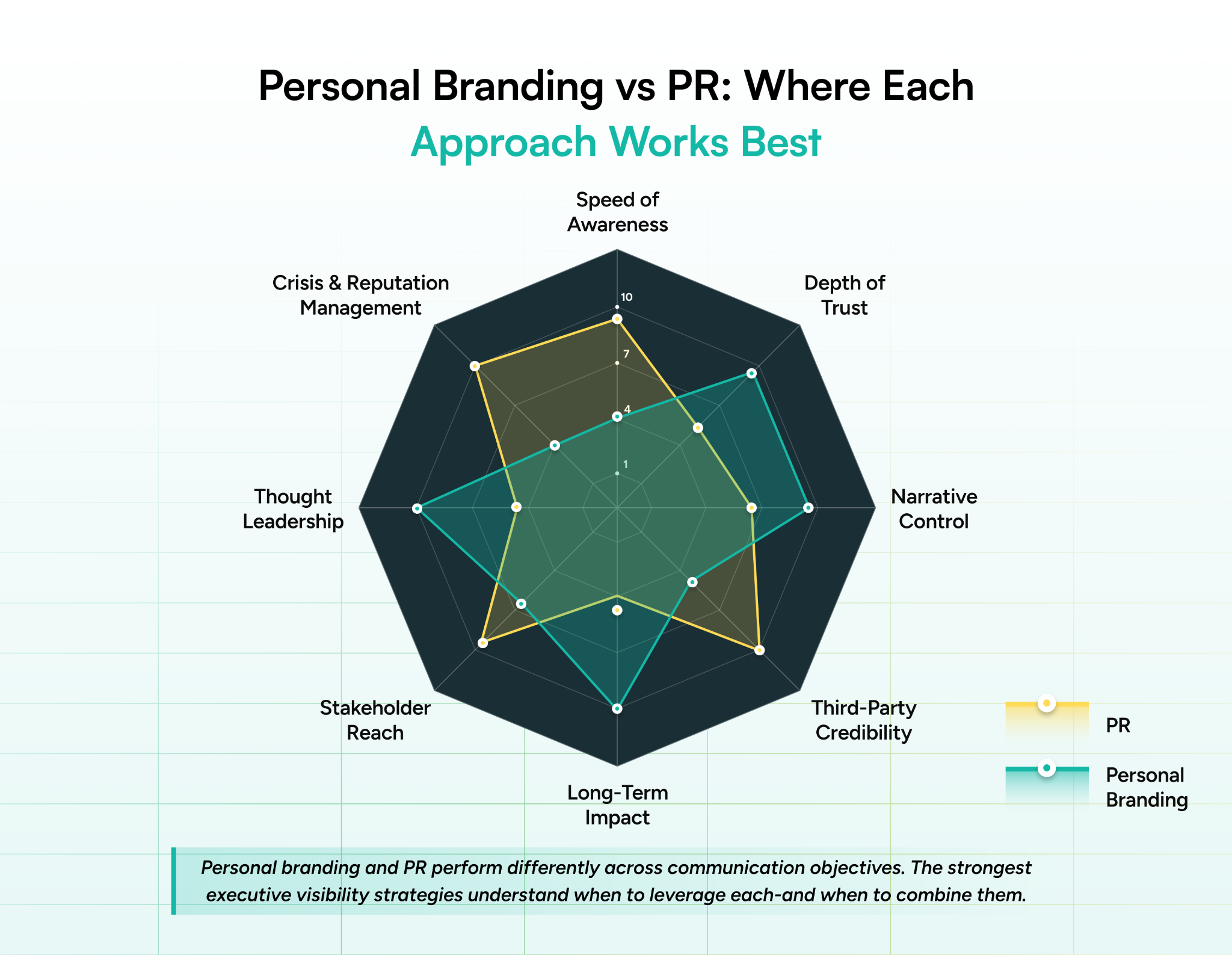
Personal branding tends to perform best in areas that require consistency and depth. It gives leaders greater control over their narrative, allows them to demonstrate expertise over time, and helps build familiarity with audiences before any formal interaction takes place.
PR, on the other hand, is designed for moments that require scale, like announcing a major milestone, entering a new market, navigating regulatory change, or communicating during periods of uncertainty. PR enables organizations to reach broader audiences quickly while benefiting from third-party credibility.
Conclusion
Executive visibility is most valuable when people have a reason to remember you after the first encounter. On LinkedIn, that comes from consistently sharing ideas that reflect what you know, how you think, and what you have learned through experience. So, when the right customer, investor, peer, or potential hire comes across your name, there is already something meaningful behind it.
At GrowedIn, we help executives turn their expertise into a LinkedIn presence that earns attention for the right reasons and builds recognition over time. Feel free to schedule a discovery call to discuss how we can strengthen your executive presence on LinkedIn.

Frequently Asked Questions
Is personal branding the same as self-promotion?
No. Self-promotion focuses on highlighting achievements, while personal branding focuses on communicating expertise, values, and perspectives consistently over time. Done well, it gives people something useful to associate with your name beyond your job title.
Can personal branding replace PR?
Not entirely. They can complement each other, but they do different jobs. Personal branding gives executives an ongoing way to share their thinking and become familiar to their audience, while PR can provide wider exposure and valuable third-party credibility.
Why has personal branding become more important for executives?
Platforms such as LinkedIn have given executives direct access to customers, investors, employees, peers, and other people in their industry. They can now contribute to conversations regularly rather than relying on interviews, company announcements, or media coverage to be heard.
How long does it take to build a personal brand?
There is no standard timeline. You may start seeing engagement relatively early, but becoming recognized for a particular area of expertise or point of view usually requires sustained effort. What you publish, how consistently you contribute, and who you are trying to reach all play a part.
When should a company prioritize PR over personal branding?
PR may deserve greater attention around major developments such as funding rounds, acquisitions, market expansions, product launches, or leadership changes. It is also particularly important when a company is dealing with public scrutiny or a reputation issue that requires carefully coordinated communication.
What makes a strong executive personal brand?
A strong executive personal brand gives people a clear sense of what you know and how you think. That comes from consistently sharing useful ideas, informed opinions, firsthand experiences, and lessons that are relevant to the people you want to reach.
Should founders and CXOs invest in both personal branding and PR?
Often, yes, particularly when an executive needs both an ongoing presence and wider exposure at important moments. Personal branding gives people regular access to the executive’s thinking, while PR can introduce that executive and their company to audiences they may not otherwise reach.
Personal Branding vs. PR: What Should Executives Prioritize?
- Personal branding and PR both help leaders become more visible, but they achieve this through different mechanisms.
- PR builds awareness through third-party validation, while personal branding builds trust through direct audience relationships.
- The growth of LinkedIn and other digital platforms has enabled executives to communicate directly with stakeholders rather than relying solely on traditional media.
- Personal branding excels at building familiarity, demonstrating expertise, and creating long-term influence through consistent engagement.
- PR remains invaluable for major announcements, regulatory communications, reputation management, and institutional credibility.
- Executives do not necessarily need to choose between PR and personal branding. The priority should depend on what they are trying to accomplish at a particular time.
- A strong personal brand provides the substance that makes PR more effective, while PR amplifies that expertise to broader audiences.


Insights Hub
LinkedIn Analytics: Metrics to Track and How to Use Them
Employer Branding on LinkedIn