 Claude
 ChatGPT
 Gemini
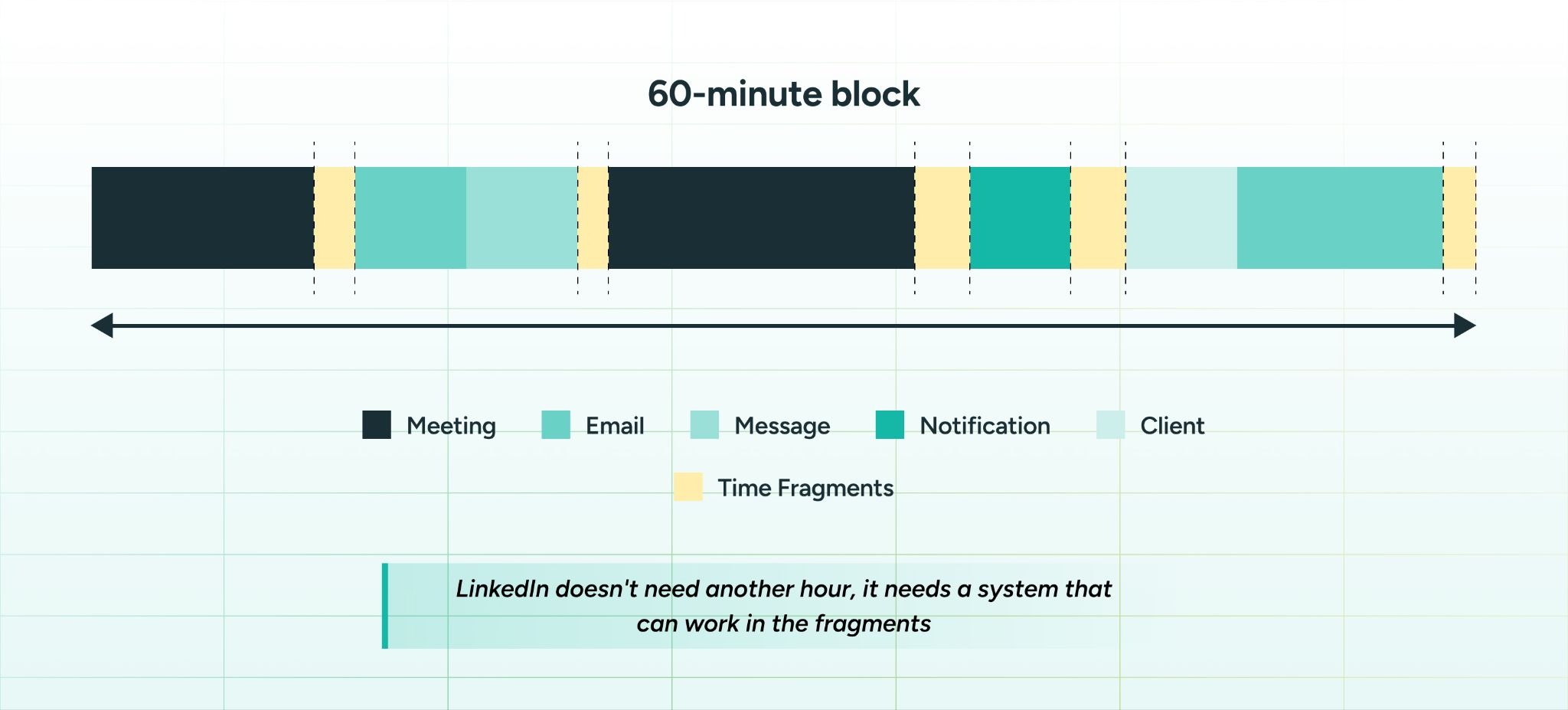
Microsoft's 2025 Work Trend Index found that employees in the top 20% of users by communication volume are interrupted by a meeting, email, or chat every two minutes during core working hours. Across its global survey, 48% of employees and 52% of leaders also said their work feels chaotic and fragmented.
If your workday already looks like a series of meetings, messages, and context switches, the usual LinkedIn advice like ‘find an hour to write, batch your content, plan your week, publish consistently’ can feel disconnected from reality. The advice itself isn’t wrong, but it assumes your workday contains neat, uninterrupted blocks of time in which you can sit down and think about what to post.
For a founder between meetings, an executive travelling between cities, or a senior professional managing a team, clients, and other competing priorities, those blocks may simply not exist.
At that point, LinkedIn becomes something you intend to get to when work slows down, but it rarely does. A few missed posts turn into a missed week, then a missed month. When you eventually return, it can feel like starting the entire process over again.
The better approach is to stop treating LinkedIn as a separate task that requires dedicated creative time.
A consistent LinkedIn presence can be built from smaller activities distributed across the working day: capturing an observation after a meeting, developing an idea when you have 15 minutes, replying to a useful conversation between calls, or using a longer window to turn several existing ideas into finished posts.
In this guide, we’ll look at how to create a system that works with the time you have, from matching LinkedIn tasks to different time windows and energy levels to building a ready-to-use content bank and creating a fallback routine for the weeks when your calendar gets completely out of control.
Stop Looking for ‘Time for LinkedIn’
Many assume ‘working on LinkedIn’ is one task. You sit down, think of an idea, write the post, edit it, publish it, and then respond to the people who engage with it. That sounds manageable until you add it to an already crowded workday.
LinkedIn Is Not One Task
Maintaining a LinkedIn presence involves several different activities:
- Capturing an idea
- Developing a point of view
- Drafting
- Editing
- Publishing
- Responding to comments
- Engaging with other people's content
- Reviewing what is worth developing next
These activities require different amounts of time and concentration. Treating all of them as “content creation” creates the impression that LinkedIn requires a large, uninterrupted block of time.
For someone whose calendar is already fragmented, that assumption alone can make maintaining a consistent LinkedIn presence feel unrealistic.
The Uninterrupted Hour Is Becoming Harder to Find
Another notable find in the Microsoft 2025 Work Trend Index Annual Report is that 80% of the global workforce says it lacks enough time or energy to get its work done.
If your workday is already bursting to the brim with meetings, messages, calls, and shifting priorities, waiting for a convenient one-hour window to work on your personal brand is not a particularly reliable strategy.
Change the Question
Instead of asking, "When will I have time for LinkedIn?" ask, "What can I do with the time I have right now?"
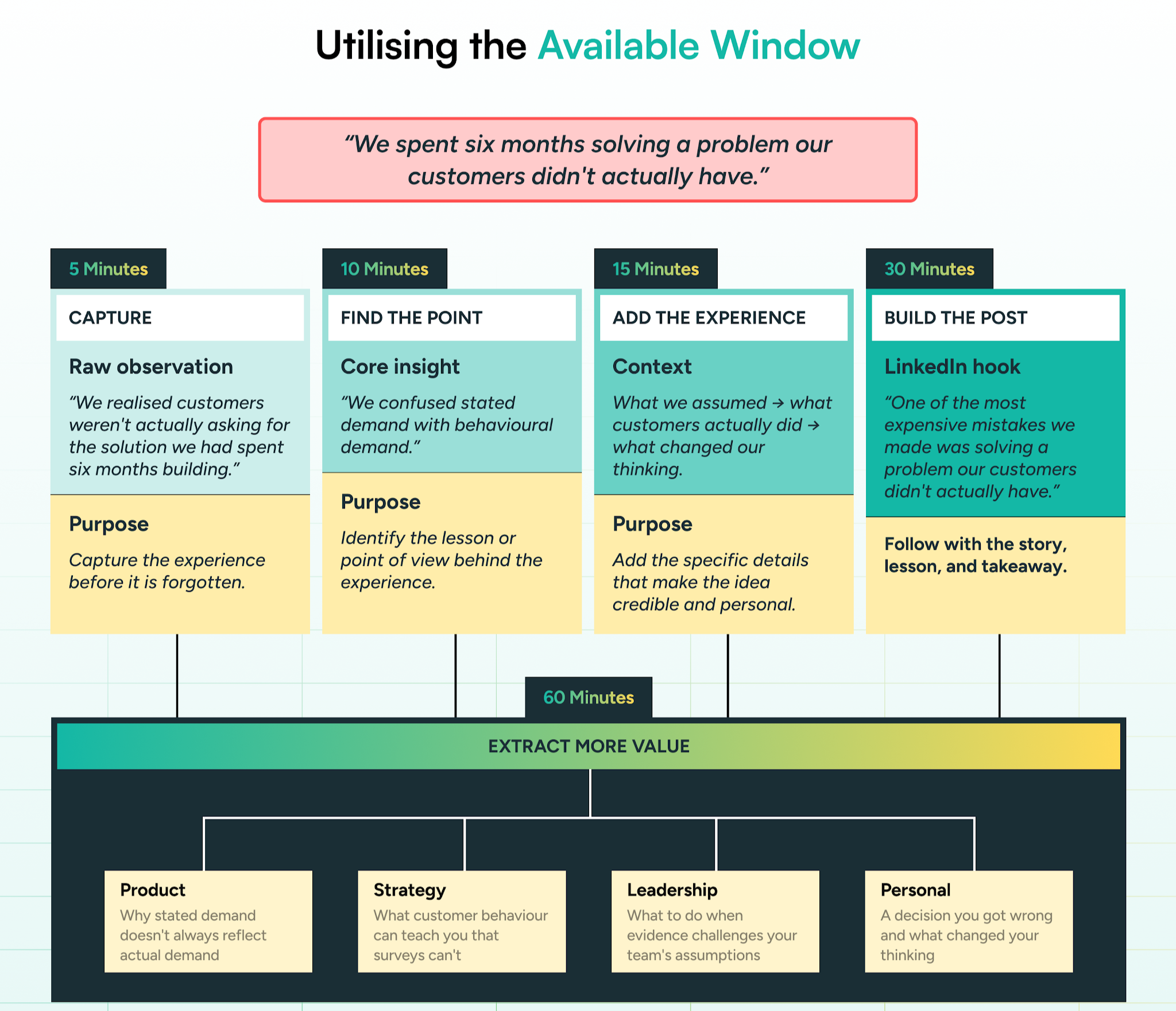
A five-minute gap between meetings might be enough to capture an idea before you lose it. Ten minutes could be enough to turn that idea into a strong opening, while 15 minutes might give you enough time to develop a rough draft. A longer block can then be reserved for work that genuinely benefits from uninterrupted concentration.
The same principle applies beyond publishing. Replying to a thoughtful comment, contributing something useful to someone else's post, saving an industry development for later, or reviewing your existing ideas can all help maintain your presence without requiring a dedicated content session.
Change the Unit of Measurement
This is the shift that makes a time-poor LinkedIn strategy more practical.
Don't measure your LinkedIn routine only by how many hours you can dedicate to it each week. Measure it by what you can accomplish with the fragments of time your schedule actually gives you.
Instead of trying to squeeze another hour of work into an already overloaded calendar, stop assuming that every LinkedIn task needs an hour in the first place.
Build a LinkedIn System Around Time Blocks
Consistency is not only a time problem but also a workflow problem. CMI's 2025 B2B research found that 37% of enterprise marketers still struggle with creating content consistently, while 47% say content repurposing is a challenge.
If organisations with dedicated marketing teams struggle to keep content moving, expecting a founder or executive to repeatedly start from a blank page is not a sustainable strategy.
The solution is to make better use of the time and material you already have.
If You Have 5 Minutes
Five minutes isn't enough to write a finished post, and it doesn't need to be. Use it to capture something worth developing later.
An interesting question from a client call, a decision you made that others might handle differently, or a surprising result from a project.
Write it down.
You can also use five minutes to:
- Reply to a comment
- Leave one substantive comment on someone else's post
- Save an industry development worth returning to
- Add an example to an existing content idea
This habit prevents useful ideas and observations from getting lost in the pace of the workday.
If You Have 10 Minutes
Ten minutes is enough to turn an observation into a usable idea. Take something from your idea bank and ask:
- What is the point I'm trying to make?
- Why does it matter?
- What do I believe that others might disagree with?
- What example makes this specific?
You might also use the time to turn an idea into a hook, expand an existing outline, or edit a rough draft. This is particularly useful for busy professionals because editing and developing are different cognitive tasks from starting with a blank page.
If the thinking already exists, ten focused minutes can move it considerably closer to publication.
If You Have 15 Minutes
Fifteen minutes gives you enough room to produce something tangible.
You could turn a client or customer question into a short post. Develop one idea from your content bank into a clear argument. Take an observation from your working week and add the example or lesson that makes it useful to someone else.
You can also repurpose an existing idea. That doesn't mean copying an old post and changing a few words. Look for a different entry point:
The original idea:
A lesson you learned from a project.
New angles:
What caused the mistake?
What assumption was wrong?
What would you do differently?
What does the lesson mean for someone earlier in their career?
One piece of thinking can therefore become several distinct pieces of content without requiring several completely new ideas.
If You Have 30 Minutes
Thirty minutes is where you can move from developing ideas to creating content.
Use the time to write a more substantial post, develop a story from a recent experience, or take one strong idea and explore several angles.
For example, one observation from a client project might produce:
- The lesson you took from it
- The assumption that turned out to be wrong
- The mistake behind the outcome
- What you would do differently
- What others in your industry could learn from it
You don't need to publish all five. The value comes from extracting more thinking from the same source material.
Thirty minutes can also be used for batching. Rather than completing one post from beginning to end, you could develop three ideas, write five hooks, or bring two rough drafts close to publication.
That creates something even more useful than a single finished post: a buffer for the next busy week.
If You Have 60 Minutes
A 60-minute window should be reserved for work that genuinely benefits from sustained attention.
This is when you can:
- Develop a more complex argument
- Write a longer or more detailed post
- Work through several drafts
- Review your content pipeline
- Turn several raw ideas into finished pieces
- Prepare content ahead of an especially busy period
LinkedIn also allows members to schedule posts in advance, so finished content doesn't necessarily have to be published at the exact moment you happen to have time.
The Point Isn't to Fill Every Gap
There is a danger in turning this framework into another productivity exercise. You don't need to spend every spare five minutes thinking about LinkedIn.
The point is to remove the all-or-nothing mindset that says you either have enough time to create a post, or you have no time to work on your presence at all.
A time-poor LinkedIn system should have different gears. Five minutes might be enough to capture an idea, ten to develop it, fifteen to start drafting, thirty to create something more substantial, and sixty to build a buffer. The gear you choose depends on the time and attention you have available.
To keep the system sustainable, your LinkedIn workflow should adapt to your calendar, instead of requiring your calendar to adapt to LinkedIn.
Separate Ideation From Content Creation
The best LinkedIn idea you have this week may not arrive when you sit down to write. It might show up halfway through a client meeting. Those moments are more valuable than an hour spent staring at a blank LinkedIn composer.
Busy professionals tend to treat having an idea and creating content as the same task. They wait until they have time to write, then expect themselves to think of an idea, develop it, write, edit, and publish it in one sitting. That is a lot of cognitive work to ask yourself to do on demand.
Your Workday Is Already Producing Content Ideas
The raw material for a personal brand is usually hiding in the work you are already doing.
Consider the things that happen during an ordinary week:
- A question someone asks you in a meeting
- Something a client misunderstands
- A decision you made and why you made it
- An unexpected result from a project
- A mistake you or your team made
- An opinion you disagreed with
- A problem you keep seeing across customers
- A shift you are noticing in your industry
- Something you had to explain to your team
None of these is a LinkedIn post yet. Your first job is simply to notice what might be worth returning to.
Record the Thought Before You Develop It
Keep one place where you can record observations as they happen. It could be a notes app, a document, a voice memo, or a dedicated content workspace. The format matters less than the friction.
When something catches your attention, don't try to write the post. Write down enough to recover the thought later.
For example, a client asks: Why aren't more companies using AI for this?
That isn’t content in itself, but it gives you somewhere to start. Later, when you have 10 or 15 minutes, you can reflect more.
Maybe your answer is: AI adoption is not the problem for most companies. Their workflow needs fixing. This becomes a point of view.
With more time, you can add an example, develop the argument, refine the opening, and eventually turn that initial observation into a finished post.
Why Separation Matters
There is a practical reason not to force all of this into one sitting. When people are interrupted or switch away from a task, returning to it can require time to reconstruct what they were thinking before the interruption.
This makes the traditional LinkedIn workflow particularly inefficient for a time-poor professional. You finally find 30 minutes, open a blank document, and start wondering what to post. Ten minutes disappear as you try to remember the interesting observation you had earlier, and then a call interrupts you. By the time you have something worth developing, your 30 minutes are gone.
An idea bank changes the starting point. You don't sit down to find an idea. Instead, you sit down with ideas that already exist and decide which one is worth developing.
Build an Idea Bank Instead of a Content Calendar
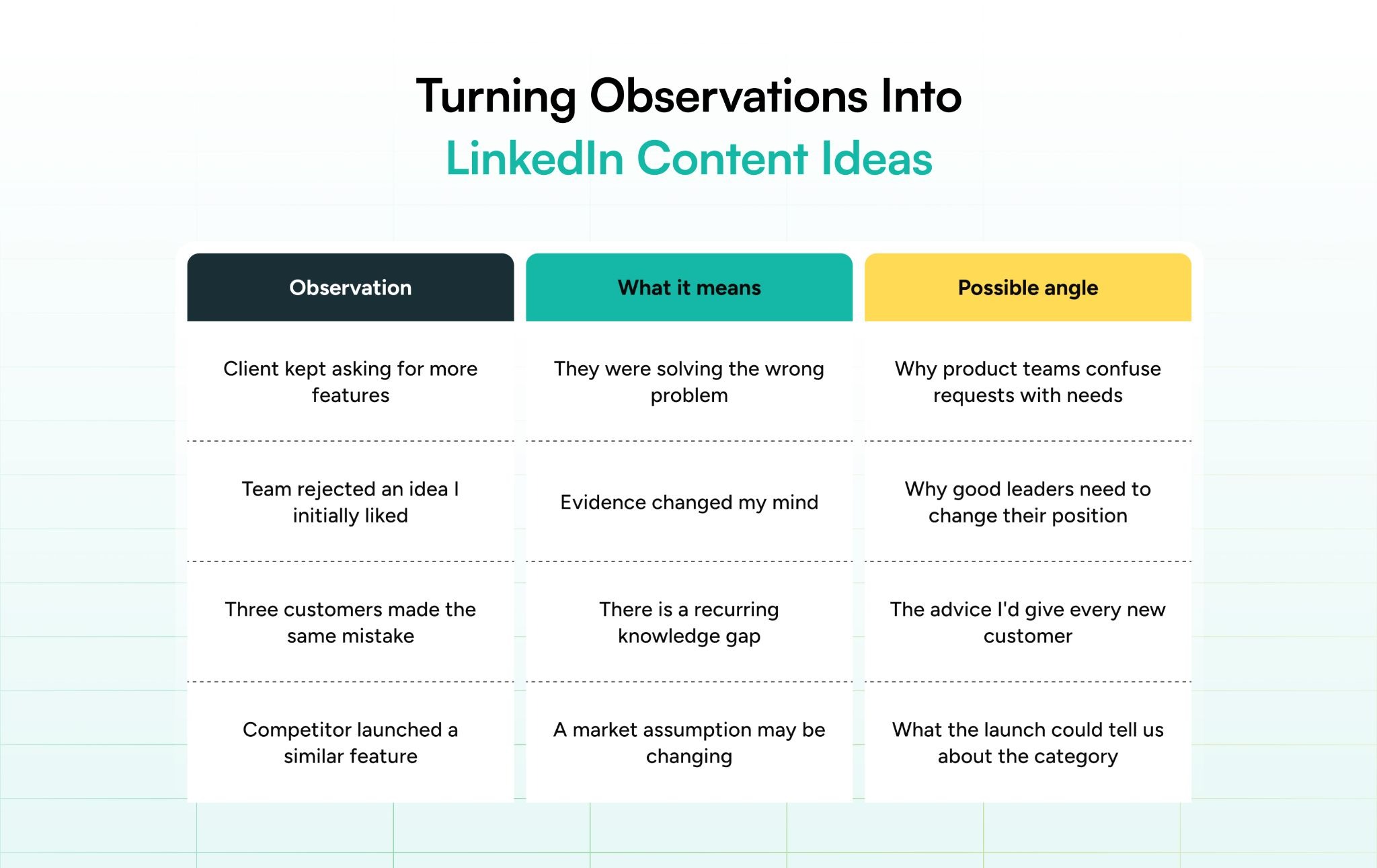
A content calendar tells you what you are supposed to publish. An idea bank tells you what you have been thinking about. The second is much more useful for personal branding because it starts with your experience rather than a predetermined list of topics.
Your idea bank might look like this:
The Goal Is to Never Start From Zero
A question from Monday can become an observation on Wednesday, a draft on Friday, and a published post next week. The underlying idea might later produce two or three more angles.
For an executive creating their own personal-brand content, an elaborate editorial calendar may not be an ideal solution; a better idea might be:
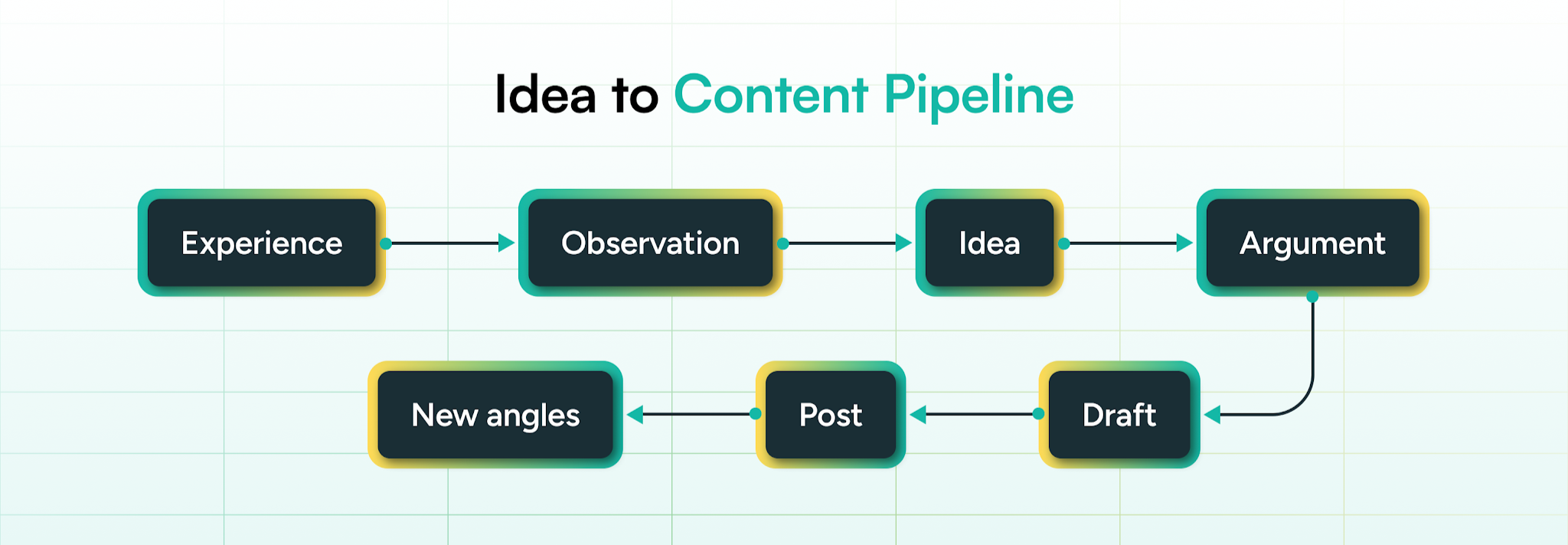
Once you separate those stages, a busy week doesn't have to mean an empty content pipeline. You can have no time to write and still have five ideas waiting for you. When you finally have 30 minutes, you are not starting from a blank page.
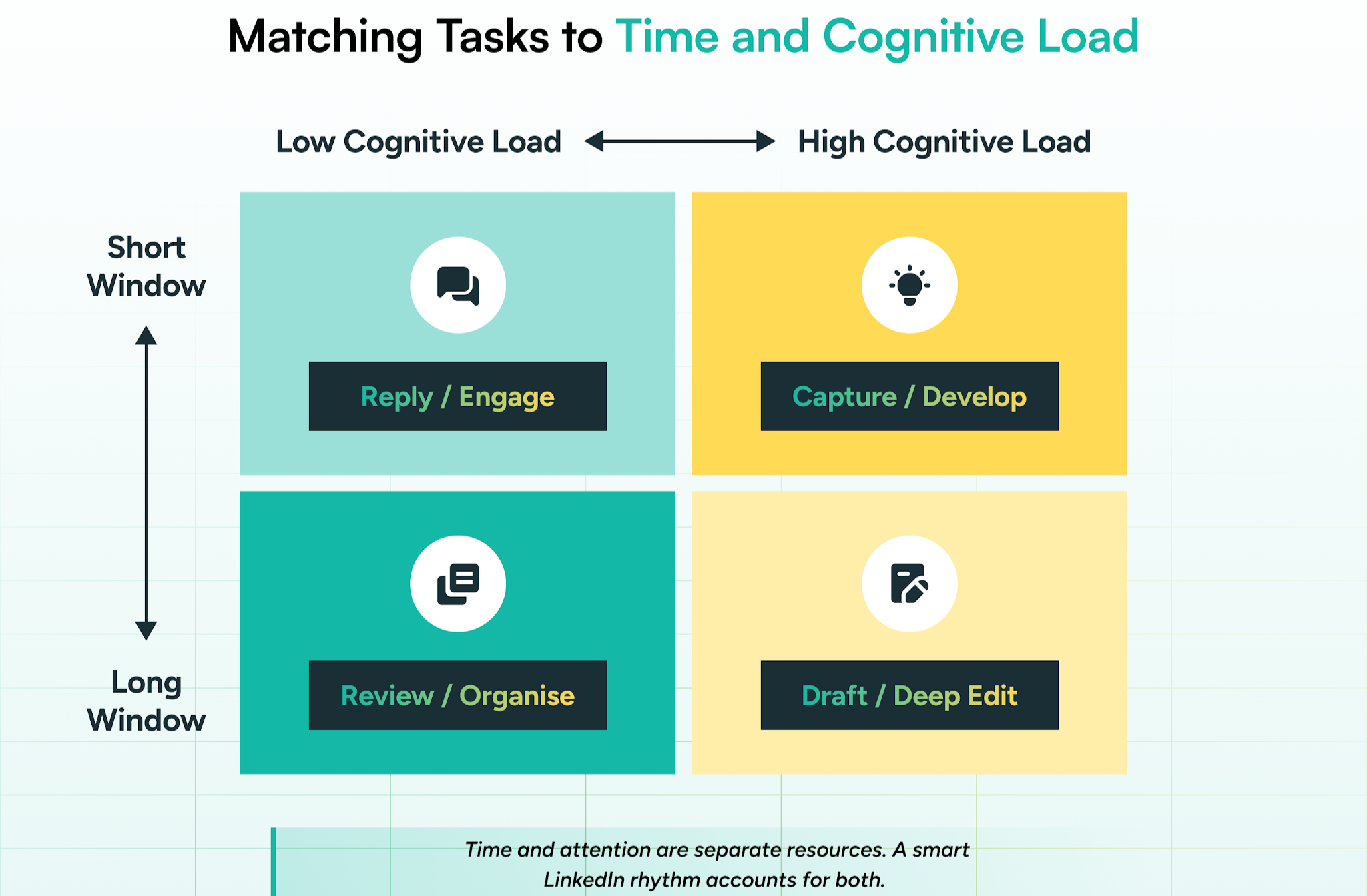
Match the Task to Your Energy
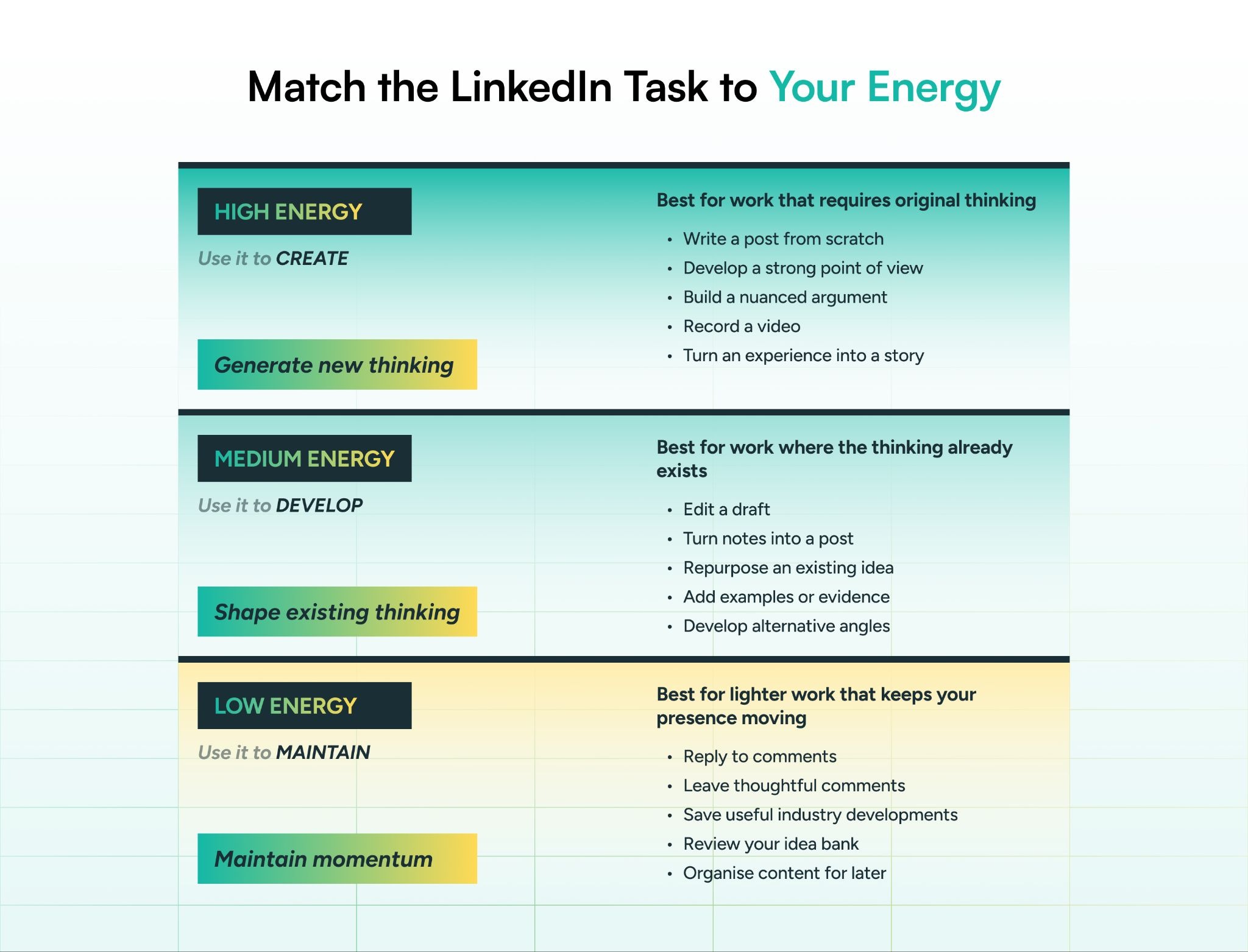
Having 30 minutes available does not necessarily mean you have 30 minutes of usable creative energy.
A 30-minute window at 9 a.m., before the work begins, could be completely different from a 30-minute window at 6 p.m., after a day full of conversations, decisions, and meetings.
While some productivity advice treats those two windows as interchangeable, LinkedIn workflows shouldn't.
Research on cognition suggests when you do cognitively demanding work can matter, and that the effect varies between people. A Scientific Reports study examining chronotype and time of day found that differences in people's biological rhythms can influence performance on decision-making tasks. In other words, there is no universal best time for complex thinking that applies equally to everyone. Don't just ask how much time you have. Ask what kind of thinking you can realistically do with that time.
Create a "Busy Week" Version of Your LinkedIn Routine
The easiest way to break a LinkedIn routine is to build one that only works during a normal week. But founders and executives rarely get normal weeks for very long.
There are product launches, fundraising rounds, hiring pushes, conferences, client deadlines, board meetings, travel, holidays, and the occasional problem that becomes a top priority.
A LinkedIn system that requires the same amount of time every week will eventually collide with one of them.
So, instead of building one routine, build two.
Your Normal-Week Routine
This is the version you use when the business is operating relatively normally.
You might:
- Note down ideas throughout the week
- Develop one or two into posts
- Spend time writing and editing
- Publish according to your usual cadence
- Respond to conversations around your posts
- Engage with people in your industry
- Review your content bank and plan what comes next
This is where most of your LinkedIn growth happens, but it shouldn't be the only version of your system.
Your Overloaded-Week Routine
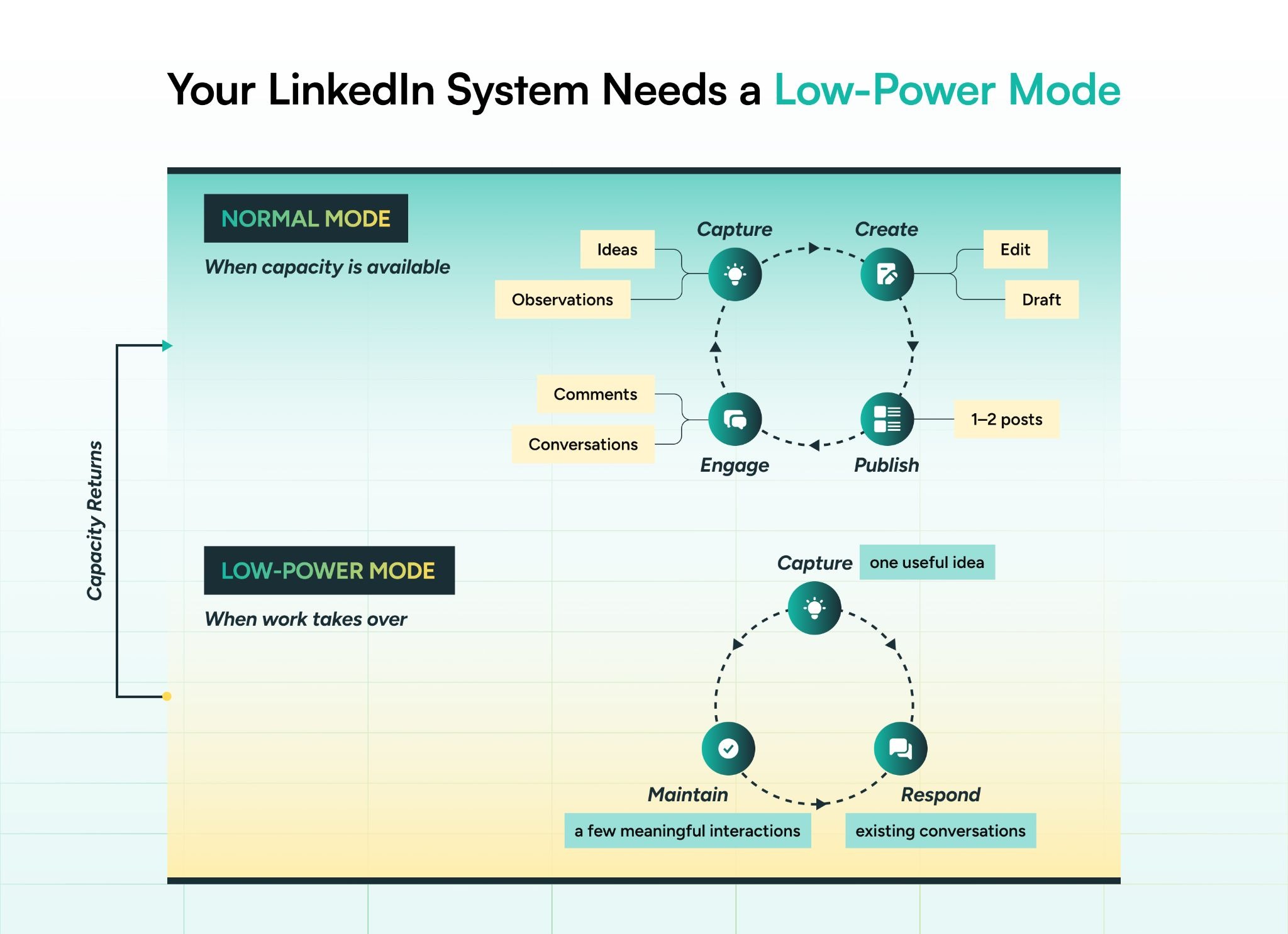
This is the low-power mode. Growing aggressively, producing the best post, or even publishing is not the target. The objective is to keep the system going until you have higher capacity again.
Your minimum viable routine might be:
1. Capture one idea. Write down something interesting that happened during the week.
2. Respond to existing conversations. Don't leave people who have taken the time to engage with you hanging.
3. Make one meaningful contribution elsewhere. Leave a useful comment on a post from someone you want to stay connected with.
4. Keep your idea bank alive. Add observations when they happen, even if you don't have time to develop them.
Build Your Minimum Viable Presence
Before you decide what your busy-week routine looks like, define the smallest amount of activity you are willing to maintain.
For example:
- 1–2 posts
- Reply to comments on your existing posts
- 2–3 substantive comments on others’ posts
- Capture new ideas
- Save relevant developments
The exact numbers aren't universal. The important thing is deciding them before you're overwhelmed. When the week gets chaotic, you shouldn't have to make another decision about whether LinkedIn deserves your attention. You already know what the minimum looks like.
Routines work better when they don't depend on circumstances remaining unchanged. For LinkedIn, that doesn't mean posting at exactly 9 a.m. every Tuesday. It means having a reliable fallback routine for the weeks when your usual schedule falls apart.
Don't Try to Catch Up Afterwards
There's another advantage to having a low-power mode: you don't create a backlog.
If you disappear for three weeks because work became intense, you may eventually feel that you need to “make up” for the missed content.
That usually leads to one of two things:
- Trying to produce several posts at once
- Giving up because restarting feels like another project
Neither is necessary. If you maintained the minimum during the busy period, there is nothing to catch up on. You simply return to your normal routine when your capacity returns.
Treat It Like a Low-Power Mode
Think about what happens when your phone goes into low-power mode. It doesn't stop functioning; it reduces what it does in the background so the essential functions can continue until there is enough power to return to normal.
Your LinkedIn system should work the same way to ensure it has a version that survives even your busiest times.
Build a Recovery Plan for When You Fall Off
Even a well-designed LinkedIn routine will occasionally be disrupted. You miss one post, then another, and a particularly busy week stretches into two. Travel is followed by a product launch or another pressing priority, and before you realize it, three weeks have passed since you last looked at your content plan.
The natural response may be to feel that you need to make up for the gap. You might be tempted to apologize for disappearing, announce that you're back, publish several posts in quick succession, or abandon the routine altogether because it feels as though you have lost your momentum.
None of those responses is necessary. A sustainable LinkedIn system should account for interruptions from the beginning and give you a straightforward way to return when they happen.
A Lapse Isn't the Same as Losing the Habit
Missing a few days because you were traveling is not the same as abandoning your system. The real difficulty begins when that break creates a psychological barrier to restarting.
If you find yourself thinking, "I've already been inactive for three weeks, so I need to figure out the perfect post to come back with," the gap itself has become another problem to solve.
Don't Announce Your Return
You don't need to publish a post explaining that you've been away. Most people are unlikely to be tracking your publishing schedule closely enough to require an explanation for a few quiet weeks.
Instead, return with something useful, whether that is a lesson from the work you've been doing, an observation from a recent experience, or a question you've been thinking about. Let the value of what you share reestablish your presence without making the absence itself the subject.
Don't Try to Catch Up
Another mistake is treating missed posts like a backlog. If you normally publish twice a week and missed three weeks, you don't owe LinkedIn six posts. There is nothing to catch up on. Publishing five posts in a few days just to compensate for a quiet period may put more pressure on you just as you're trying to restart. Instead, return to your usual routine and pick up from where you are now.
Your Five-Step Restart
When you've been away from LinkedIn for two or three weeks, don't redesign the strategy. Run the recovery sequence.

Build the Restart Before You Need It
The best time to decide how you'll recover from a lapse is before the lapse happens. You don't have to decide what “getting back on LinkedIn” means while you're already feeling behind.
This is also why your idea bank is so important. If you step away for three weeks and come back to an empty document, you first have to find an idea, choose a topic, work out what you want to say, and then write the post.
If you come back to ten useful observations you've captured over the previous month, much of that early work has already been done. You can choose an idea that still feels relevant and start developing it.
Let Recovery Be the Goal
A sustainable system should account for interruptions, whether that means missing a few days, giving business priorities your full attention for a week, or simply losing momentum for a while.
None of that means the system has stopped working. What matters is how easy it is to return. If one missed week makes it difficult to pick up the routine again, your process may be asking too much of you.
A better measure is whether you can return to your idea bank, choose something worth developing, publish when you're ready, and gradually settle back into your usual workflow.
The Right Things to Automate
There is plenty of administrative work you can remove from the process: setting reminders, scheduling posts, organizing your idea bank, tracking drafts, maintaining a content pipeline, or identifying older ideas worth repurposing.
The principle is simple: Automate administration. Don't automate the perspective.
Tools can remind you that you have an unfinished draft. They can help you organize 20 ideas into a usable content pipeline. They can schedule a post for next Tuesday or surface an older piece that could be developed from a new angle.
What they cannot provide is the part that makes personal-brand content worth following: your judgment, experience, and point of view. An AI tool can help turn rough notes into a cleaner draft, suggest structures, or identify gaps in an argument. But if it starts deciding what you believe, generating generic opinions, or replacing the specific experiences behind your content, you have removed the very thing that differentiates a personal brand from corporate content.
A useful rule is: Automate the friction, but keep the thinking human.
If a task exists mainly to help you remember, organize, format, or move something through your workflow, look for ways to automate it. If the task determines what you believe, what you have learned, or what you want your audience to understand, stay closely involved.
Review Your LinkedIn Routine Every Month
A LinkedIn routine should not be something you design once and follow forever. Your workload changes, your responsibilities change, and the way you create content should change with them.
A short monthly review can help you see whether the system still fits the way you work. Spend 10 to 15 minutes looking at the process itself, rather than focusing only on reach or engagement numbers.
Ask:
- Which part of the process did I keep skipping?
- Where did I lose the most time?
- Which tasks felt unnecessarily difficult?
- Am I still starting from a blank page too often?
- What ideas kept coming up in my work?
- What could I prepare in advance?
- What can I remove altogether?
If writing is consistently the bottleneck, you may need to do more thinking or idea development before your writing sessions. If you have plenty of drafts but rarely publish, look at what is preventing those drafts from moving forward. If you keep missing your engagement routine, consider reducing it to something you can realistically sustain.
The monthly review should make your existing LinkedIn system easier to manage without adding unnecessary complexity. Over time, that means removing unnecessary steps, keeping what works, and adapting the process around the way you work.
Know When to Bring in LinkedIn Ghostwriting Support
At some point, the constraint may not be your system, but the time you can realistically give it. A LinkedIn ghostwriter or dedicated agency can take on much of the work involved in turning your expertise into consistent content, without replacing the thinking behind it.
Working with a ghostwriter doesn't mean handing over your LinkedIn presence and stepping away. You still bring the experience, opinions, stories, and judgment that make the content yours. The writer's role is to draw those ideas out, organize them, do additional research where needed, and turn them into posts that sound like something you would actually say.
Conclusion
You don't necessarily need more hours in your week to maintain a meaningful LinkedIn presence. What helps is having a system that reduces the number of decisions you need to make when time does become available. That means having somewhere to capture an idea between meetings, knowing what you can accomplish in five minutes versus 30, and having a simpler version of your routine for weeks taken over by travel, launches, or unexpected priorities.
And if maintaining that system still requires more time than you can realistically give it, you don't have to manage every part of the process yourself. Reach out to discuss how dedicated support can help turn your expertise and ideas into a consistent LinkedIn presence.

Frequently Asked Questions
How much time do I need to spend on LinkedIn each week?
There is no fixed minimum. A better approach is to build a routine around the time you actually have, using shorter windows for idea development, engagement and editing, and longer windows for writing and deeper content creation.
What should I do on LinkedIn if I only have five minutes?
Use five minutes to capture an idea, reply to an existing comment, leave one thoughtful comment, or save an industry development worth revisiting. The goal is to keep the system moving rather than force yourself to create a complete post.
How do I stay consistent on LinkedIn during a particularly busy week?
Create a low-power version of your normal routine. Instead of trying to maintain your usual publishing schedule, focus on a few essential actions such as capturing ideas, responding to conversations, and maintaining meaningful engagement until your schedule returns to normal.
What if I have time to work on LinkedIn but don't have the energy to write?
Match the task to your cognitive energy. Use high-energy periods for writing and original thinking, medium-energy periods for editing and repurposing, and low-energy periods for commenting, replying, organizing ideas, and other lighter activities.
What should I do if I haven't posted on LinkedIn for several weeks?
Don't try to compensate for the gap with a burst of posts or an announcement about your return. Reopen your idea bank, choose one useful idea, develop and publish it, re-enter relevant conversations, and return to your normal workflow.
Should I use AI and automation to save time on LinkedIn?
Use automation for administrative work such as reminders, scheduling, organizing ideas and tracking drafts. AI can also help with editing or developing rough material, but your experiences, judgment, and point of view should remain at the centre of the content.
How often should I review my LinkedIn routine?
A short monthly review is enough for most professionals. Focus less on analytics and more on where the system is creating friction: which tasks you keep skipping, where you're losing time, and what you can simplify, prepare in advance, or remove.
How to Maintain a LinkedIn Presence with Limited Time
- Build your LinkedIn routine around the time you actually have, rather than waiting for large uninterrupted blocks.
- Break content creation into smaller activities that can be completed across different time windows.
- Separate idea capture from content creation so you never have to start from a blank page.
- Match LinkedIn tasks to your energy level, using high-energy periods for creation and lower-energy periods for maintenance.
- Create a low-power LinkedIn routine for weeks when work, travel, or other priorities take over.
- Build a simple recovery plan so a few weeks of inactivity don't turn into abandoning your strategy.
- Automate administrative friction while keeping your personal experiences, judgment, and perspective human.
- Review your LinkedIn system monthly and keep simplifying it until consistency becomes easier to maintain.


Insights Hub

LinkedIn Analytics: Metrics to Track and How to Use Them
Employer Branding on LinkedIn