 Claude
 ChatGPT
 Gemini
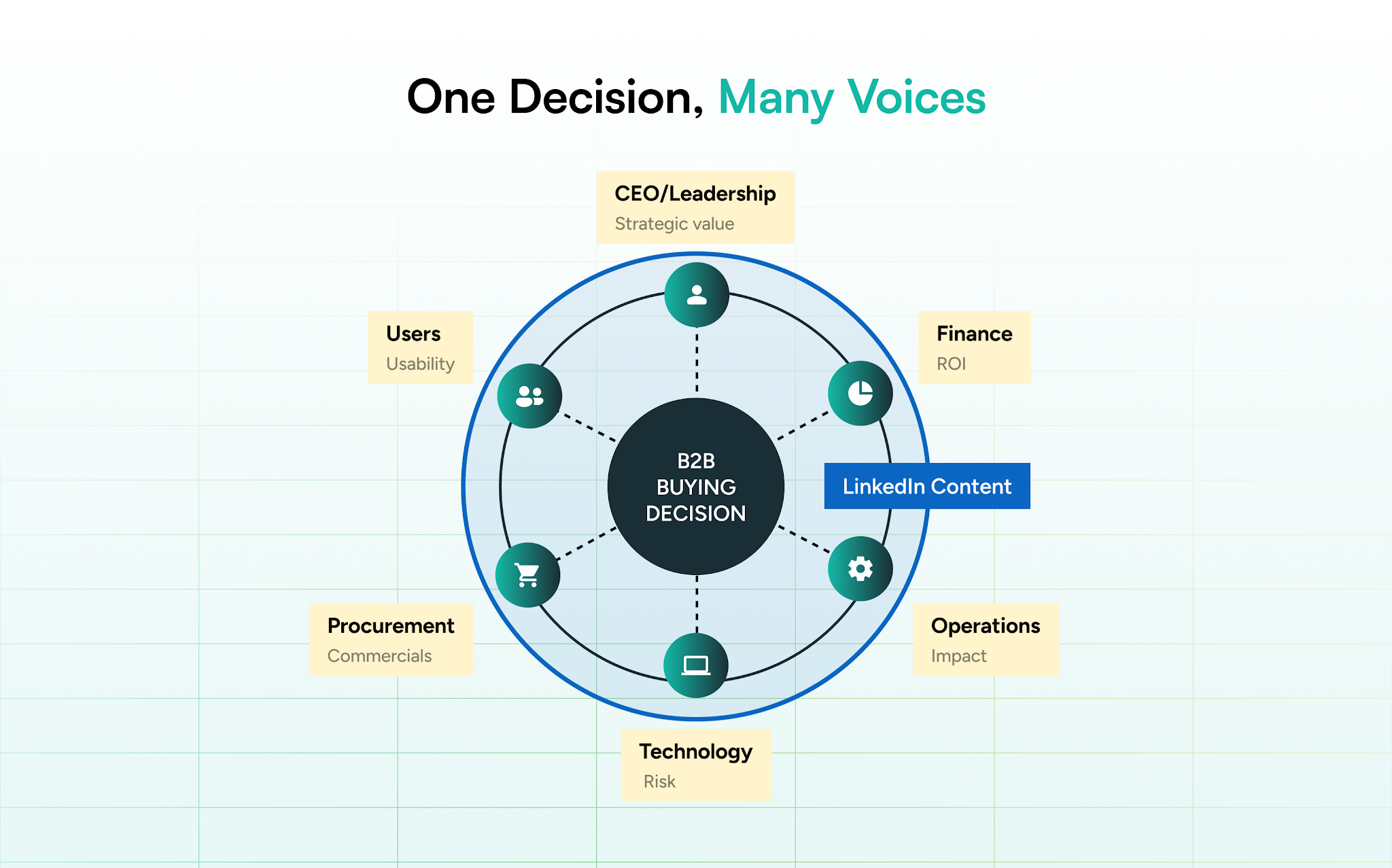
An average of 13 stakeholders are now involved in a single B2B purchasing decision. And more than 40% of deals stall because that buying group cannot reach internal alignment.
So if your LinkedIn content is written only for the person who owns the budget or is most likely to take a sales call, you may be speaking to only one part of the decision. Finance, procurement, operations, legal, technology, and senior leadership can all affect whether a vendor makes it through the buying process, even when they aren't the people actively searching for a solution.
The 2025 Edelman–LinkedIn B2B Thought Leadership Impact Report found that these hidden buyers are just as engaged with thought leadership as more visible decision-makers: 63% spend more than an hour a week consuming it, while 55% use it when evaluating vendors.
This is why a LinkedIn content strategy cannot simply be a schedule of posts, formats, or topics. For founders, that may mean developing a distinctive point of view around an industry, problem, or shift in the market. For brands, it may mean turning proprietary knowledge, customer evidence, research, and organisational expertise into content that builds credibility at scale.
The strongest strategies do both, and make sure the two reinforce each other. If the question of personal profile vs company page is about choosing the right LinkedIn assets, the next question is what those assets should actually say, and how individual pieces of content work together to build authority over time.
That requires thinking about LinkedIn content as more than a publishing exercise. A strong LinkedIn content strategy starts with what the business wants to achieve, what its audience cares about, and where it has something credible and distinctive to say. From there, the goal is to develop a consistent body of ideas that builds authority and makes your expertise recognizable to the people whose attention, trust, and decisions matter.
Position Before You Plan Content
Before deciding what to post on LinkedIn, decide what you want people to associate with you. That sounds obvious, but many B2B content strategies start several steps later. The first conversation is usually about frequency, formats, and content pillars:
How often should we post? Should the founder publish twice a week? Do we need more carousels? Should the company page share more customer stories?
Those are production questions.
The strategic question comes first: What should the market remember us for?
A publishing schedule can make a LinkedIn presence look active. It cannot, by itself, make that presence distinctive.
Buyers are not simply consuming content to find out what a company sells. They are using content to form judgments about whether the organization understands their problems and is worth considering. Therefore, a sound LinkedIn presence consistently needs to demonstrate how well you understand the problems your audience cares about.
Build a Content Territory You Can Own
A company might decide that it wants to talk about AI. A founder might choose leadership. A cybersecurity company might select cybersecurity trends. These are topics, not positions.
A more useful progression is:
Topic → Content Territory → Point of View → Content Idea
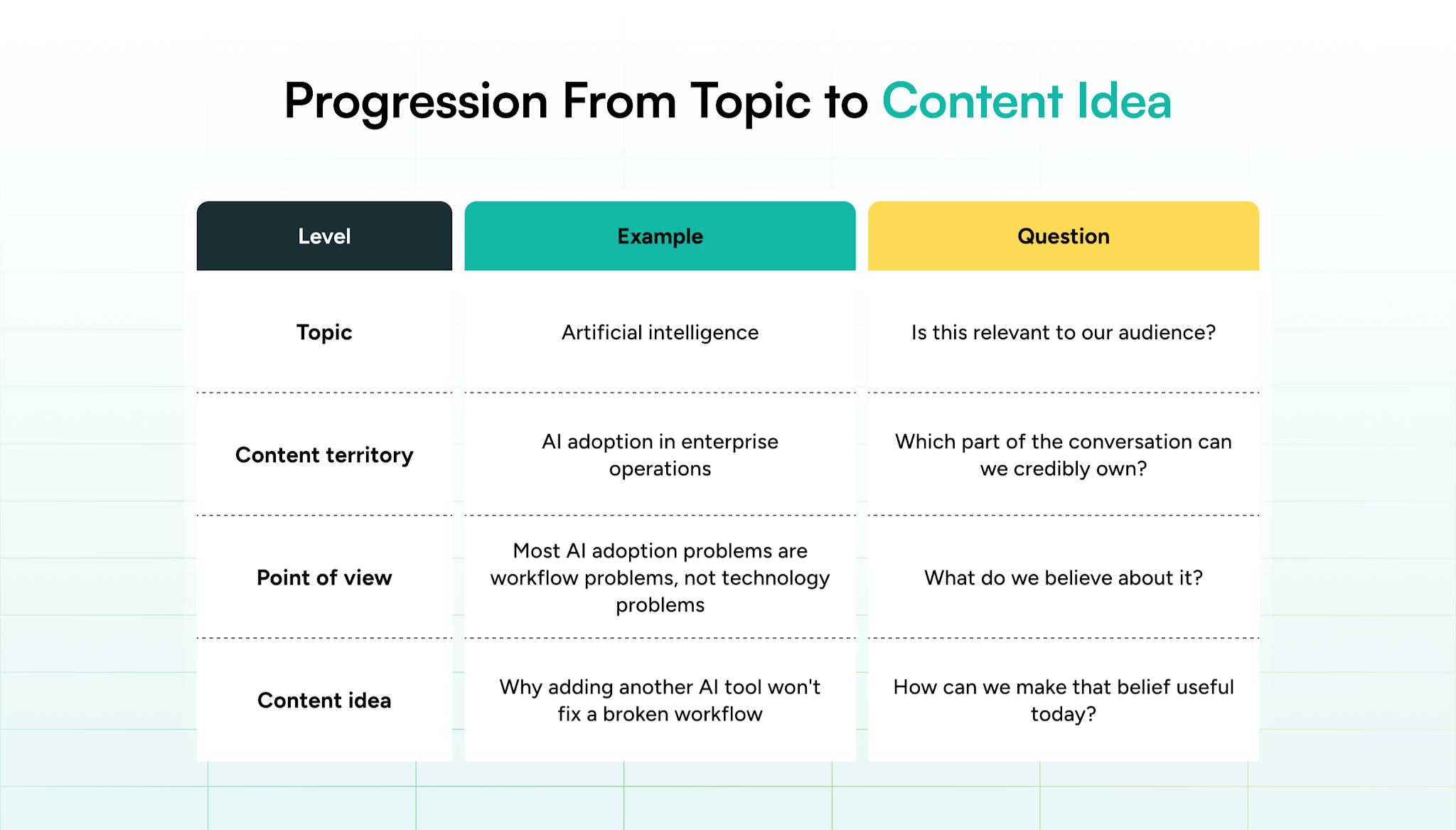
Within that territory, you can examine implementation failures, productivity claims, workflow redesign, employee adoption, investment decisions, governance, and the changing economics of software.
The Four Ingredients of a Good Content Territory
A useful content territory sits at the intersection of four things:
Expertise, Relevance, Distinctiveness and Evidence.
Expertise asks whether you genuinely know something about the subject.
This doesn't mean having a formal qualification. Founders and executives often develop valuable expertise through proximity to problems: hundreds of customer conversations, years of operating experience, difficult decisions, failed experiments, implementation projects, or patterns they have observed repeatedly.
Relevance asks whether the subject matters to the people you need to reach.
A founder may have deep knowledge of an obscure operational issue, but that does not automatically make it a useful content territory. The strongest territories sit where your expertise intersects with something your audience is actively trying to understand, navigate, or anticipate.
Distinctiveness asks whether your perspective is interchangeable with everyone else's.
This is where broad statements such as "AI is transforming business" or "great leaders need to communicate effectively" fall apart. They may be true, but they don't give the audience a reason to associate the idea with you.
Distinctiveness can come from:
- An unconventional interpretation
- A strong prediction
- A contrarian position
- A proprietary framework
- First-hand experience
- Data others don't have
- A recurring pattern you've noticed
- An assumption you believe your industry gets wrong
And then there is Evidence. Why should anyone believe you? A point of view becomes considerably more valuable when it is supported by something you have actually observed, tested, measured, or learned. That might be proprietary research, customer data, case studies, experiments, industry benchmarks, or direct operating experience.
Your Information Advantage Is Where the Territory Usually Comes From
You don't need to invent a content territory in a brainstorming session. In many cases, the strongest one is already hiding inside the organization. Founders and senior executives have an information advantage that a generic content team cannot manufacture from a keyword list.
A founder might repeatedly hear the same objection from customers. A SaaS company might see the same implementation mistake across dozens of accounts. A consulting firm might notice a pattern in how companies respond to a regulatory change. A CTO might see where AI projects consistently fail after moving from experimentation into production.
Those observations are strong raw material for effective content.
Start With What You Repeatedly Observe
Look for patterns rather than isolated anecdotes.
- What do customers misunderstand?
- What problems keep appearing?
- What do we know that competitors don't have easy access to?
- What does leadership disagree with?
- What is changing that will force our audience to rethink something?
The important part is not merely reporting the change but asking what it means for your audience. High-quality thought leadership can influence buyers before they are actively evaluating vendors. An Edelman-LinkedIn study found that 75% of global B2B decision-makers and C-suite executives said a piece of thought leadership had led them to research a product or service they were not previously considering.
Once you identify a promising subject, put it through the four tests outlined above before making it a recurring content territory.
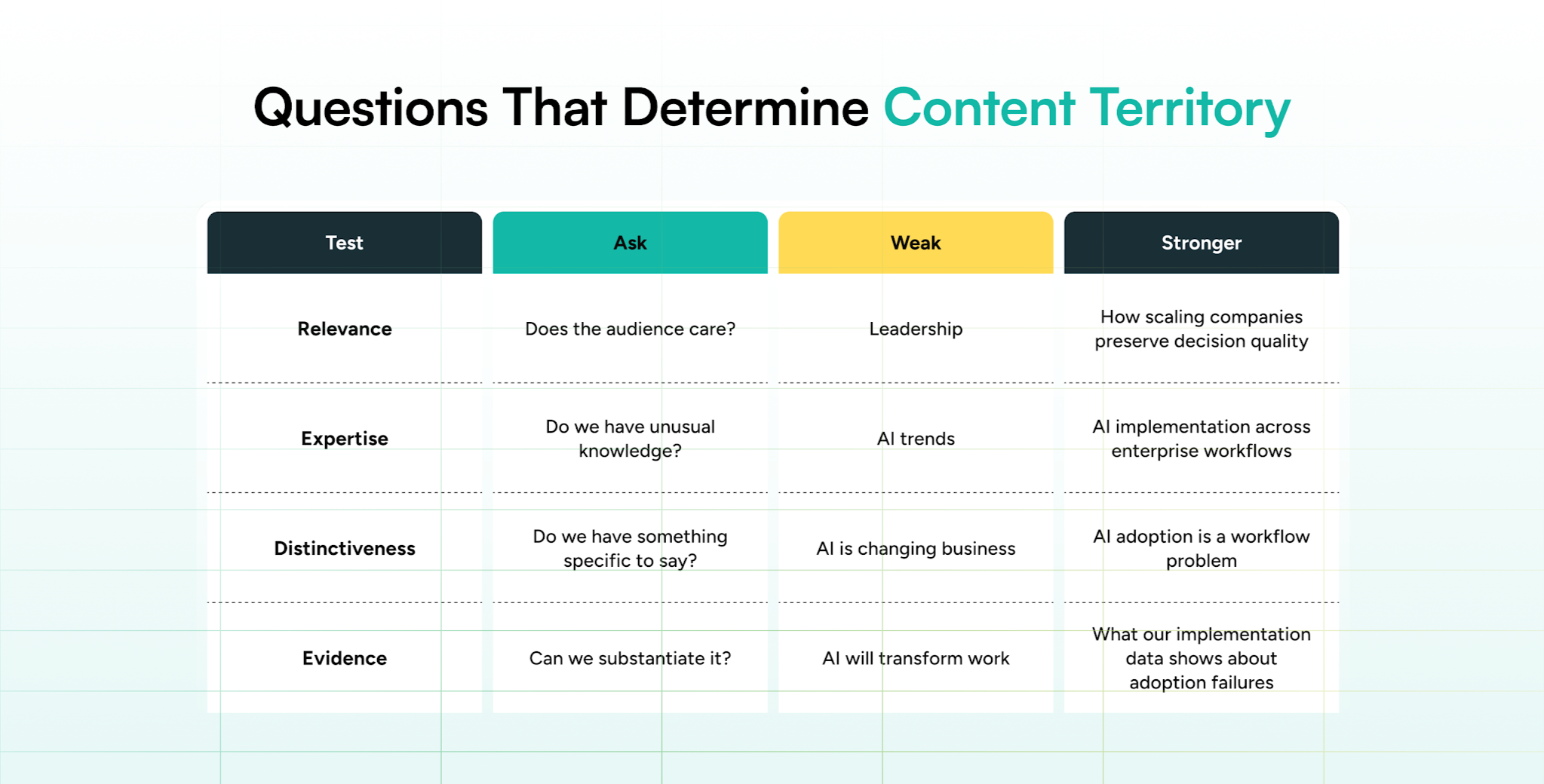
The fourth test is often neglected. A company can have a distinctive opinion without having earned the credibility to make it. But evidence turns an interesting opinion into something much closer to thought leadership.
And it gives the content team something extremely valuable: a defensible source of ideas that competitors cannot easily replicate.
Turn Expertise Into a Point of View
Knowing a subject does not automatically give you something worth saying about it.
Years of operating experience, technical depth, and firsthand exposure to difficult problems can establish expertise, but thought leadership asks you to go further.
While expertise tells people what you know, a point of view tells them how you think.
It takes an observation and asks:
- Why is this happening?
- What are people getting wrong about it?
- What does our experience suggest instead?
- What should the audience do differently?
That is where expertise becomes useful to someone beyond the person who possesses it.
A simple way to turn expertise into a point of view is to move through four stages.
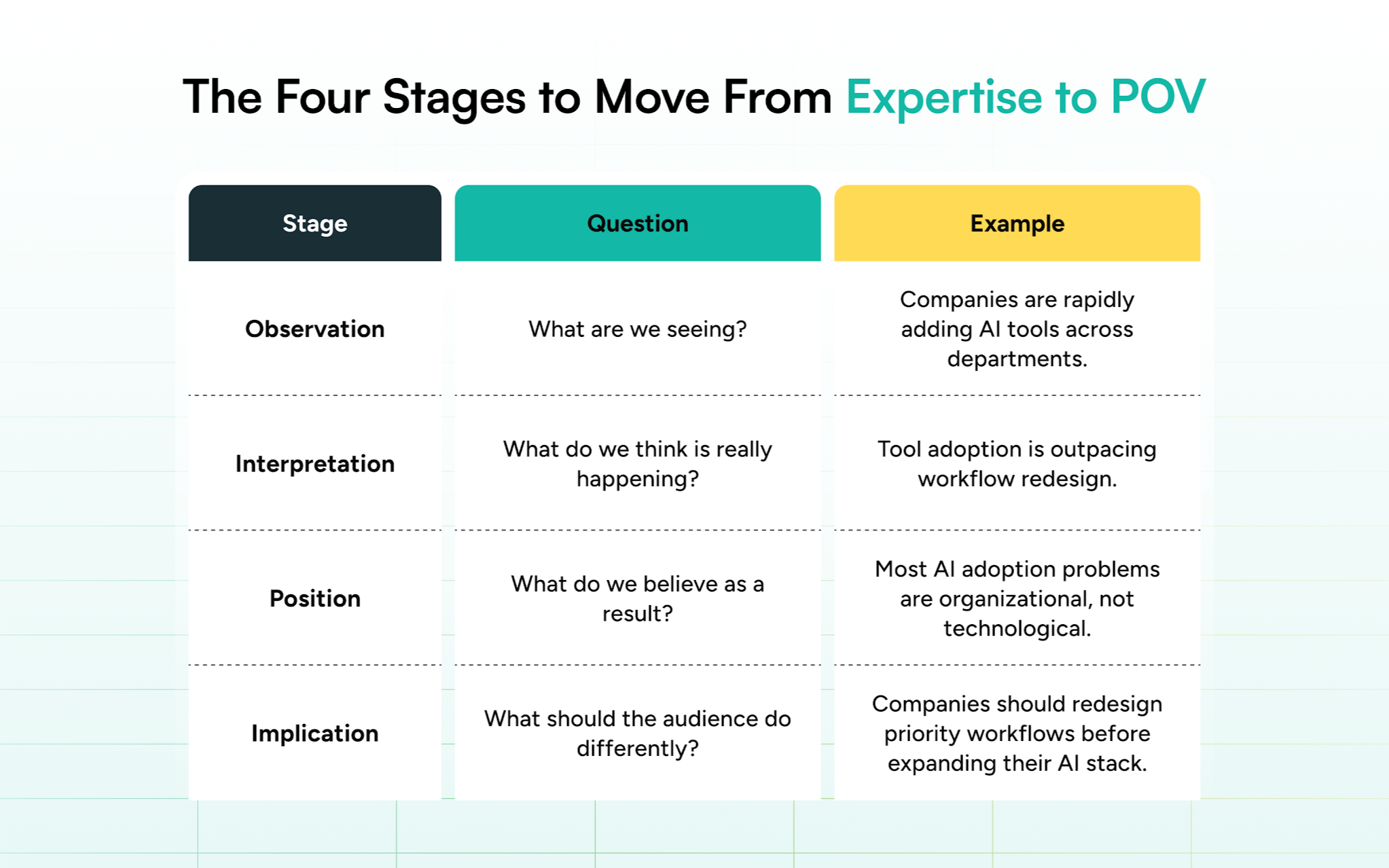
Notice what changes as you move forward. A broad observation about AI adoption becomes an explanation of the underlying problem, then a clear position, and finally a recommendation someone can act on.
Without the interpretation and position, you have an industry update. Without the implication, you may have an interesting opinion but little practical value.
The Difference Between an Opinion and a Point of View
An opinion might be: AI is going to change how companies work.
A point of view is more specific: Most companies are approaching AI as a technology deployment problem. The bigger constraint is that the workflows being automated were never designed for AI-assisted work in the first place.
The first statement is difficult to disagree with, and equally difficult to remember. The second creates a proposition that someone can examine, challenge, or apply.
It also creates multiple avenues for future content:
- Which workflows are most poorly suited to AI?
- Why do companies automate broken processes?
- What should leaders redesign before deploying AI?
- What does successful implementation actually look like?
- Where have companies seen productivity gains?
- What did we learn from implementations that failed?
A strong point of view has enough depth to sustain a larger body of thinking. It gives you a central idea to test against new evidence, explore from different angles, and develop as the market changes, rather than forcing you to start from scratch every time you need something to say.
Originality Doesn't Mean Inventing Something Nobody Has Ever Said
This is an important distinction for executives. A point of view does not need to be completely unprecedented to be valuable.
Originality can come from the combination of the idea and its source.
Two executives can make the same broad argument. One may have arrived at that conclusion after reading industry reports. The other may have reached it after observing enterprise implementations and repeatedly encountering the same workflow problem.
The conclusion may be similar, but the authority behind it is not.
The same principle applies to a founder writing about leadership. They do not need to discover an entirely new leadership principle to have something worthwhile to say. Experience at a particular scale, within a particular industry, or under unusual circumstances can produce a distinctive interpretation of a familiar problem.
A Practical Way to Extract a Point of View
For founders and subject-matter experts, the most useful questions are the ones that require you to interpret your experience rather than simply recount it:
- What surprised you?
- What did you believe five years ago that you no longer believe?
- What problem looks simple from the outside but isn't?
- What does your industry spend too much time discussing?
- What important issue isn't getting enough attention?
- What have you seen repeatedly that isn't reflected in conventional advice?
- What decision would you make differently now?
- Where does your experience contradict the prevailing narrative?
These questions move the conversation away from information the company can simply look up and towards knowledge that has been earned. That is exactly where the strongest executive content starts surfacing.
Point of View That Creates Tension
One final test can make this process considerably sharper: What would someone reasonably disagree with here?
Not that every LinkedIn post needs to provoke an argument, but a meaningful position can contain some tension. It also gives the audience something to evaluate against their own experience. That is the role of a point of view in a strategic LinkedIn system. It gives expertise a clear direction.
And once that direction is clear, individual posts no longer have to carry the burden of establishing authority from scratch. They become expressions of a larger way of thinking.
Build a Content Architecture, Not a List of Pillars
Understanding what you want to be known for is only the beginning. The next challenge is turning that strategic position into enough content to sustain a LinkedIn presence without making every post feel like a variation of the same idea.
The traditional content pillar model falls short here. A typical content plan might say:
- Leadership
- Industry insights
- Company culture
- Customer stories
- Product
That gives a team categories to fill. But categories don't tell you how the pieces should relate to one another.
You can publish five posts under "industry insights" and still end up with five disconnected observations. You can publish a customer story, a founder opinion, and a research post in the same week without any of them reinforcing what you want the audience to remember.
Plenty of content ideas can still result in a broken LinkedIn presence without a system that connects them into a coherent body of work.
Think in Layers, Not Categories
A useful content architecture has five layers:
Each layer solves a different problem.
1. Strategic Narrative
This is the broad idea you want your content to reinforce over time. Think of it as the underlying argument that connects the content. For example, a B2B consulting firm might want to build a reputation around the thought that “Growth is more sustainable when companies have systems connecting individual functions rather than optimizing each one.”
That narrative can support different conversations about sales, operations, customer experience, leadership and organizational design.
2. Content Territories
Territories are the recurring areas through which that narrative gets explored.
For the consulting firm above, those might include:
- Organizational design
- Cross-functional decision-making
- Customer experience
- Operating models
- Leadership at scale
The territories give the strategy breadth without allowing it to become completely open-ended.
3. Content Angles
One territory can support multiple angles. For instance, you could approach cross-functional decision-making through:
- A common misconception
- Customer examples
- Framework
- Industry development
- A failure
- A prediction
- Data points
- Counterargument
That gives you consistency without repetition.
4. Evidence
Evidence prevents the architecture from becoming an abstract collection of opinions. Each angle should have something behind it:
- Customer evidence
- Proprietary research
- Internal data
- Case studies
- Executive experience
- External research
- Benchmarks
- Experiments
- Observed patterns
The same idea can also be supported by different types of evidence. For example, a post arguing that poor handoffs are damaging customer experience might use a customer story in one instance, internal data in another, and an executive's own experience in a third.
The argument remains consistent while the evidence keeps the content fresh.
5. Formats
Only now should you decide how the idea should appear. Format comes last.
Starting with "We need two carousels this week" reverses the process. You end up looking for ideas that fit the format rather than choosing the format that best communicates the idea.
What you produce and what works are not necessarily the same thing. Format should therefore be treated as a strategic decision, not a fixed content quota.
Give Every Piece of Content a Specific Purpose
Your architecture only becomes useful when you think about what every piece of content is meant to accomplish. A strong content system should give individual pieces different jobs.
Establish Authority
Demonstrate that the person or organization understands a subject at a level worth paying attention to. This might come through analysis, original research, a sophisticated framework or an informed interpretation of an industry issue.
Create Relevance
Connect expertise to something the audience is dealing with now. The objective isn’t simply to be knowledgeable, but to make that knowledge matter.
Differentiate
Give the audience a reason to see your perspective as distinct from the alternatives. This could be a different argument, methodology, interpretation, or approach.
Build Trust
Show the thinking behind the claims. Customer evidence, transparency about mistakes, lessons from experience, and concrete examples can make an abstract proposition more believable.
Educate
Help the audience understand something they genuinely need to understand.
This is particularly useful for complex B2B businesses where the buyer may need to understand a problem before they can appreciate the solution.
Create Conversation
Give people something worth responding to. Not every post needs to ask a question at the end. A strong disagreement, useful observation, or unresolved tension can create conversation naturally.
Create Commercial Proximity
Help the right people understand where your expertise intersects with their business needs. This does not mean turning the feed into a stream of product promotion. A post explaining a problem exceptionally well can create commercial relevance without mentioning the product at all.
Think of the Entire Feed as a Body of Work
Imagine someone discovers a founder through one post and visits their profile. They see another post from two weeks earlier about a related issue, then find a customer example from the month before. They come across a framework that approaches the same broad problem differently, followed by a company research report that supports one of the founder's arguments.
Individually, these are separate assets. Together, they create something much more powerful: a recognizable body of thought. Each piece can stand on its own while contributing to a larger, consistent way of thinking.
Make Founder and Brand Content Work as One System
A founder's LinkedIn presence and a company's LinkedIn presence should not feel like two unrelated publishing programmes. But they also shouldn't sound as though the same person wrote both.
The better approach is to give each a distinct role within the same coherent system. People and brands bring different kinds of credibility to the conversation.
The Founder Brings the Human Interpretation
A founder can explain why something matters because they have experienced it directly. Their strongest content can come from decisions they have made, mistakes they have learned from, patterns they have noticed, or convictions they have developed through years of operating.
Founder content can therefore contribute:
- Experience — what they have actually seen or done
- Interpretation — what they think a development means
- Conviction — what they believe the market gets wrong
- Lessons — what experience has taught them
- Predictions — where they think the market is heading
- Leadership perspective — how they make decisions and navigate change
The value is not simply that a founder is more visible. It is that their perspective can put a human voice behind the company's expertise.
The Brand Brings Institutional Depth
The company has access to a different pool of knowledge. It may have years of customer data, research across multiple markets, case studies, product intelligence, or patterns that become visible only at organizational scale.
Brand content can contribute:
- Research that supports or challenges a market assumption
- Data that gives an argument greater weight
- Customer evidence that shows how a problem plays out in practice
- Institutional knowledge accumulated across teams and markets
- Case studies that demonstrate outcomes
- Market intelligence gathered through the organization's broader vantage point
This creates a suitable division of labour: the founder can make the argument, while the organization can give that argument depth, evidence, and scale.
Think in Terms of a Content Flywheel
The two channels should therefore feed one another rather than operate independently.
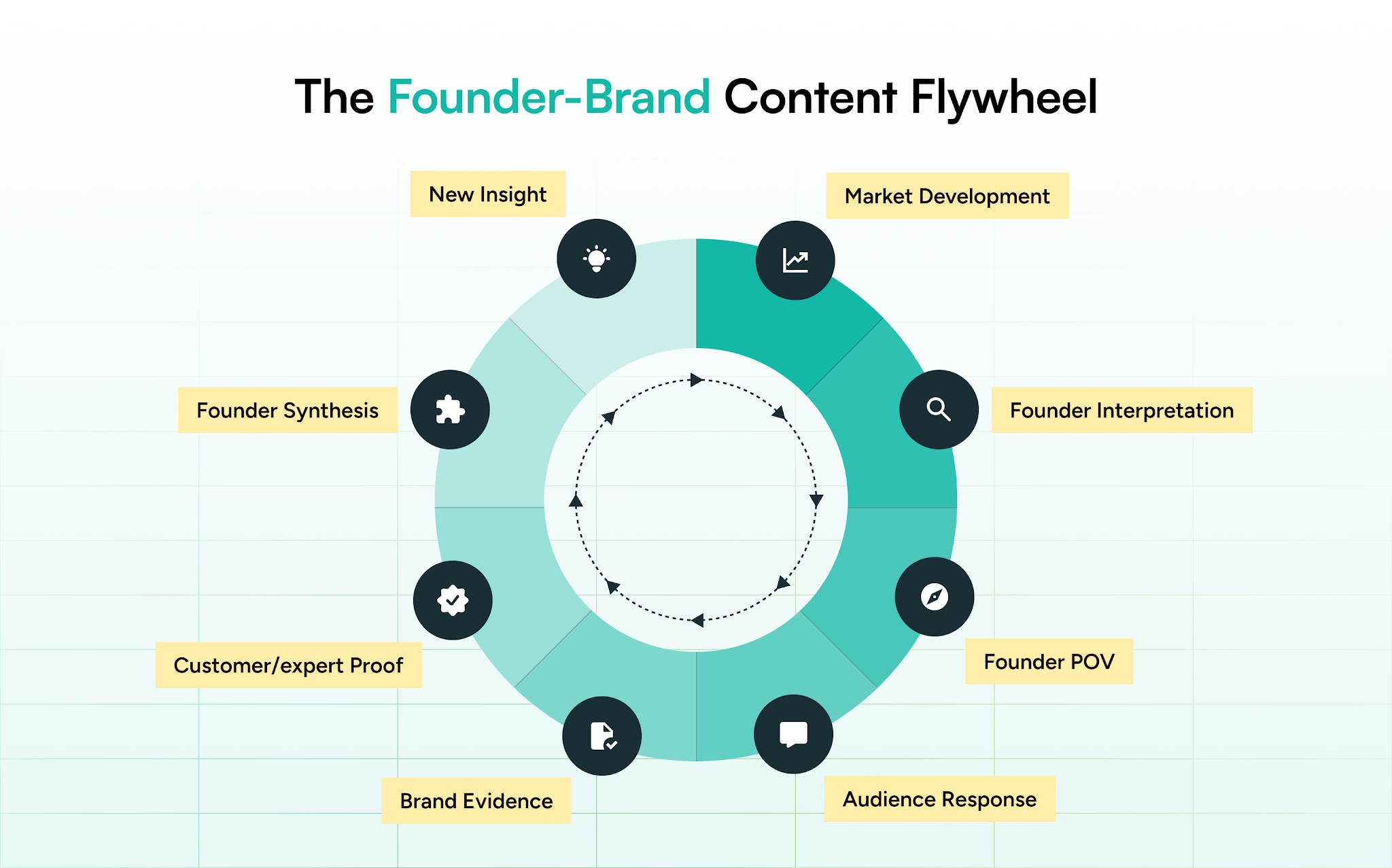
For example, a founder might respond to a change in the market with an argument based on what they are seeing in customer conversations. The resulting discussion reveals a recurring question. The company can then investigate that question using its research, customer data or internal expertise. That evidence becomes a deeper brand piece, which gives the founder new material to interpret from another angle.
The content has now moved forward rather than simply being republished. This is what makes the system cumulative. It also prevents a common problem with founder-led content: making the executive responsible for constantly generating new ideas from scratch.
Instead, the organization becomes an intelligence engine behind the founder's voice, while the founder gives that intelligence a perspective people can recognize.
And the reverse is equally important. The brand should not simply turn every founder post into a company-page rewrite. If the founder has raised an interesting argument, the company's role is to add something the founder could not provide alone: evidence, research, customer experience, scale, or a broader organizational perspective.
The result is a connected content ecosystem rather than two feeds competing for attention. The founder makes the expertise memorable, and the brand makes it scalable.
Match the Content to the Moment
One crucial question is how a LinkedIn content strategy should respond to what is happening in the market and how audiences are behaving.
A content strategy should provide direction without becoming a script. The market changes, audience attention shifts, and new conversations emerge. A strong system leaves enough room to respond without abandoning the strategic position you have built.
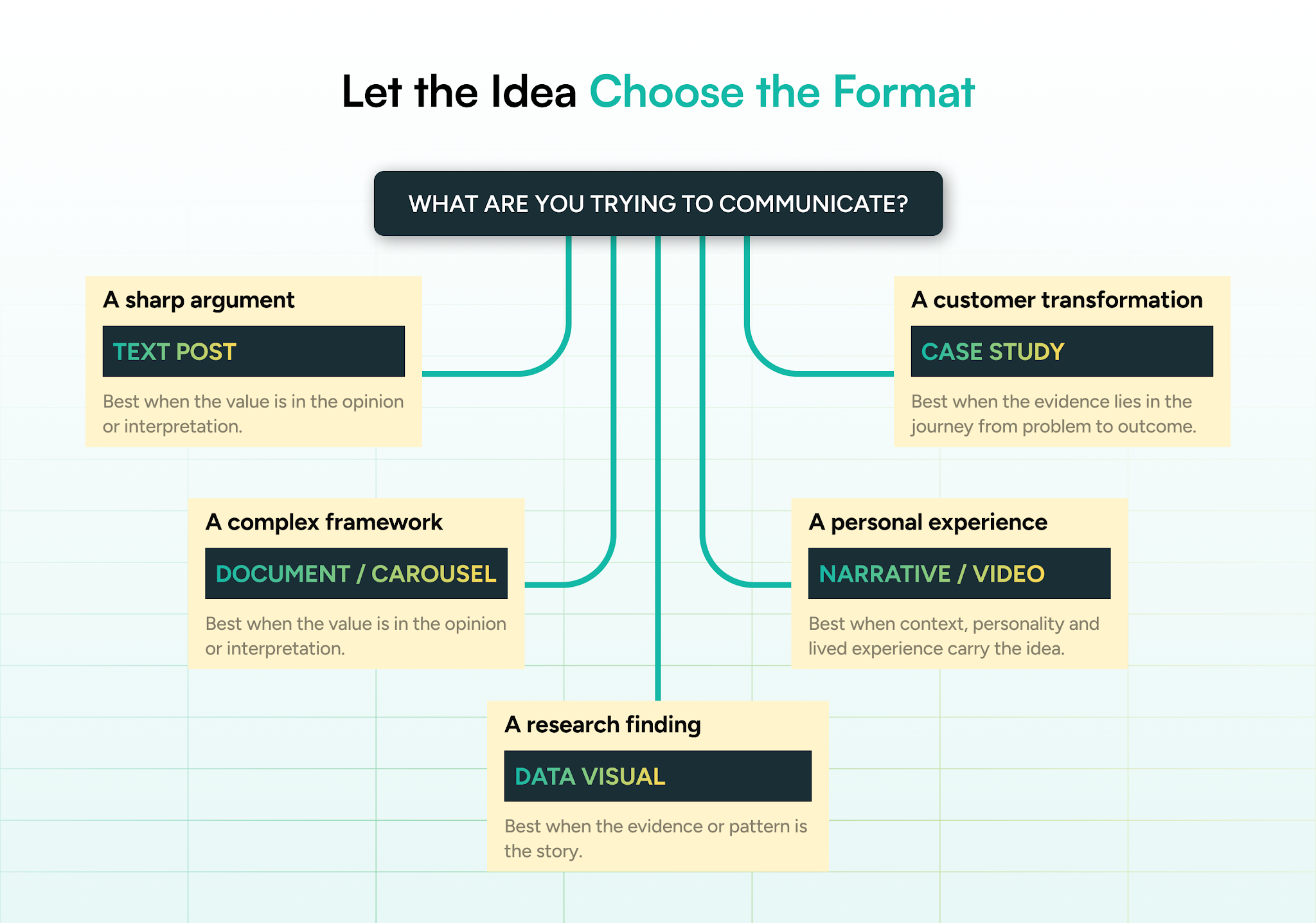
Format Should Follow the Idea
The format should serve the thought. Choosing a format simply because it is popular can force a good idea into a structure that does not serve it well.
Cadence Should Follow Resources
There is no universally correct number of posts a founder or brand should publish each week. A frequency that is manageable for one organization may dilute the quality of another's content.
The right cadence is the highest frequency at which you can maintain quality.
That means considering the availability of subject-matter experts, access to original insights, production resources, and the time required for review and approval. A slower cadence with consistently strong ideas can create more value than a busy publishing schedule filled with interchangeable content.
Cadence should also be flexible. A major industry development may justify publishing sooner than planned, while a quiet period may be better used to develop a stronger piece rather than manufacture something for the sake of maintaining a schedule.
Engagement Becomes Intelligence
Comments and conversations reveal the language your audience uses, the objections they have, the assumptions they disagree with, and the questions your existing content hasn't answered.
Pay attention to:
- Objections — What makes people challenge the argument?
- Questions — What requires further explanation?
- Misconceptions — What does the audience consistently misunderstand?
- Language — Which words and phrases do they naturally use to describe the problem?
- Emerging concerns — What issues are beginning to surface repeatedly?
- Future opportunities — Which conversations deserve a deeper piece of content?
This turns engagement into a feedback mechanism rather than simply a distribution exercise.
The result is a strategy that becomes more responsive over time: the market influences what you address, the idea determines how you present it, available resources determine how often you publish, and audience response helps determine what you develop next.
Measure Whether You're Building Authority
A LinkedIn content strategy can generate impressive numbers without building any value. A post might reach thousands of people, for example, but if those people have little relevance to the business, the number tells you very little about whether the strategy is working.
A better approach is to evaluate performance at three levels.
Level 1: Content Performance
Look at the immediate signals around individual pieces of content: reach, saves, shares, and meaningful engagement. These help identify which ideas are attracting attention and which formats or angles are prompting people to respond.
But this is the most superficial layer. Attention is useful, but it is not the same as authority.
Level 2: Authority
This is harder to measure but more useful. Are the people you actually want to reach engaging with the content? Are you being mentioned in relevant conversations? Are founders being invited to speak, contribute expertise, or comment on industry developments? Are people approaching the organization because they recognize its expertise in a particular area?
These are signs that the content is moving past visibility and beginning to build recognition and credibility.
Level 3: Business
The final measure is whether the authority being built is creating meaningful opportunities. That could show up as qualified conversations, pipeline influence, partnerships, recruitment interest, investor conversations or inbound opportunities that can be traced back to the organization's growing visibility and credibility.
Not every LinkedIn interaction will have a direct commercial outcome, and it shouldn't. The purpose of measurement is to understand whether the broader system is moving in the right direction.
The three levels should therefore be considered together. A post that performs well can reveal a useful idea. Repeated recognition around that idea can indicate growing authority. When that authority starts opening relevant doors, the content strategy is doing its job.
Build a Feedback Loop
Every piece of content gives you information about what your audience finds relevant, what they question, and which ideas are worth developing further.
The process should therefore look less like a fixed calendar and more like a continuous loop:
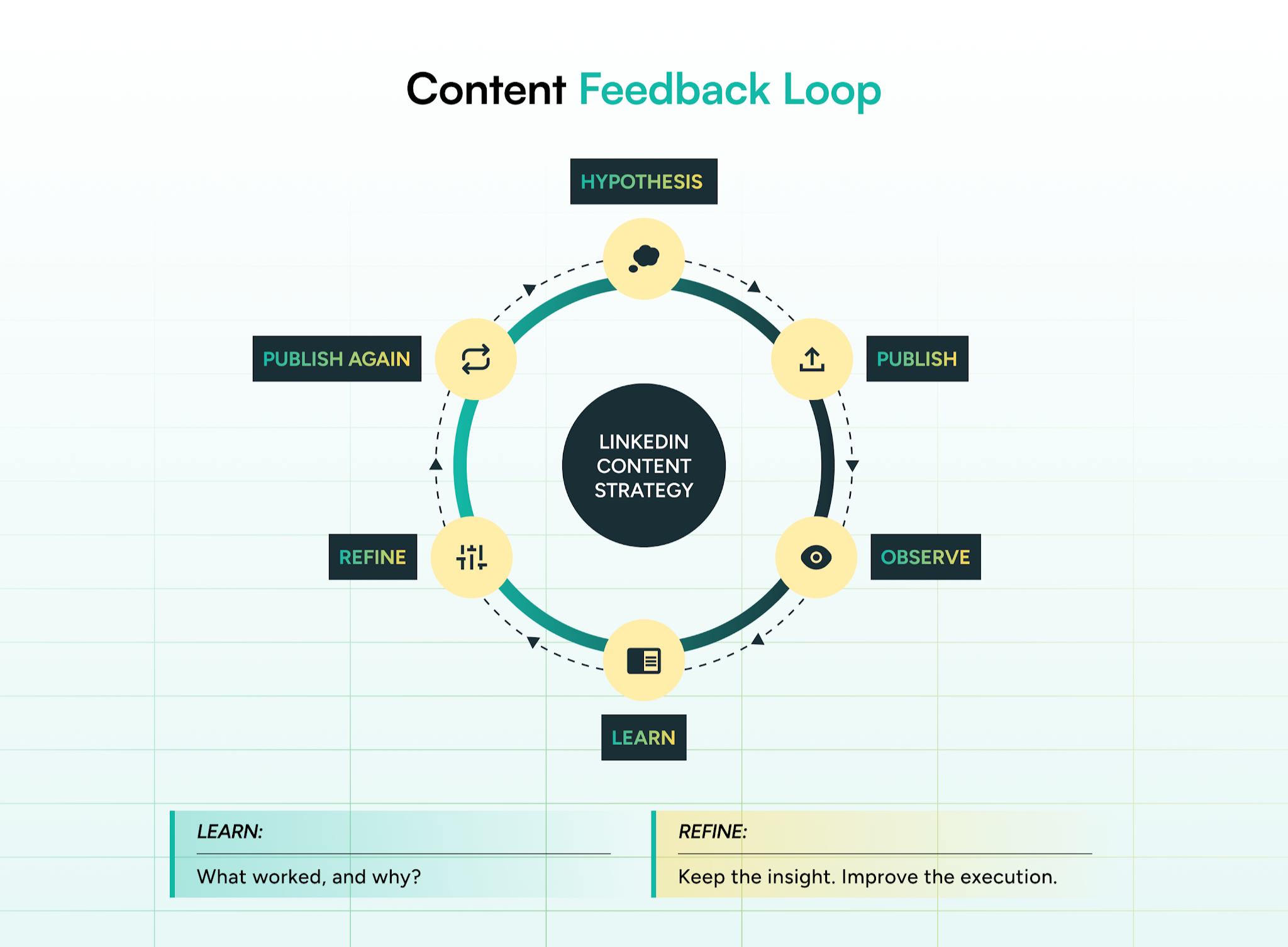
The important part is what happens between publishing and creating the next piece.
A post that performs well shouldn't automatically become a template for the next 10 posts. Instead, look at why it worked.
- Did it attract the right audience?
- Did the argument resonate?
- Did people challenge the assumption?
- Did it create meaningful conversations?
- Did it reinforce the territory you want to own?
- Did it produce a useful business signal?
Likewise, weaker performance is not necessarily a reason to abandon an entire topic. The angle, timing, format, or lack of evidence may have limited its effectiveness even if the underlying idea was strong.
Over time, you should become better at recognizing which ideas deserve attention, which arguments strengthen your position, and which content creates noise without contributing much to the broader strategy.
Conclusion
The real test of a LinkedIn strategy lies in the outcome rather than publishing cadence. It is whether, after a consistent few months, the right people have started to associate your name with a particular way of thinking.
That doesn’t happen with one exceptional post. It comes from the accumulation of consistent ideas, credible evidence, and recognizable perspectives. Over time, individual pieces stop functioning as isolated updates and start forming a larger body of thinking that tells the market what you understand, what you believe, and where your expertise sits.
For founders, that means LinkedIn can become an extension of how they lead and think, not another channel demanding constant performance. For brands, it can turn institutional knowledge into an asset that compounds with every useful insight shared. And when the two work together, everything they say contributes to the same market position.
If you want to build that kind of strategic presence for yourself or your organization, GrowedIn helps founders and brands turn expertise into a distinctive LinkedIn presence built around clear positioning, credible thought leadership, and long-term authority. Feel free to schedule a call to see what that could look like for your brand.

Frequently Asked Questions
What is a LinkedIn content strategy for founders and brands?
It is a structured approach to deciding what a founder or brand should communicate, who it should reach, what it should be known for, and how its content contributes to broader business objectives.
How is a content strategy different from a LinkedIn content calendar?
A content calendar determines when and what you publish, while a content strategy determines why you are publishing it, what you want to be associated with, and how individual ideas build toward that position.
Should founders and company pages post the same content?
Not necessarily. They should work from the same strategic direction while contributing different perspectives: founders can bring experience, interpretation, and conviction, while brands can provide research, data, customer evidence, and institutional expertise.
How do I find the right content territory for my LinkedIn strategy?
Look for the intersection of what your audience cares about, what you have genuine expertise in, what you can say distinctively, and what you can support with credible evidence.
How often should a founder or brand post on LinkedIn?
There is no universally effective posting frequency; the right cadence is the highest frequency at which you can consistently maintain the quality, relevance, and strategic value of your content.
What makes LinkedIn content thought leadership rather than just expertise?
Expertise tells people what you know, while thought leadership adds interpretation and a defensible point of view that helps the audience understand an issue differently.
The Strategic LinkedIn Content Framework for Founders and Brands
- A strong LinkedIn strategy starts with the market position you want to build, not a publishing schedule.
- Move from broad topics to focused content territories, distinctive points of view and specific content ideas.
- Turn expertise into original thinking by combining observation, interpretation, position, and evidence.
- Build a content architecture that connects individual posts to a larger strategic narrative.
- Give founders and brands distinct roles while keeping them aligned around the same strategic centre.
- Let the idea determine the format and let available resources determine the publishing cadence.
- Measure the strategy through attention, authority, and business impact rather than vanity metrics alone.
- Use audience response as a feedback loop to make the strategy more precise over time.


Insights Hub

LinkedIn Analytics: Metrics to Track and How to Use Them
Employer Branding on LinkedIn