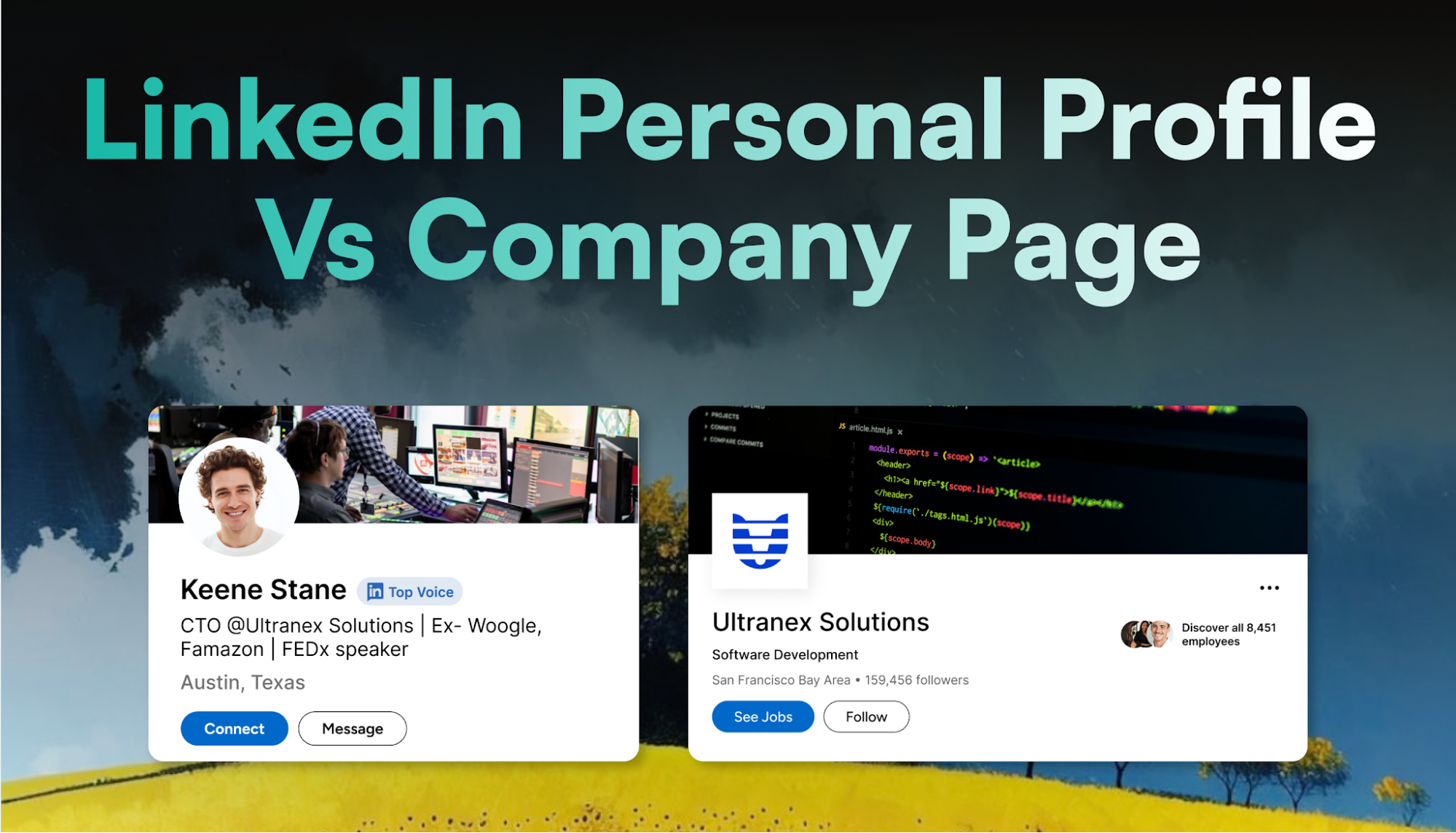
A founder shares a thoughtful post on LinkedIn. It sparks conversations, attracts comments from industry peers, and may even lead to a few inbound inquiries.
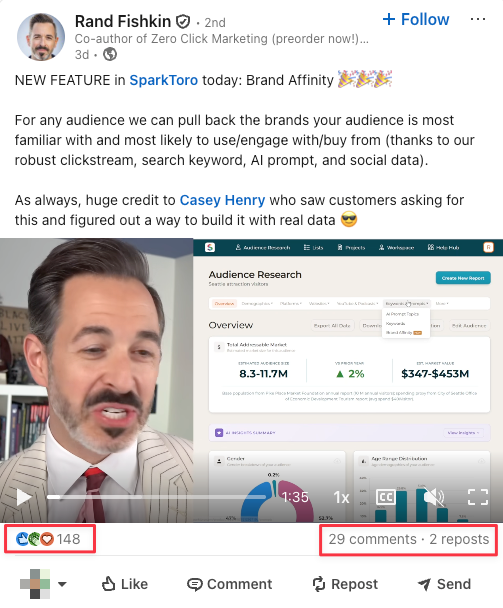
Around the same time, the company's LinkedIn page publishes a nearly identical message, yet barely anyone notices.
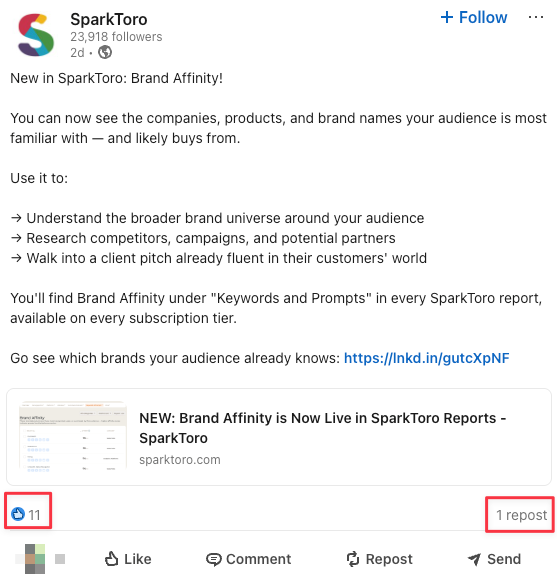
It's a scenario many businesses are familiar with, because people engage with other people differently than they engage with brands.
As more professionals turn to LinkedIn to learn from people as much as companies, founders and executives often face a practical question: Should you focus on building your personal profile first, or invest in your company page from the start?
The answer isn't necessarily one or the other. Understanding which asset creates momentum first, and how each contributes to your broader LinkedIn marketing strategy, can help you make better decisions about where to invest your time and effort.
In this guide, we'll compare the strengths of LinkedIn company pages and personal profiles, explain where each delivers the most value, and help you decide where to focus your efforts based on your business goals.
Why the LinkedIn Company Page vs Personal Profile Decision Is Important
The decision to invest in a LinkedIn company page or a founder's personal profile reflects how B2B buying has evolved.
Today's buyers don't wait for sales conversations to begin their research. They educate themselves independently, compare vendors, and evaluate the people behind a business long before filling out a contact form. As a result, your LinkedIn presence has become an extension of your company's credibility.
The question is no longer whether your business should be active on LinkedIn. It's where to focus your efforts, so they generate the greatest impact.
Buyers Research Both Companies and the People Behind Them
Modern B2B buyers go beyond the business website. They'll visit your LinkedIn company page to understand what your organization does, but they'll also click on your founders, executives, and leadership team to understand who they're buying from.
Company pages communicate what a business offers, while executive profiles reveal the expertise, perspectives, and people behind those claims.
LinkedIn's recent Trust Advantage research found that 88% of buyers say seller engagement is most valuable during the middle stages of the buying journey, when they're comparing vendors and looking for reassurance before making a decision. In other words, expertise from real people often has the greatest influence precisely when purchase decisions are being made.
Decision-Makers Trust People More Than Logos
One reason founder-led content performs so well is that people naturally engage with individuals more than organizations.
A Boston-based marketing agency analyzed the performance of seven employee LinkedIn profiles against its company page over the same period. The results showed that personal profiles generated 2.75× more impressions and 5× more engagement per post, despite having 46% fewer followers on average.
The implication is that reach isn't determined just by audience size; it also depends on who is publishing the content. Buyers are more inclined to respond to opinions, experiences, and expertise shared by a founder or executive than to similar updates published by a corporate account.
Organic Reach Has Shifted Toward Individuals
LinkedIn's algorithm rewards content that generates meaningful conversations instead of one-way corporate announcements.
Another analysis by the same agency normalized performance by follower count to compare distribution efficiency, not just raw reach. Even after accounting for audience size, employee profiles consistently outperformed the company's LinkedIn page in both impressions and engagement, suggesting that the advantage isn't simply a result of having more followers; it's rooted in how LinkedIn distributes content from people versus brands.
For founders, this means a thoughtful post from a personal profile can often reach and influence more prospective buyers than the same message published exclusively through the company page.
Modern B2B Buying Is Relationship-Driven
B2B purchases are rarely impulsive. They're built on confidence, familiarity, and trust developed over multiple interactions.
A founder or executive who consistently shares industry insights, comments on emerging trends, or offers practical lessons builds familiarity long before a prospect enters a buying cycle. By the time that prospect visits the company page, the business already benefits from the credibility established by its leadership.
That's why the most effective LinkedIn strategies don't treat personal profiles and company pages as competing channels. They assign each a distinct role.
A founder's personal profile is the engine for visibility, thought leadership, and relationship building. A LinkedIn company page acts as the organization's official destination that reinforces credibility, showcases products and services, supports recruitment, and serves as the foundation for paid campaigns.
Together, they create a stronger B2B LinkedIn strategy than either could achieve on its own.
Understanding the Role of a LinkedIn Company Page
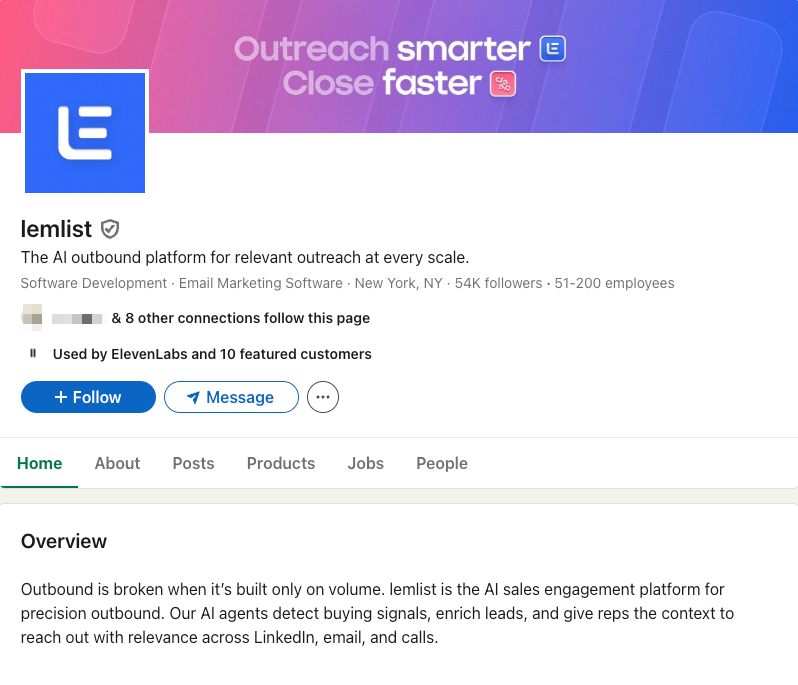
A LinkedIn company page is not merely a social media profile. It's your organization's official identity on the platform. While personal profiles drive conversations, company pages provide the context and credibility that prospects look for before taking the next step.
Think of it as your business's digital headquarters on LinkedIn. Once a founder's post sparks interest, the company page is where buyers can look to validate what they've learned.
Your Business's Official Identity
A company page is the one place where your organization controls its narrative. It brings together your brand story, company description, website, products and services, industry focus, employee count, and key updates into a single destination.
For prospects researching your business, this becomes a trusted reference point. An active, well-maintained page signals that the company is legitimate, engaged, and invested in its professional presence.
Strengthening Employer Branding
Potential candidates often evaluate an organization long before submitting an application. They're looking beyond job descriptions to understand company culture, leadership, employee achievements, and recent milestones. A consistently updated company page helps showcase these aspects, making it easier to attract talent that aligns with your organization's values and vision.
This becomes even more valuable as your team grows and hiring becomes a strategic priority rather than an occasional activity.
Showcasing Products and Services
Unlike a personal profile, a company page provides a structured space to present what your business actually offers.
Whether you're launching a new product, publishing customer success stories, announcing partnerships, or sharing industry reports, your company page acts as a centralized repository of business information. It allows prospects to understand your offerings without relying solely on your website.
For B2B organizations with multiple solutions or business units, this centralized presence becomes especially valuable.
Enabling Recruitment and Paid Campaigns
Some of LinkedIn's most powerful business features are tied directly to company pages.
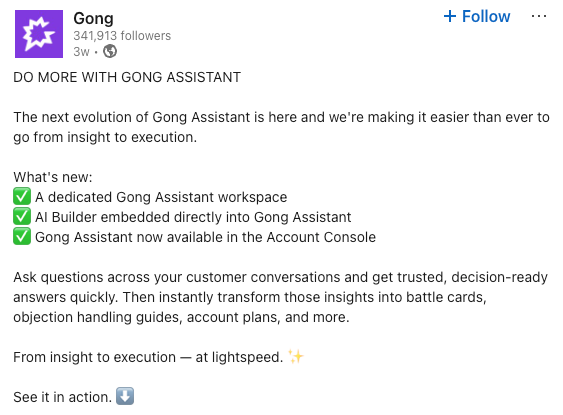
Recruiters use them to promote open roles and strengthen employer branding, while marketing teams rely on them to run Sponsored Content, Lead Gen Forms, and other advertising campaigns. These capabilities make company pages essential for organizations looking to scale demand generation or talent acquisition.
In other words, while personal profiles excel at building relationships organically, company pages provide the infrastructure needed for broader marketing and recruitment initiatives.
Where LinkedIn Company Page Management Matters
Simply creating a LinkedIn company page isn't enough. Its value depends on how consistently it's managed.
For many B2B buyers, your company page is one of the last stops before they decide whether to engage with your business. After discovering a founder's post or hearing about your company through a referral, they'll often visit your page to verify who you are, what you do, and whether your brand appears credible.
Effective LinkedIn company page management ensures your page remains active, relevant, and aligned with your broader brand strategy.
Consistent Publishing Keeps Your Brand Relevant
A dormant company page can make an active business look inactive. Regular publishing demonstrates that your organization is growing, innovating, and engaged with its industry.
A healthy content mix should include product launches, customer success stories, company milestones, educational insights, event highlights, and behind-the-scenes moments. These updates not only keep followers informed but also give prospects confidence that they're evaluating a business that's actively investing in its market presence.
Consistency also creates more opportunities for your content to be amplified through employee networks, extending its reach beyond your existing followers.
Employee Advocacy Extends Your Brand's Reach
One of the most overlooked advantages of a LinkedIn company page isn't its own audience. It's the audience connected to your employees.
Every time an employee shares, comments on, or reposts company content, that message reaches entirely new professional networks that the company page may never access organically.
This reinforces an important principle: people are more likely to engage with content when it comes from someone they know or trust than from a corporate account.
Rather than encouraging employees to simply repost company updates, encourage them to add their own perspective. A founder explaining the reasoning behind a product launch or a sales leader sharing lessons from a customer conversation often creates far more meaningful engagement than a standard corporate announcement.
Performance Analytics: Turn Activity Into Strategy
Posting consistently is only valuable if you understand what's working.
LinkedIn's analytics provide insights into follower growth, impressions, engagement rates, audience demographics, and top-performing posts. Over time, these metrics help marketing teams identify the topics, formats, and publishing patterns that resonate most with their audience.
Analytics also help connect content performance with business objectives. If customer stories consistently outperform product announcements, that may indicate buyers respond more strongly to proof than promotion. If hiring posts generate exceptional engagement, it may be worth investing more in employer branding content.
Instead of measuring success solely by follower growth, focus on metrics that indicate meaningful engagement and business impact.
Brand Consistency Reinforces Trust
Your LinkedIn company page doesn't exist in isolation.
A prospective customer might discover your founder through a thought leadership post, visit your company page, browse your website, and read customer testimonials: all within a few minutes. Every touchpoint should reinforce the same message about who you are and what your business stands for.
From your visual identity and company description to the tone of your posts, every element should support a consistent brand experience. When your company page and leadership profiles reinforce the same positioning, prospects are more likely to perceive your business as credible, established, and trustworthy.
The Takeaway
A LinkedIn company page isn't just another social profile; it's a strategic business asset. Consistent publishing keeps your brand visible, employee advocacy expands your reach, analytics sharpen your strategy, and brand consistency boosts buyer confidence.
However, even the most well-managed company page has one inherent limitation: it isn't where most conversations begin. That's why, for many founders and B2B organizations, personal profiles often become the primary driver of visibility and engagement, a distinction we'll explore in the next section.
Where LinkedIn Company Pages Fall Short
Despite their importance, company pages aren't designed to replace personal profiles.
One of the biggest challenges is organic visibility. Brand pages generally receive lower engagement than individual profiles because LinkedIn users are more likely to interact with people than with organizations. This often makes audience growth slower and reduces the reach of purely organic content.
Company pages also have fewer opportunities to cultivate authentic conversations. While followers can react and comment, brands rarely participate in discussions with the same authenticity, personality, or spontaneity as founders and executives. As a result, interactions often feel more transactional than relational.
None of this makes company pages less valuable; it simply clarifies their role. They're excellent at validating a business, communicating official updates, and supporting recruitment and paid marketing. But when it comes to building trust, starting conversations, and expanding organic reach, they're most effective when complemented by active leadership profiles.
Why Personal Profiles Usually Outperform Company Pages
If company pages establish credibility, personal profiles create the momentum that gets people there in the first place.
That's because LinkedIn is fundamentally a professional networking platform. Users log in to learn from industry peers, follow experts, and participate in conversations, not just consume brand updates. As a result, founders and executives often benefit from greater visibility and engagement than company pages, even when they're sharing similar content.
LinkedIn Rewards Conversations, Not Broadcasts
LinkedIn's algorithm is designed to surface content that generates meaningful interactions. Posts that spark comments, discussions, and back-and-forth conversations are more likely to be shown to a wider audience than one-way announcements.
This naturally favors personal profiles. Founders and executives can respond to comments, share opinions, and participate in industry conversations in ways that feel authentic. Company pages, by comparison, often communicate in a more formal, corporate voice, making it harder to generate the same level of engagement.
People Trust People
Professional relationships are built on people, not logos.
When a founder shares lessons from scaling a business, reflects on a recent challenge, or offers a perspective on an industry trend, readers aren't just engaging with content; they're getting to know the person behind the company. That familiarity creates trust, making prospects more likely to remember the business when a relevant need arises.
For founders, investing in a LinkedIn personal brand isn't about becoming an influencer. It's about consistently demonstrating expertise and building credibility in the market you serve.
Storytelling Turns Expertise Into Thought Leadership
Company pages typically communicate what happened: a product launch, a customer win, or a hiring announcement.
Founders can explain why it happened.
Sharing the thinking behind a product decision, the lessons learned from a failed experiment, or the challenges of growing a business transforms routine updates into stories that educate and resonate. These narratives are more memorable because they're rooted in personal experience rather than corporate messaging.
That's what makes LinkedIn for founders so powerful. A founder's perspective adds context that a company page often can't.
Thought Leadership Attracts Opportunities
Thought leadership isn't about posting every day or chasing viral content. It's about consistently sharing ideas that help your audience think differently.
Over time, this positions founders as trusted voices in their industry. That credibility compounds, leading to speaking invitations, podcast appearances, partnership opportunities, media mentions, and inbound conversations with prospective customers.
When buyers repeatedly encounter valuable insights from your leadership team, they're far more likely to engage when they're ready to evaluate solutions.
LinkedIn Company Page vs Personal Profile: A Quick Comparison
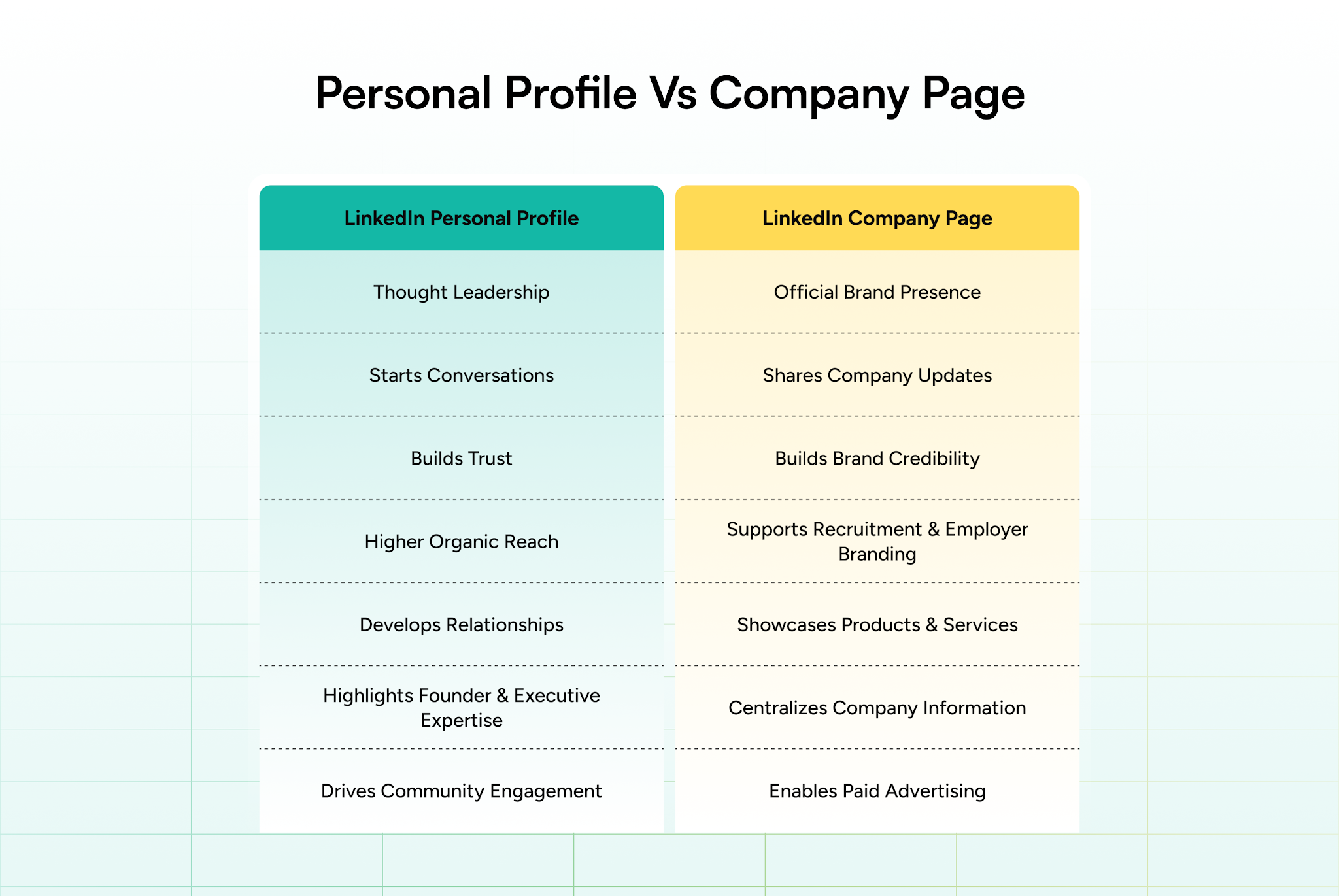
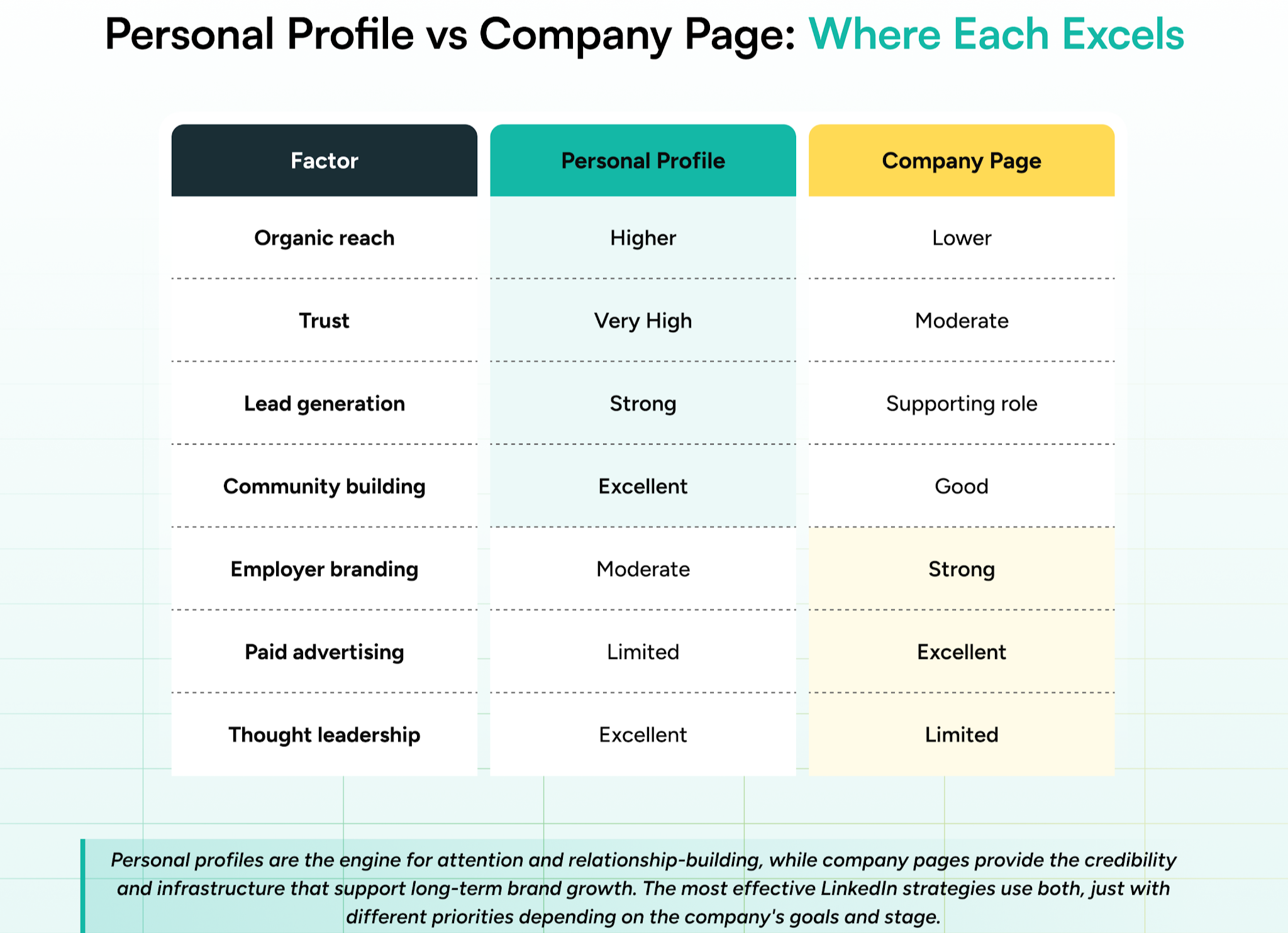
While both personal profiles and company pages play an important role in a B2B LinkedIn strategy, they are designed to achieve different outcomes. Personal profiles are typically stronger at building relationships, creating conversations, and establishing executive credibility, while company pages serve as the official source of information, supporting brand validation, recruitment, and paid marketing efforts. Understanding these differences helps founders and marketing teams allocate their time and resources more effectively.
Where Founders Should Invest First
For most founders and early-stage companies, the highest return on LinkedIn investment usually comes from building a strong personal presence before scaling the company page.
This isn't because company pages are unimportant. It's because trust and attention are often created through people first. A founder's personal profile gives a person the platform to connect with, learn from, and remember, while the company page provides the validation and information that supports those relationships.
Personal Profiles Can Build an Audience Faster
Growing a company page organically can take significant time, especially for businesses without an established brand or large customer base. A founder, however, already has something a company page doesn't: a personal network.
Every connection represents a potential audience of industry peers, customers, partners, investors, and future employees. By consistently sharing valuable insights, founders can build visibility faster because they're not starting from zero.
For founders pursuing LinkedIn personal brand growth, the goal isn't simply gaining followers. It's creating recognition among the people who matter to the business.
Conversations Create Stronger Relationships
LinkedIn is built around professional conversations, and personal profiles are naturally better suited for them.
A founder can share an opinion, respond to comments, ask questions, and participate in discussions in a way that feels authentic. These interactions create relationships over time, often before a potential customer has any immediate buying intent.
This is especially important in B2B, where purchasing decisions are rarely made after a single interaction. Buyers often engage with a company's ideas and leadership long before they become prospects.
Thought Leadership Creates Inbound Opportunities
A consistent founder presence can turn expertise into business opportunities.
When executives regularly share industry observations, lessons from building a company, or perspectives on market changes, they become associated with specific areas of expertise. Over time, this visibility can lead to inbound conversations from potential customers, partners, employees, and industry peers.
A strong founder personal brand on LinkedIn acts as a long-term business development asset. Instead of constantly reaching out to find opportunities, founders create conditions where relevant opportunities can come to them.
Relationships Scale Through the Founder Network
A company's reach is limited by its follower base. A founder's reach extends through every relationship they build.
When a founder shares company milestones, product updates, or industry insights, employees and followers are more likely to engage because there is a personal connection behind the content. This creates a ripple effect where the founder's visibility increases awareness of the company itself.
Many successful B2B brands use this approach: the founder builds trust and attention, while the company page captures and reinforces that interest.
When Your Company Page Deserves Equal Investment
While founder-led content can be the fastest way to build visibility, there are situations where a company page deserves equal attention. As businesses grow, their LinkedIn presence needs to evolve from being founder-driven to becoming a broader brand asset.
A company page provides something a personal profile cannot: an official, scalable platform that represents the entire organization. It becomes especially valuable when multiple teams, products, and business objectives need to be supported.
Larger Organizations Need a Central Brand Presence
For larger companies, relying only on executive profiles can create a fragmented brand experience.
As teams expand across regions, departments, and business units, the company page becomes a central hub where customers, employees, investors, and partners can find accurate information about the organization.
It also provides consistency in how the company presents itself, whether someone discovers the business through a founder, an employee, a job listing, or a marketing campaign.
For established organizations, the question is no longer personal profile vs company page. Both serve different audiences and business needs.
Active Hiring Requires Strong Employer Branding
When recruitment becomes a priority, a well-managed company page becomes essential.
Candidates don't just evaluate job descriptions; they research the company behind the role. They want to understand the culture, values, leadership style, and employee experience before deciding whether to apply.
A company page gives organizations a platform to showcase:
- Employee stories and achievements
- Workplace culture
- Team milestones
- Career opportunities
- Company values
While executives can share personal perspectives on culture and leadership, the company page provides the official employer brand that candidates return to when evaluating the organization.
Product Launches Benefit From Brand-Owned Visibility
For companies with established products or multiple offerings, the company page plays an important role in communicating updates at scale.
Product announcements, feature releases, customer stories, webinars, and industry reports all have a natural home on the company page. Unlike a founder's profile, which is limited by the individual's personal positioning, the company page can showcase the full breadth of the organization's offerings.
This is particularly important for B2B companies where multiple stakeholders may be involved in the buying decision. Different buyers may visit your page looking for different signals, from product capabilities to customer proof points.
Paid Campaigns Require a Company Page Foundation
LinkedIn advertising is another area where company pages become critical.
Organizations running Sponsored Content, Lead Gen Forms, or account-based marketing campaigns need a strong company presence to support those efforts. Paid traffic often leads prospects to a company's LinkedIn page before they move further down the buying journey.
A well-optimized page increases the chances that visitors who click through from an advertisement find a credible, updated, and consistent brand presence.
Multiple Spokespeople Create a Stronger Brand Ecosystem
As companies mature, thought leadership expands beyond the founder. For instance, a CEO may focus on vision and industry trends; a CTO may share technical insights; a sales leader may discuss customer challenges; and a product executive may highlight market developments.
In these cases, the company page becomes the anchor that connects multiple voices under one brand identity.
The goal is not to replace individual voices with corporate messaging. Instead, the company page acts as the foundation that allows multiple executives and employees to contribute to a larger brand narrative.
The Strongest LinkedIn Strategy Combines Both
A strong B2B LinkedIn strategy doesn't treat personal profiles and company pages as competing channels; it uses them together to create a connected brand ecosystem. A founder's profile often acts as the starting point, sharing insights and perspectives that attract attention and spark conversations. When employees engage with and amplify that content, the reach expands beyond the founder's immediate network.
The company page then reinforces that interest by showcasing business milestones, products, customer stories, and official updates. As prospects move between these touchpoints, they gain a more complete understanding of both the people behind the business and the organization itself. This combination builds familiarity, strengthens trust, and creates more opportunities for meaningful business conversations.
Practical Recommendations
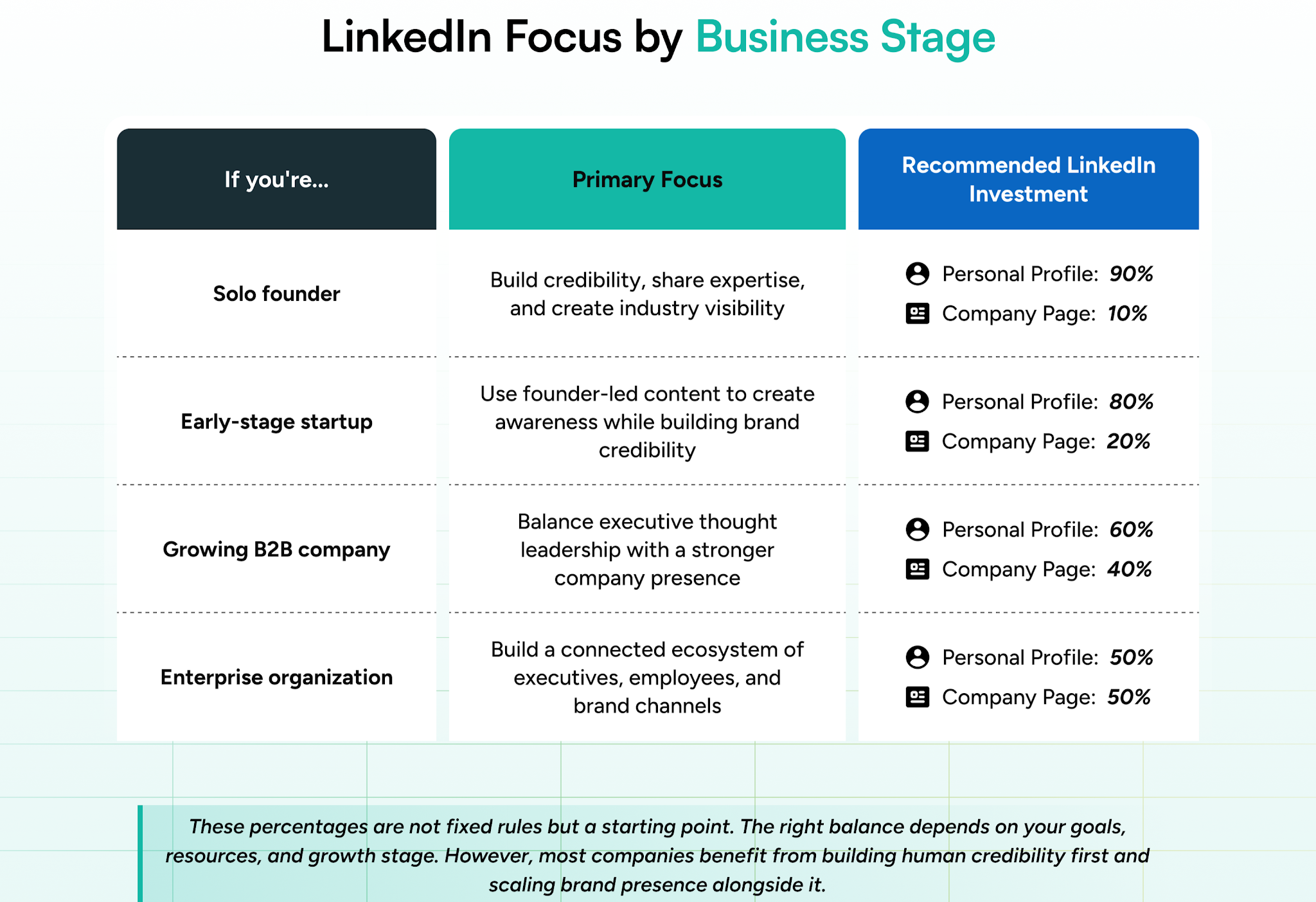
Your LinkedIn investment should evolve with your business stage. Solo founders and early-stage startups usually benefit most from prioritizing personal branding, as founder-led content creates faster visibility and trust. As companies grow, the focus should shift toward balancing executive voices with a strong company presence. Larger organizations need both to support brand credibility, recruitment, demand generation, and thought leadership at scale.
Conclusion
A founder's profile creates visibility, trust, and conversations. A company page reinforces credibility, showcases the business, and helps prospects validate their decision. The goal isn't simply to post more; it's to build a LinkedIn presence that moves people from awareness to trust to action.
The right strategy depends on your business stage, audience, and growth goals.
If you're not sure where to focus your LinkedIn efforts, GrowedIn can help you build a B2B LinkedIn strategy that turns executive and brand visibility into meaningful business opportunities.
Feel free to schedule a call to discover the right LinkedIn growth approach for your business.

Frequently Asked Questions
Should founders focus on LinkedIn personal profiles or company pages first?
For most founders and early-stage companies, investing in a personal profile first often delivers faster results. Founder-led content helps build trust, start conversations, and create visibility. However, the company page should still be maintained as a credibility asset where prospects can learn more about the business.
For most founders and early-stage companies, investing in a personal profile first often delivers faster results. Founder-led content helps build trust, start conversations, and create visibility. However, the company page should still be maintained as a credibility asset where prospects can learn more about the business.
Is a LinkedIn company page still important for B2B companies?
Yes. While personal profiles often drive more engagement, company pages play an important role in validating the business. They provide official company information, showcase products and services, support recruitment efforts, and enable LinkedIn advertising.
Yes. While personal profiles often drive more engagement, company pages play an important role in validating the business. They provide official company information, showcase products and services, support recruitment efforts, and enable LinkedIn advertising.
Why do LinkedIn personal profiles usually get more engagement than company pages?
People naturally tend to connect with people more than brands. Personal profiles allow founders and executives to share opinions, experiences, and stories, creating more authentic conversations. LinkedIn's algorithm also tends to favor meaningful interactions, which often happen more naturally through individual accounts.
People naturally tend to connect with people more than brands. Personal profiles allow founders and executives to share opinions, experiences, and stories, creating more authentic conversations. LinkedIn's algorithm also tends to favor meaningful interactions, which often happen more naturally through individual accounts.
How often should a company post on its LinkedIn page?
There is no universal posting frequency, but consistency matters more than volume. A sustainable schedule that includes company updates, customer stories, industry insights, and employee content is usually more effective than posting only during major announcements.
There is no universal posting frequency, but consistency matters more than volume. A sustainable schedule that includes company updates, customer stories, industry insights, and employee content is usually more effective than posting only during major announcements.
Can a founder’s LinkedIn profile help generate leads?
Yes. A strong founder personal brand can create inbound opportunities by building credibility before a sales conversation begins. When potential customers repeatedly see valuable insights from a founder, they are more likely to engage when they have a relevant business need.
Yes. A strong founder personal brand can create inbound opportunities by building credibility before a sales conversation begins. When potential customers repeatedly see valuable insights from a founder, they are more likely to engage when they have a relevant business need.
Should employees share company content on LinkedIn?
Employee advocacy can significantly expand the reach of company content. Employees, especially founders and leadership teams, can add credibility and context by sharing company updates with their own perspectives instead of simply reposting corporate announcements.
Employee advocacy can significantly expand the reach of company content. Employees, especially founders and leadership teams, can add credibility and context by sharing company updates with their own perspectives instead of simply reposting corporate announcements.
How should companies balance LinkedIn personal branding and company page management?
The right balance depends on the company's stage. Early-stage companies may prioritize founder visibility, while larger organizations often need a stronger mix of executive thought leadership, employee advocacy, and company page content. The most effective strategy uses both channels with clear roles.
The right balance depends on the company's stage. Early-stage companies may prioritize founder visibility, while larger organizations often need a stronger mix of executive thought leadership, employee advocacy, and company page content. The most effective strategy uses both channels with clear roles.
LinkedIn Company Page vs Personal Profile: Where Should You Invest First?
- LinkedIn personal profiles and company pages serve different purposes; they are not competing channels.
- Founder profiles typically perform better for building trust, starting conversations, and generating organic visibility.
- Company pages act as a credibility hub for prospects, employees, customers, and partners.
- Modern B2B buyers research both companies and the people behind them before making decisions.
- LinkedIn company page management requires consistent publishing, employee advocacy, analytics, and brand consistency.
- A founder personal brand on LinkedIn can create inbound opportunities through thought leadership and relationship building.
- Growing companies should gradually shift from founder-only visibility to a balanced LinkedIn ecosystem.
- The strongest B2B LinkedIn strategy combines executive voices with a well-managed company presence.


Insights Hub
The Best Time To Post on LinkedIn In 2026
Personal Branding vs. PR: What Should Executives Prioritize?
How to Maintain a LinkedIn Presence with Limited Time
Want to explore how this applies to your brand?
Let’s talk.
