 Claude
 ChatGPT
 Gemini
In the early days of a business, the founder is often its most effective marketing channel. They know why the company exists and what problem it solves. They can explain the thinking behind a product, share lessons from difficult decisions, and answer questions with a level of authenticity that corporate brochures can’t replicate.
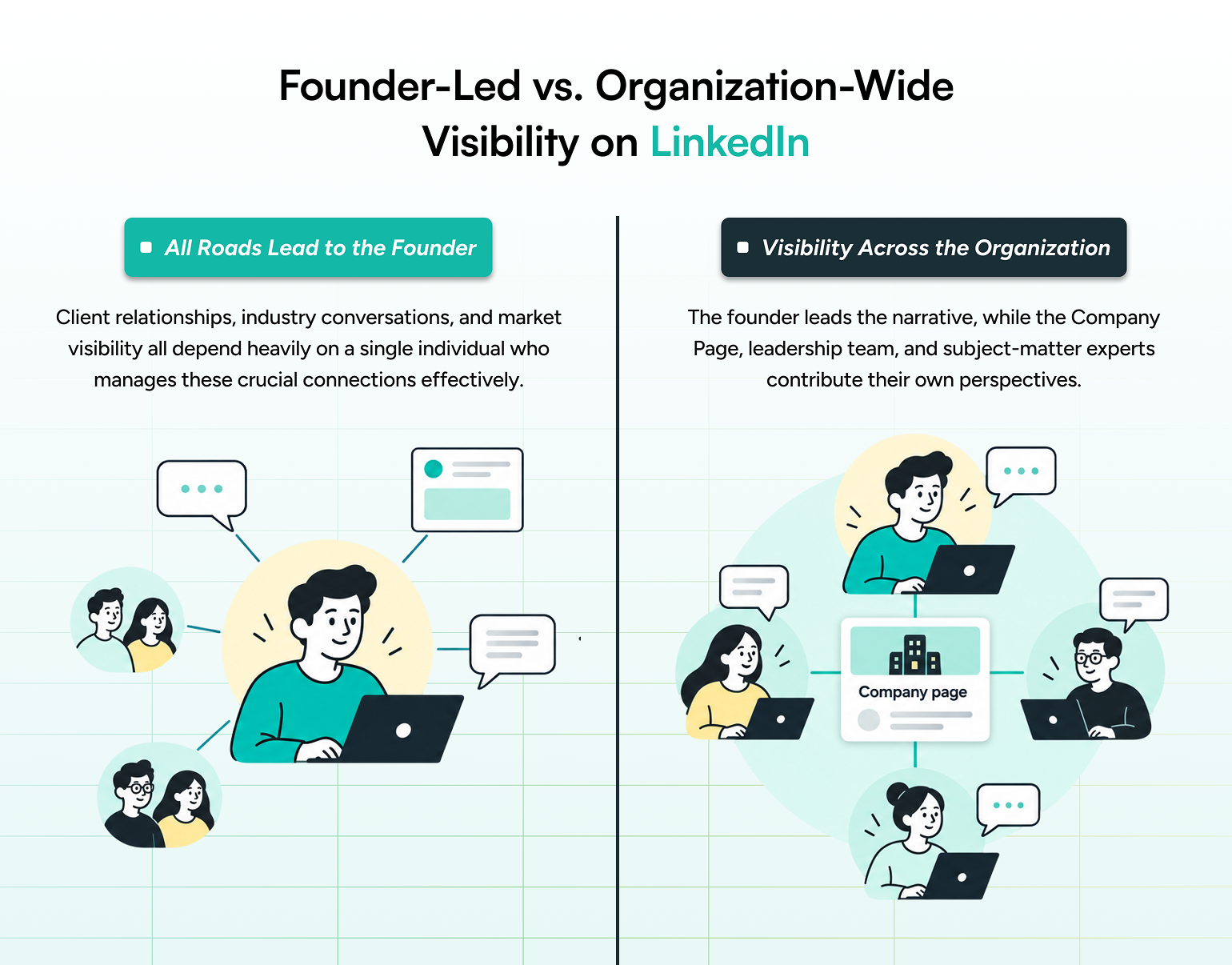
This advantage becomes clearly visible on LinkedIn. A founder can share a point of view, participate in industry conversations, connect directly with potential customers, and put a human face to an otherwise unfamiliar business. For a young company competing against established players, that personal connection can make a meaningful difference. But it can also create a less obvious challenge.
As the business grows, the founder's LinkedIn profile may remain its most recognizable public presence. Customers follow the founder to learn about the company, prospective employees look to them for insights into its culture, and industry peers associate the company's expertise with the founder's opinions. Even when the organization has developed a capable leadership team, its public voice may still revolve around one individual.
Having the founder as the brand's front door is an advantage, until every important conversation has to pass through it.
What happens when the founder has less time to publish? When the company enters a new market and needs to demonstrate expertise in a different area? When a new executive joins, the next generation of leaders emerges, or the business prepares for a transition? And what happens to the valuable insights within the organization that never reach a wider audience simply because they do not come from the founder?
LinkedIn provides an opportunity to address these challenges. The founder's profile can remain an important source of perspective while the Company Page, leadership team, and subject-matter experts develop their own distinct voices. A founder may be the reason people first discover a company, but its long-term reputation should reflect the collective expertise, values, and vision of the organization.
When Founder-Led Visibility Works, and When It Can Become a Constraint
People do not build professional relationships with Company Pages. They want to understand the people, thinking, and expertise behind a business.
A founder is well placed to provide that context. They can discuss the original problem that inspired the company, explain how their thinking has evolved, and share the decisions that shaped its direction. These stories give an organization something more distinctive than a list of services or a polished corporate statement.
LinkedIn is a natural setting for these conversations because its audience is already there for professional discovery, industry knowledge, and business relationships. For founders, this is an opportunity to connect personal expertise with commercial outcomes.
When founders share how they see their industry evolving, prospective customers can start understanding emerging challenges before a sales conversation even takes place. Talking openly about hiring decisions also gives potential employees a better sense of what the organization stands for. And by sharing lessons from building the business, founders can make an unfamiliar company feel more tangible and relatable.
How Founder Dependence Develops on LinkedIn
Founder dependence doesn’t usually begin as a planned strategy. It often develops because the founder is the easiest person to put in front of the audience.
They already have a network, understand the business, and put forward their own opinions. They may also be the only person who feels comfortable publishing publicly.
Over time, a pattern develops:
- The founder publishes most of the company’s substantive insights.
- The audience begins associating the business’s expertise primarily with the founder.
- Other leaders and specialists remain less visible, even when they have relevant knowledge.
- The Company Page becomes a secondary channel for announcements, product updates, and republished founder content.
- The founder becomes responsible for sustaining a major share of the organization’s public presence.
The problem is that the company has not built enough additional sources of influence around them.
The Business Case for Moving Beyond a Single Voice
Building a broader LinkedIn presence is sometimes treated as a nice-to-have initiative for companies that have spare marketing capacity. However, it can support several practical business priorities.
It Helps Buyers Understand More Than One Part of the Business
A founder may be excellent at explaining the company’s vision but may not be the best person to discuss implementation, customer experience, or technical architecture. Those subjects belong to the people closest to the work.
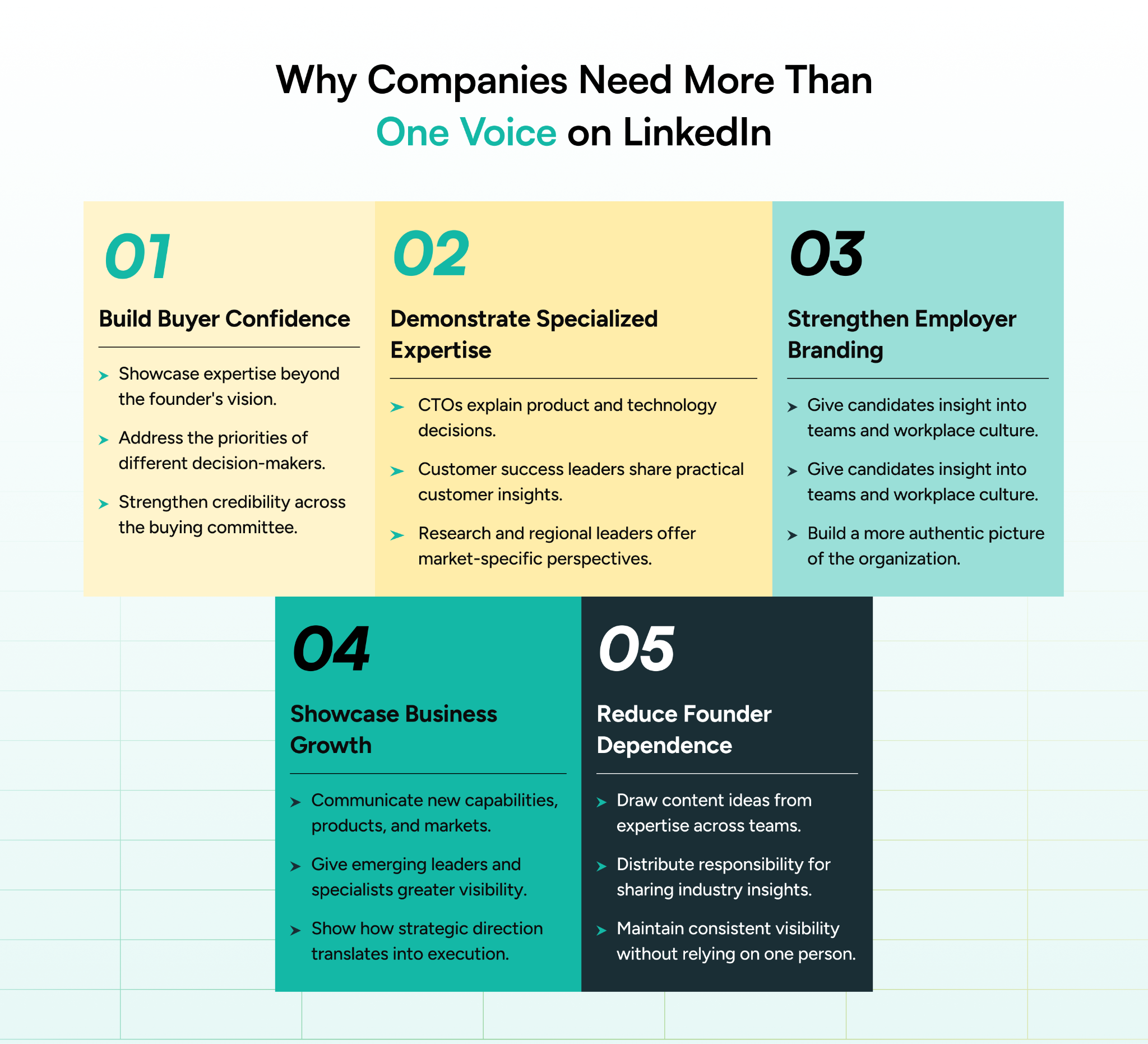
The CTO can offer insight into the thinking behind product and engineering decisions, while the customer success leader brings a view of how people use the product. Emerging market trends become more meaningful when interpreted by the head of research, and regional executives can add context on how customer needs vary from one market to another.
Their contributions give prospective buyers a more complete understanding of what the organization can do. A founder may get the first buyer interested, but winning over the wider buying committee takes more than one person’s perspective. Finance will be weighing the commercial risks, the technology team needs confidence in how the solution will integrate with existing systems, and operations will want to know whether it can deliver in the real world. A broader group of credible voices can help the company address these questions with greater depth.
On LinkedIn, this means creating opportunities for specialists to explain the aspects of the business they understand best.
It Gives the Company a Wider Talent Story
Potential employees do not learn about an organization only through its Careers page.
They may encounter the CEO’s views on leadership, an engineer’s explanation of a difficult technical problem, a manager’s reflections on team development, or an employee’s account of a project.
These different perspectives can make the organization easier to understand as a place to work. They also contribute to effective employer branding by giving prospective candidates a more complete picture of the work, the people, and the environment they may be joining.
LinkedIn can help bring these perspectives into view, provided employees are encouraged to speak authentically and are not simply asked to repeat corporate messaging.
It Creates More Room for the Company To Evolve
As a business scales, its capabilities and priorities change. It may enter new markets, introduce products, expand its leadership team, or develop expertise that did not exist when the founder established the company.
If its public identity remains closely associated with the founder's original area of expertise, communicating these developments can become difficult. A wider group of visible leaders and specialists can demonstrate the organization's growing capabilities through their own knowledge and experience.
The founder can continue to communicate the company's strategic direction, while other leaders provide a closer view of how that direction translates into products, customer relationships, and day-to-day operations.
It Reduces the Operational Pressure on the Founder
There is also a practical question of capacity. Founders already manage competing demands involving strategy, hiring, customers, operations, and capital. Expecting one person to consistently produce the company's most compelling LinkedIn content can create an unnecessary bottleneck.
A more collaborative approach allows the marketing team to draw on knowledge that already exists across the organization. The founder remains an important voice, but the company's ability to share valuable insights no longer depends entirely on their availability.
The Mistake: Treating the Company Page as a Smaller Version of the Founder’s Profile
When businesses recognize the need for a stronger company presence on LinkedIn, their first response may be to publish more frequently from the Company Page. That can help, but publishing volume alone does not address the underlying issue.
If the founder publishes an opinion on Monday and the Company Page republishes it on Tuesday, the organization has added another post without contributing a new perspective. Similarly, if every company update reflects the founder’s personal views, the Company Page can become an echo of their profile instead of a valuable source of organizational knowledge.
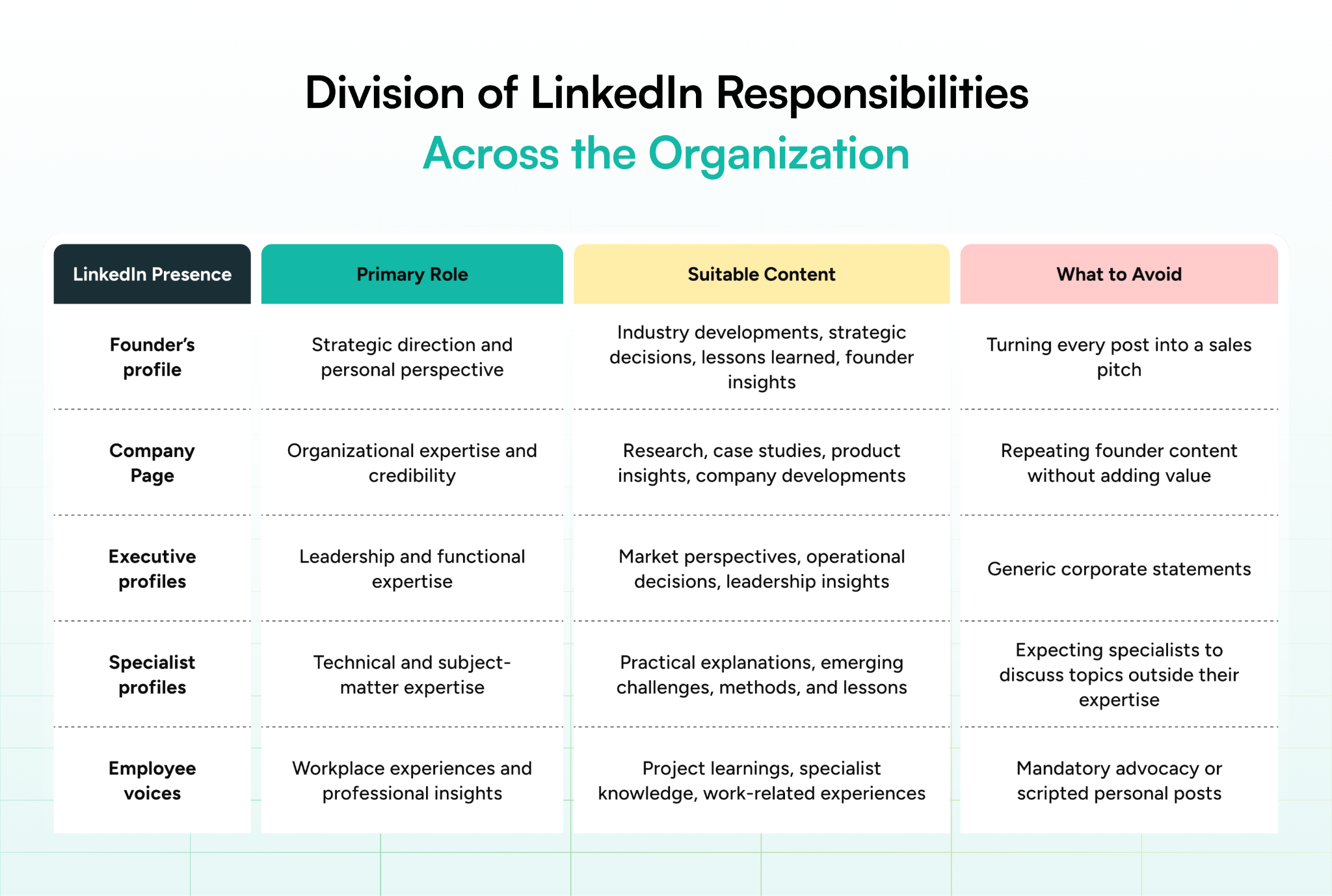
A more effective approach is to give each LinkedIn presence a distinct role.
The Founder’s Profile: Perspective and Direction
Founder content can explain why the company exists, which market assumptions the founder challenges, what they have learned from customers, and where they believe the industry is heading.
Founders can also discuss decisions that have shaped the organization, including why a product was developed, what prompted expansion into a new market, or how a difficult experience influenced the company's direction.
The Company Page: Evidence and Organizational Depth
The Company Page can demonstrate the organization's collective expertise and capabilities.
It can publish research, product developments, customer case studies, original data, event insights, organizational news, and contributions from different teams.
The founder might offer an interpretation of an industry development, while the Company Page shares research or evidence that adds depth to the discussion. Similarly, when the founder raises a broader business challenge, the Company Page can demonstrate how different teams are addressing it in practice.
The Company Page should have its own editorial identity, helping audiences understand the organization's expertise without simply repeating the founder's personal opinions.
Other Leaders: Expertise and Execution
Executives and specialists can bring the company's expertise into sharper focus.
For example, the founder might discuss why customer onboarding is becoming a strategic issue in the industry. The head of customer success could share practical lessons about common onboarding challenges, while the product leader could explain the decisions behind features designed to address them.
These perspectives complement one another, giving audiences a fuller understanding of the issue and how the organization approaches it.
Employees: The Experience Behind the Business
Employees can offer a closer view of how the organization works.
Their contributions might include lessons from projects, explanations of specialist work, insights from customer interactions or reflections on professional development.
However, this should never involve requiring employees to publish personal opinions or turning everyone into an unpaid brand spokesperson. Participation should be voluntary, supported, and appropriate to each person's role.
The objective is to make relevant expertise and experiences more visible while allowing employees to communicate in their own voices.
Build a LinkedIn Presence Around What the Business Knows
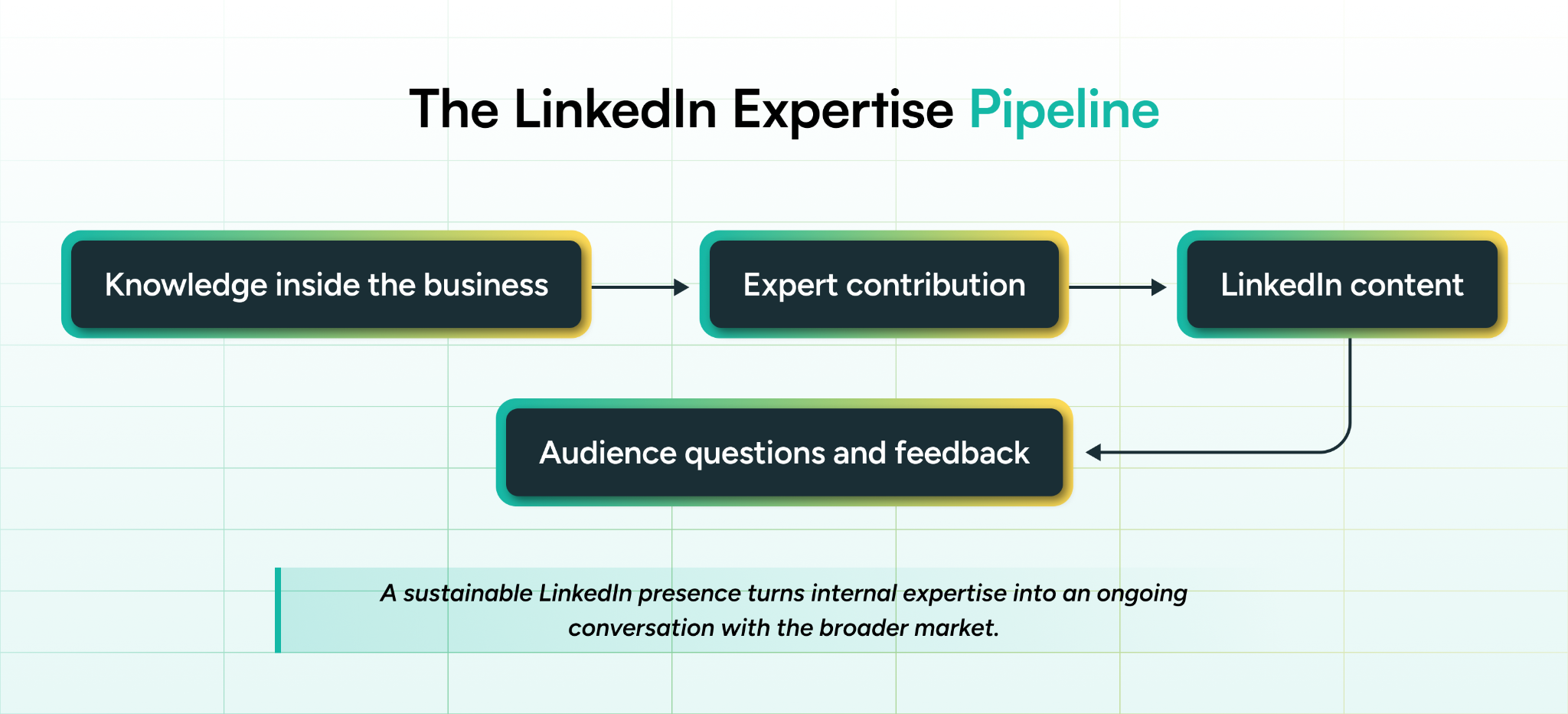
A founder may be the most visible person in the organization, but they are not the only person with knowledge worth sharing. The challenge is to identify that expertise, make it useful to an external audience, and establish a sustainable process for publishing it.
Step 1: Identify the Knowledge Already Inside the Business
Begin by identifying the questions the company is well equipped to answer.
These might include:
- What do customers commonly misunderstand?
- What changes are specialists observing in the industry?
- Which assumptions does the company challenge based on its experience?
- What lessons have emerged from delivering projects or developing products?
- What do buyers need to know before making an informed decision?
- What has the organization learned that could benefit people who may never become customers?
These questions are more useful than simply asking, “What should we post this week?” They direct attention toward genuine expertise instead of filling a content calendar with generic observations.
For a technology company, the knowledge map might cover product design, cybersecurity, implementation, customer adoption, and industry regulations. For a professional services firm, it could include client challenges, operational improvements, market developments, and lessons from complex engagements.
The topics will vary by organization, but the principle is consistent: identify existing expertise before asking people to create content.
Step 2: Match Topics to the People Closest to Them
Once the knowledge areas are identified, determine who can speak credibly about each one.
The founder may be best placed to explain the company's strategic direction. The head of sales might understand how buyer priorities are changing, while the product lead can offer insights into emerging technical requirements. The people team may have valuable perspectives on employee development and workplace culture.
However, contributing expertise does not necessarily mean writing LinkedIn posts independently.
A dedicated LinkedIn ghostwriter or content specialist can conduct short interviews, gather examples, and turn those conversations into well-structured posts. The subject-matter expert should review the final content, verify its accuracy, and retain control over the opinions expressed under their name.
It is important to separate helping someone communicate their expertise and inventing an opinion for them.
Step 3: Turn Recurring Questions Into Content Themes
A useful content system needs some consistency, but it does not need to reduce every person to a rigid publishing formula.
For example, a company could develop four recurring themes:
- What the Market Is Getting Wrong: Challenging common assumptions that affect customers and their decisions.
- What the Company Is Learning: Sharing lessons from projects, research, product development, and customer engagements.
- How the Work Actually Happens: Offering practical explanations from the people responsible for delivering results.
- Where the Industry Is Heading: Providing informed perspectives on developments relevant to customers and partners.
Multiple contributors can bring different experiences and perspectives to each theme. This creates variety while maintaining a recognizable editorial direction across the organization's LinkedIn presence.
Step 4: Give the Company Page a Role Beyond Distribution
Consider a founder who publishes a LinkedIn post about how businesses underestimate the cost of poor implementation.
Instead of simply reposting that opinion, the Company Page could publish a practical breakdown of common implementation mistakes, drawing on examples from the delivery team. A specialist could then examine one of those mistakes in greater detail, while a customer case study could illustrate how a particular challenge was resolved.
Each contribution adds something to the discussion and gives the audience a different perspective on the same issue.
This approach also helps the organization build a more substantial body of knowledge. Valuable insights are no longer confined to the founder's personal feed. They can be developed into research, case studies, practical resources, and other content that the Company Page can continue sharing and building upon.
Step 5: Make Participation Realistic
A common reason employee-led content programs fail is that they add publishing responsibilities to already busy jobs. A specialist who is expected to write two polished posts every week may quickly stop participating. A leader who has to invent a fresh topic each time may find the process burdensome.
A more practical system could involve a monthly interview, a short review of draft content, and occasional participation in relevant conversations.
The marketing team can handle research, editing, and scheduling support, while the contributor provides the expertise and approves the final message.
Start with a small number of willing contributors. Learn which formats suit them. Expand only when the process is manageable.
What Should the Founder Do When the Company Starts Speaking for Itself?
Broadening the company's LinkedIn presence does not mean the founder should become less visible. Their participation remains valuable, particularly when they can provide strategic context and personal perspectives that other voices may not offer.
Continue To Communicate the Larger Direction
The founder should retain a clear role in communicating the company's mission, strategic priorities, and vision for the future. Audiences should still be able to understand why the business exists, what it hopes to achieve, and how its leaders approach important decisions.
However, the founder does not need to personally explain every technical development or operational lesson. Those discussions can benefit from the expertise of the people directly involved.
Recognize Expertise Publicly
When another leader or specialist shares a valuable insight, the founder can help bring that contribution to a wider audience.
This might involve engaging thoughtfully with a colleague's post, sharing company research with additional context, or explaining how a specialist's work contributes to the organization's broader priorities.
These interactions should feel like genuine professional engagement, not routine promotional endorsements. They also help audiences recognize the depth of expertise available across the organization.
Make Space for Disagreement and Distinct Perspectives
A company can share a common direction without expecting every leader to hold identical opinions.
Thoughtful differences can make professional discussions more informative. A sales leader may emphasize a particular customer challenge, while a product leader identifies a different concern. The founder might approach an issue through a long-term strategic lens, while an operations leader explains the practical constraints involved.
These perspectives can coexist when they are supported by evidence, communicated professionally, and consistent with the organization's broader principles.
Stop Measuring the Founder’s Success Only by Personal Reach
If the company wants to develop a broader LinkedIn presence, the founder's follower count should not be the only measure of progress. The founder may continue to attract the largest audience. That does not mean the Company Page, other leaders, or specialists are underperforming.
Check whether audiences can discover and understand the organization through multiple credible sources. Are prospective customers engaging with the people responsible for delivering the work? Are relevant specialists gaining visibility among the right professional audiences? Are the company's ideas reaching people outside the founder's existing network? Is the organization developing resources and insights that remain useful beyond the lifespan of an individual LinkedIn post?
These questions provide a more comprehensive picture of progress than comparing every employee's post with the founder's highest-performing content.
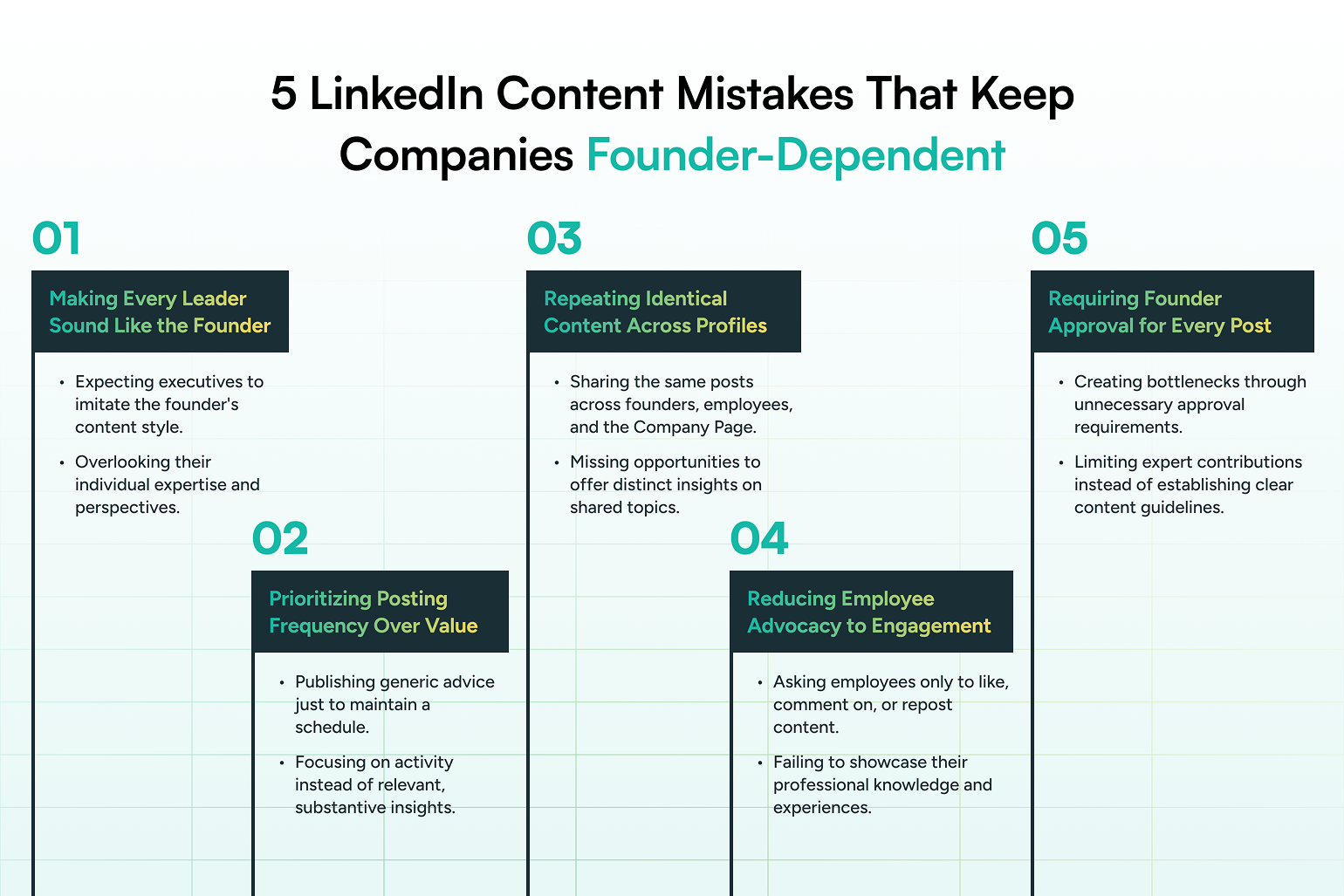
The LinkedIn Content Mistakes That Keep Companies Founder-Dependent
Mistake 1: Turning Every Leader Into a Miniature Founder
Not every executive needs to publish inspirational lessons, personal origin stories, or broad industry predictions. Their content should reflect the expertise they bring to the business and the subjects they can discuss with authority.
Each person should have the freedom to share useful insights in a way that feels natural to them, allowing their individual knowledge and experience to come through.
Mistake 2: Confusing Activity With Expertise
A busy LinkedIn feed is not necessarily a useful one. Publishing generic advice simply to maintain a schedule can make it harder for audiences to recognize the company's actual expertise among the many similar messages competing for attention.
Consistent publishing is valuable when there is something meaningful to contribute. The frequency of posts should not take priority over the relevance and substance of the ideas being shared.
Mistake 3: Copying the Same Post Across Every Profile
There are occasions when several people may need to share the same announcement, such as a major company milestone or an industry event. However, routinely publishing identical wording across the founder's profile, Company Page, and employee profiles misses an opportunity to offer different perspectives.
For example, during a product launch, the founder can explain the strategic thinking behind it, the product lead can discuss the customer problem it addresses, and the Company Page can share product details and supporting resources.
The message remains consistent, but each contribution gives the audience something different.
Mistake 4: Treating Employee Advocacy as a Distribution Shortcut
Employee advocacy is sometimes reduced to a request for staff to like, comment on, or repost company content. That may increase activity around a post, but it does not help the company demonstrate the breadth of its expertise.
A better approach gives employees a reason to participate. They might explain their work, share lessons from a project, offer practical observations, or discuss an issue from their professional perspective.
Mistake 5: Making the Founder the Final Approval Point for Everything
If every LinkedIn post from every leader requires the founder's approval, the company has simply created another bottleneck. Clear content guidelines and proportionate review processes can maintain consistency without requiring the founder to approve every contribution.
For example, the company can establish its communication principles, provide guidance on handling confidential information, identify who should verify technical claims, and specify which topics require executive or compliance review.
Within those boundaries, subject-matter experts should have the freedom to contribute. The organization can maintain accuracy and consistency without making the founder responsible for approving every public statement.
How to Measure Whether the Company Is Growing Beyond the Founder
A broader LinkedIn presence needs measures that reflect the company's business objectives. If the organization wants to make more of its expertise visible, counting total posts or tracking follower growth on the founder's profile will not provide a complete picture.
Measurement should cover three areas: whether the company is reaching relevant audiences, whether its wider expertise is gaining visibility, and whether its LinkedIn activity is supporting business priorities.
Measure the Breadth of Participation
Begin with a practical question: how many people across the organization are contributing to its LinkedIn presence?
Possible measures include:
- The number of active contributors across leadership and specialist functions.
- The proportion of content featuring expertise beyond the founder.
- The number of Company Page posts that include original evidence, research, or analysis.
- The consistency of contributions over a quarter.
- The range of subject areas covered by the organization's content.
These metrics are not intended to create competition between employees. They help the company assess whether its LinkedIn presence reflects knowledge from different parts of the business.
Measure Audience Quality Over Audience Size
A post with fewer views may still be valuable if it reaches the right people. Companies should assess whether their content is engaging relevant professional roles, industries, prospective customers, partners, and potential employees.
The quality of conversations should also be reviewed. A thoughtful question from a prospective buyer may offer more business value than dozens of reactions from people outside the company's target audience.
Where available, LinkedIn Page analytics and campaign reporting can help teams examine audience characteristics and engagement patterns. Individual profile analytics may provide additional context, although access to detailed performance data from other people's profiles is limited.
These findings should be interpreted in relation to the intended audience and purpose of each piece of content.
Measure Signs of Commercial Influence
LinkedIn should not receive sole credit for every lead or business outcome. Business buying decisions can involve multiple stakeholders and interactions before a prospective customer contacts the sales team.
However, companies can look for underlying signals:
- Are prospective customers referring to founder or specialist content during sales conversations?
- Are inbound inquiries demonstrating greater familiarity with the company's work?
- Are relevant professionals engaging with subject-matter experts?
- Are LinkedIn conversations generating useful introductions or meetings?
- Are sales and recruitment teams using the content in their conversations with prospects and candidates?
These indicators can help the organization assess how LinkedIn contributes to customer relationships, business development, and recruitment.
Establish a Baseline Before Setting Targets
Before setting performance targets, review the company's existing LinkedIn activity.
For example, the team could examine the previous three months to determine how much content came from the founder, how frequently the Company Page published original material, which other leaders contributed, and what engagement those contributions generated.
After implementing a broader content approach, the team can compare the following quarter's results with that baseline. The comparison should reveal whether the organization is developing a more diverse and sustainable LinkedIn presence, while also identifying areas that need further attention.
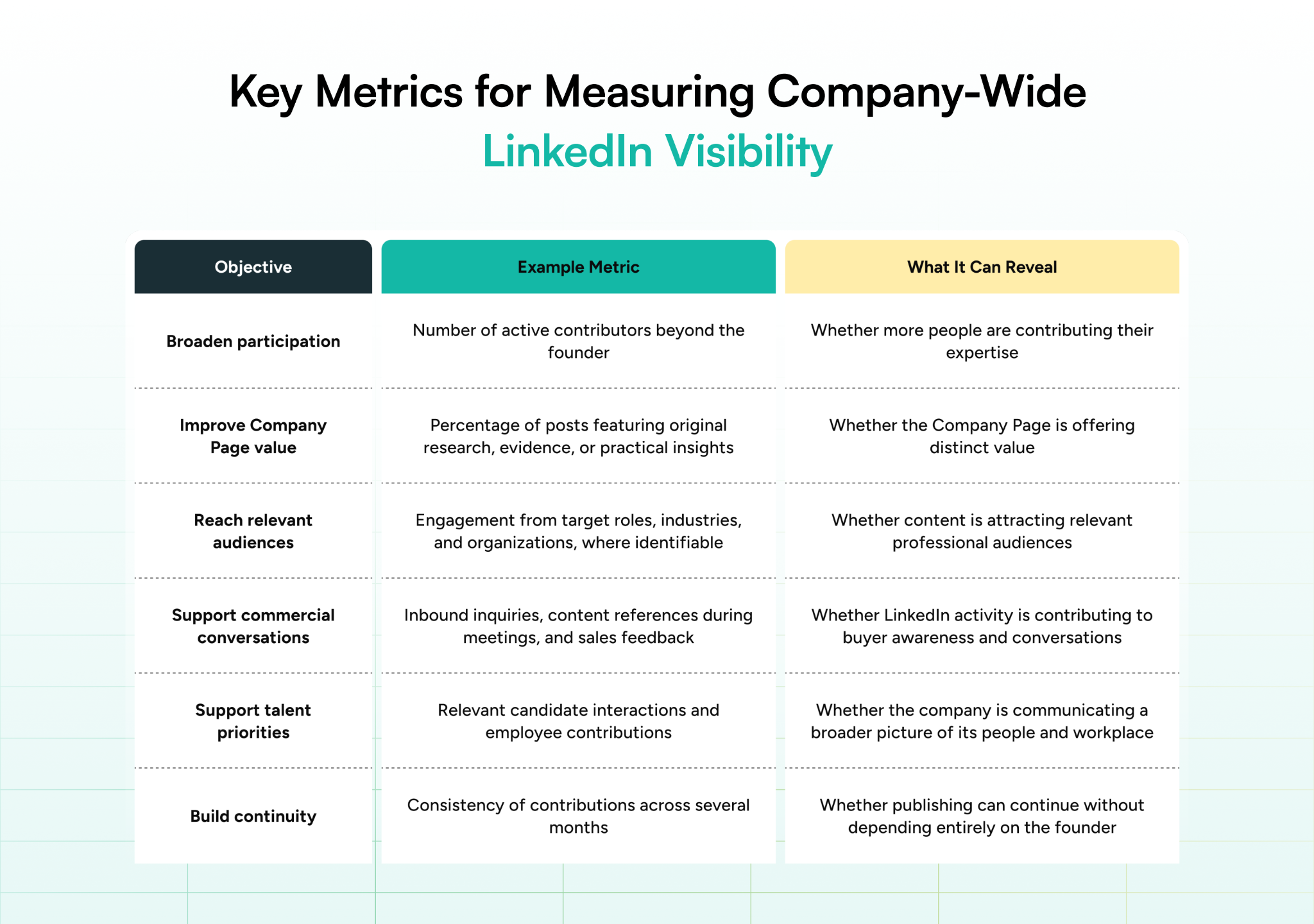
The most useful measures will depend on the business. A professional services firm may prioritize qualified inquiries, while a technology company might focus on engagement from technical decision-makers or prospective employees.
A 90-Day Plan to Build a Company Presence Beyond the Founder
Companies do not need to launch a large employee advocacy program overnight. A phased approach is more realistic and gives the organization time to identify which voices, topics, and formats work best.
Days 1–30: Audit the Current Presence
Review the founder's LinkedIn profile, the Company Page, and the activity of relevant leaders.
Identify which topics appear repeatedly, which business functions are represented, and where the company relies almost entirely on the founder to communicate its expertise.
Examine the content that has generated meaningful conversations, not just the posts with the highest reach. Sales and recruitment teams may also be able to identify frequently asked questions or content that helps them explain the company's capabilities.
By the end of the first month, the business should have a clear picture of its existing expertise, priority audiences, and gaps in its LinkedIn presence.
Deliverables:
- A baseline of founder and Company Page activity.
- A map of internal subject-matter experts.
- Three to five priority themes for LinkedIn.
- A shortlist of willing contributors.
Days 31–60: Run a Focused Pilot
Choose a small group of contributors instead of inviting the entire organization to participate immediately.
For example, the pilot could involve the founder, one senior executive, two specialists, and the Company Page. Each contributor should have a defined role and a manageable level of involvement.
The marketing team can conduct short interviews, turn expert insights into posts, and coordinate publication so that contributions complement one another.
During this phase, evaluate the process alongside content performance. Are contributors comfortable with the format? Is the approval process taking too long? Are posts becoming repetitive? Are readers asking relevant follow-up questions?
The focus should be on developing a publishing process that contributors can sustain.
Deliverables:
- A small library of approved content.
- A clear process for interviews, drafting, and review.
- Initial observations about audience response.
- Feedback from participating leaders and specialists.
Days 61–90: Refine and Expand
Use the pilot results to decide what to retain, improve, or discontinue.
If specialist interviews produce useful content with relatively little effort, continue using the format. If Company Page posts simply repeat the founder's perspectives, reconsider the division of editorial responsibilities. If certain themes generate meaningful questions from prospective buyers, explore those subjects in greater depth.
The business can then invite additional contributors based on the expertise and perspectives needed.
At the end of 90 days, compare performance against the initial baseline to assess whether the company's LinkedIn presence is becoming broader, more useful, and less dependent on the founder's publishing capacity.
Deliverables:
- A refined content and contributor model.
- A three-month performance review.
- A plan for the next quarter.
- Clear ownership of ongoing coordination.
The timeline is a starting point, not a universal rule. A small company may complete the pilot more quickly, while a larger or regulated organization may require additional review and governance.
Developing a manageable process and refining it based on actual results is far more effective than launching a complex program before the organization knows what works.
What Happens When the Founder Eventually Steps Back?
There is a longer-term reason to build a LinkedIn presence that does not depend entirely on the founder: businesses change, and so do leadership roles.
Founders may take on new responsibilities, appoint a new CEO, move into a board role, or step away completely from day-to-day operations. Some transitions are planned years in advance, while others happen unexpectedly.
When a company's LinkedIn presence revolves almost entirely around its founder, these changes can leave a gap in how the business communicates with its audience. Other leaders may have little established visibility, and the Company Page may not have developed a distinct identity or audience of its own.
A broader presence gives the organization more options. It does not guarantee a smooth leadership transition or diminish the founder's importance. However, the company will already have other credible voices, established content themes, and channels through which it can continue communicating its expertise.
The same principle applies even when the founder has no plans to step away. A company that can communicate its expertise through several people is better positioned to introduce new services, enter new markets, and give emerging leaders greater visibility.
Conclusion
A founder's visibility can be one of a company's greatest strengths on LinkedIn. Their experience, perspective, and personal connections can open doors that corporate communication may not manage on its own. There is no reason to lose that advantage as the business grows.
The opportunity is to build on it. When the Company Page, executives, and subject-matter experts contribute their own knowledge, audiences gain a fuller picture of the organization. They can see the people behind its capabilities, understand how different teams approach challenges, and develop confidence in the business beyond its founder's personal reputation.
At GrowedIn, we help companies put that system in place through LinkedIn strategy, Company Page management, executive thought leadership, and content development. Our approach draws on the expertise already present within the business, helping founders and their teams build a coordinated LinkedIn presence while keeping their involvement manageable. Schedule a call to discuss how we can help build a LinkedIn presence that reflects the full strength of your organization.

Frequently Asked Questions
Why is it risky for a business to rely solely on its founder’s personal brand?
When most visibility and credibility are tied to the founder, the company may struggle to establish an independent identity. This can limit its ability to build relationships, showcase wider expertise, and sustain visibility as the business grows.
How can a company build a LinkedIn presence beyond its founder?
A company can expand its presence by showcasing the expertise of its leadership team, developing a distinct Company Page voice, and encouraging leaders to share insights relevant to their roles and audiences.
What is the difference between a founder’s LinkedIn profile and a Company Page?
A founder's profile reflects their individual experience, perspectives, and leadership approach. A Company Page represents the organization, showcasing its collective expertise, people, and developments. Both can support a consistent business identity while offering audiences different types of content.
Should every executive be active on LinkedIn?
Not necessarily. Companies should prioritize leaders who have relevant expertise, valuable perspectives, and an interest in contributing. Their participation should reflect their professional responsibilities and availability, without expecting everyone to follow the same content style or publishing schedule.
What should leaders post about on LinkedIn?
Leaders can share insights drawn from their professional experience, including product decisions, customer challenges, industry developments, research findings, and operational lessons. The most useful topics are those they can discuss with authority and that are relevant to their intended audiences.
How can a business measure whether its LinkedIn presence is becoming less founder-dependent?
Businesses can track participation from executives and specialists, original Company Page content, and engagement from relevant audiences. They can also review whether these contributions are generating meaningful conversations, supporting business priorities, and reducing reliance on the founder's publishing activity.
How to Build a LinkedIn Brand That Isn't Founder-Dependent
- Founder-led visibility can help businesses gain recognition and build relationships, but excessive dependence on one person can make it difficult to establish an independent company identity.
- Building a broader LinkedIn presence allows companies to showcase their collective expertise while retaining the founder's influence and personal connections.
- The founder's profile, Company Page, and other leadership profiles should have distinct editorial roles, offering complementary perspectives instead of repeating the same content.
- Executives, specialists, and employees can help prospective customers, partners, and candidates understand the company's capabilities, people, and working culture.
- Each contributor should share insights grounded in their own expertise and experience, without being expected to imitate the founder's voice or follow a uniform posting schedule.
- A coordinated LinkedIn strategy requires clear content themes, defined responsibilities, and a manageable process for gathering and publishing insights from across the organization.
- Companies should assess progress through contributor participation, relevant audience engagement, original Company Page content, and signs of commercial influence, not just follower counts or posting frequency.
- A phased 90-day plan can help businesses audit their existing presence, test contributions from a small group, and refine their approach before expanding participation.


Insights Hub
LinkedIn Company Page Audit
LinkedIn Analytics: Metrics to Track and How to Use Them