 Claude
 ChatGPT
 Gemini
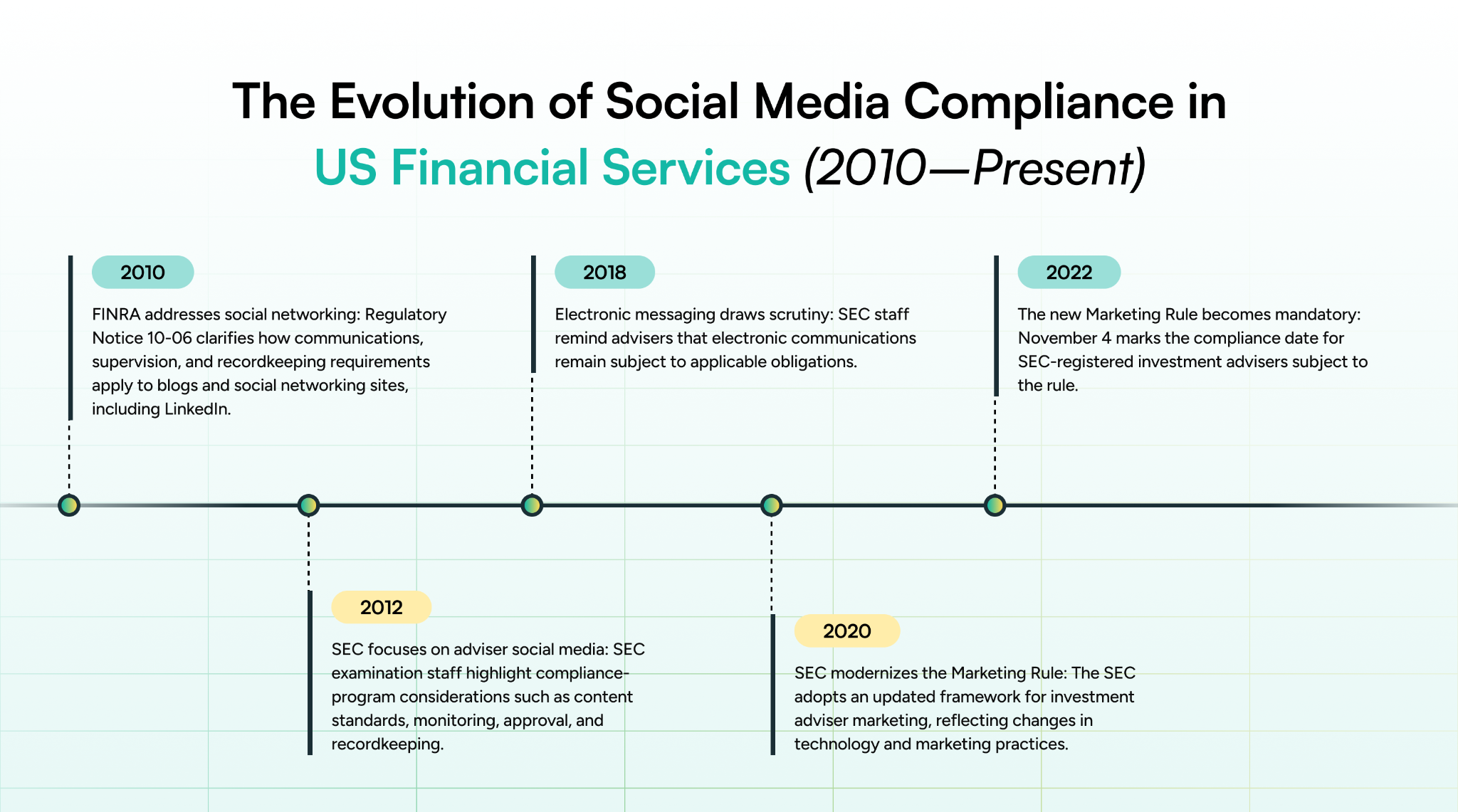
The 2008 financial crisis highlighted the need for accountability and investor protection in the US financial industry. Even so, regulators soon faced the challenge of how to apply established safeguards to an industry increasingly communicating and marketing itself through digital channels.
FINRA (Financial Industry Regulatory Authority) addressed the use of social networking sites in specific guidance issued in January 2010, clarifying how existing rules on public communications, supervision, and recordkeeping applied to firms and registered representatives online. A decade later, the SEC (Securities and Exchange Commission) modernized its investment adviser Marketing Rule, acknowledging that decades-old advertising regulations had not kept pace with advances in communication technology and changing investor expectations.
For today’s founders and C-suite executives, LinkedIn is one of the principal platforms where these regulations come into everyday practice. A post sharing a market perspective, describing an investment approach, or promoting a firm’s expertise needs more scrutiny than an editorial sign-off. Depending on the firm and the communication, it may raise questions about substantiation, disclosures, supervision, and record retention.
Understanding these regulations is essential to building a leadership presence that is both credible and compliant. This article explains what FINRA and SEC rules mean in practice for financial services executives posting on LinkedIn and offers a practical approach to how a ghostwriting workflow can accommodate compliance review without stifling their voice.
Which Regulatory Rules Apply to Your LinkedIn Content?
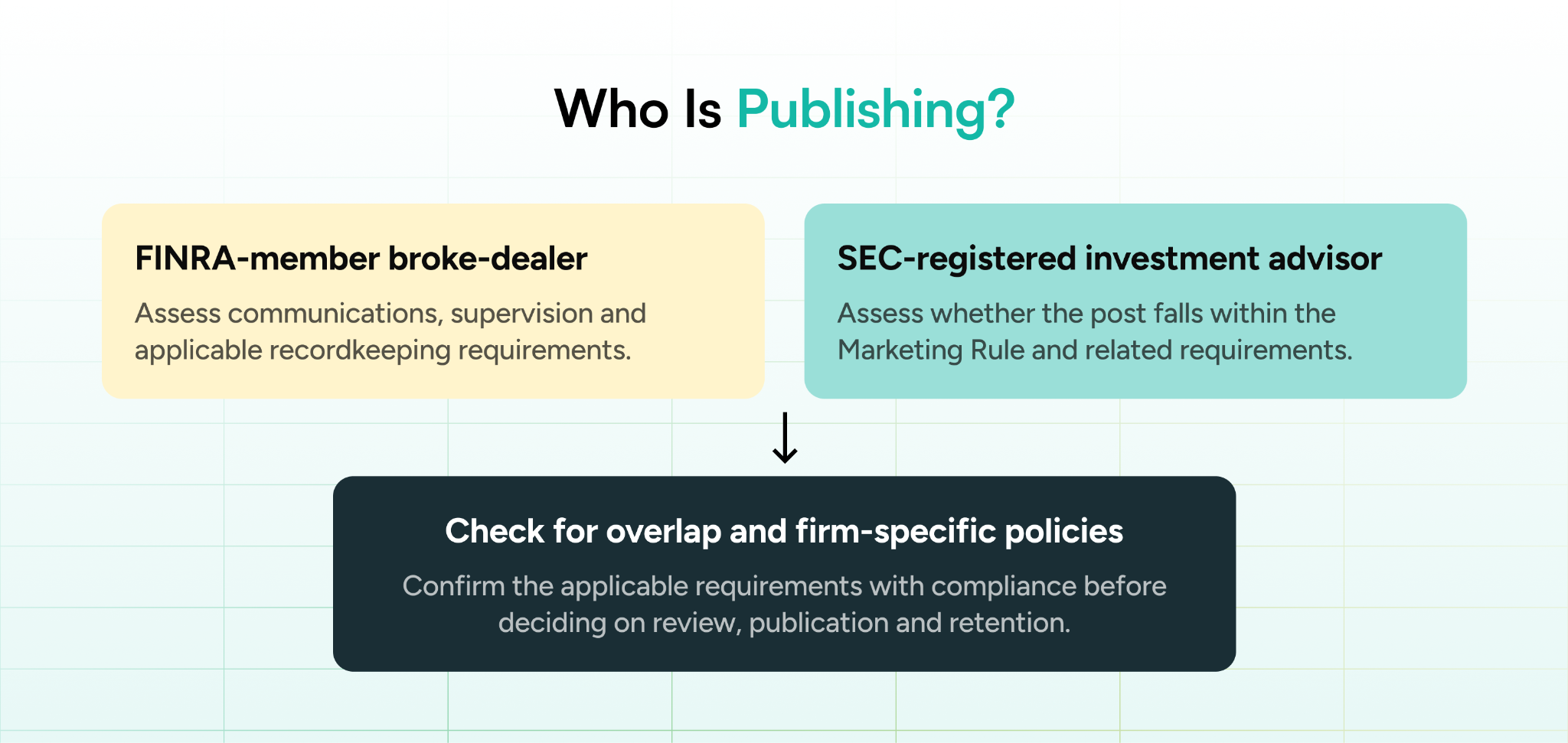
A financial services executive can publish from a personal LinkedIn account and still be subject to rules that depend on the firm they represent, the capacity in which they communicate, and what their content says. Identifying the applicable regulatory framework is the first step in building a compliant LinkedIn presence across an industry where regulatory roles can overlap.
FINRA’s 2026 Industry Snapshot counted more than 639,723 registered representatives, with approximately 331,802 also registered as investment adviser representatives at the end of 2025. Clearly, a substantial share of registered professionals operate across both brokerage and investment advisory contexts.
The Three Main Regulatory Contexts
1. FINRA-member broker-dealers
If the executive is an associated person of a FINRA-member broker-dealer, the firm's communications and supervisory obligations may apply to their professional LinkedIn activity. FINRA Rule 2210 governs communications with the public, while Rule 3110 addresses supervision, including communications. FINRA's social-media guidance explains how existing requirements apply to online communications.
Examples: A brokerage firm’s CEO discussing the firm's services, a registered representative sharing investment-related content, or an executive promoting a securities offering.
2. SEC-registered investment advisers
The SEC's Investment Adviser Marketing Rule, Rule 206(4)-1, applies to investment advisers registered or required to be registered with the SEC when they directly or indirectly disseminate an advertisement within the rule's scope. It includes requirements on misleading claims, substantiation, performance information, and testimonials and endorsements. Related recordkeeping requirements appear under Rule 204-2.
However, not every LinkedIn post qualifies as an advertisement under the rule. Whether it does depends on the content and context of the communication, including its audience and purpose.
Examples: An RIA (Registered Investment Adviser) founder discussing the firm's investment process, an executive promoting advisory services, or a leader sharing performance-related claims.
3. Dual-registered and affiliated businesses
Some financial services firms operate as both broker-dealers and investment advisers, while others have affiliated entities subject to different regulatory frameworks. In these situations, an executive's responsibilities, the entity involved, and the nature of the communication determine which requirements may apply.
A shared content workflow can accommodate both frameworks, provided the firm assesses the applicable requirements for each communication and ensures that the relevant compliance reviews are completed.
Examples: A wealth management executive overseeing brokerage and advisory services, or a group CEO representing several affiliated financial businesses.
What About a CEO Who Isn't a Registered Representative or Investment Adviser?
A CEO doesn't necessarily need to be individually registered for their LinkedIn activity to fall within the firm's compliance requirements. Posts published on behalf of a regulated firm may be subject to applicable regulatory obligations, while internal policies may also cover senior executives, employees, contractors, and external ghostwriters.
Distinguish between the rules that legally apply to the firm or person and the firm's internal policies governing who can publish, what needs review, and which records must be retained. Internal policies may impose controls beyond the minimum requirements that apply to a particular post.
FINRA's social media guidance and the SEC's Marketing Rule provide useful references, but the firm's compliance or legal team should assess which requirements apply to each executive's role and communications.
FINRA Rules for LinkedIn: Communications, Supervision, and Recordkeeping
For executives at FINRA-member broker-dealers, LinkedIn still lies within the firm’s compliance framework as a professional networking platform. FINRA's social media guidance covers how existing rules governing communications with the public, supervision, and recordkeeping apply to online activity. The practical distinction is between content that needs approval before publication and content that can be published under a supervisory process, subject to applicable content standards.
The framework rests on three key rules:
- FINRA Rule 2210: Sets standards for communications with the public, including classification, approval, and recordkeeping.
- FINRA Rule 3110: Requires firms to maintain a supervisory system reasonably designed to achieve compliance with applicable securities laws and FINRA rules.
- SEC Exchange Act Rules 17a-3 and 17a-4: Establish requirements for making and preserving broker-dealer records, including relevant business communications.
FINRA Rule 2210: What Executives Can Communicate on LinkedIn
FINRA Rule 2210 governs communications with the public by FINRA member firms and their associated persons. It is particularly relevant to LinkedIn because the platform combines relatively permanent information, such as profile content, with posts, comments, and other forms of ongoing interaction.
The first step is to understand how the rule classifies communications. It distinguishes between retail communications, correspondence, and institutional communications. The classification depends primarily on the audience and the number of retail investors who receive or can access the communication within a 30-calendar-day period.
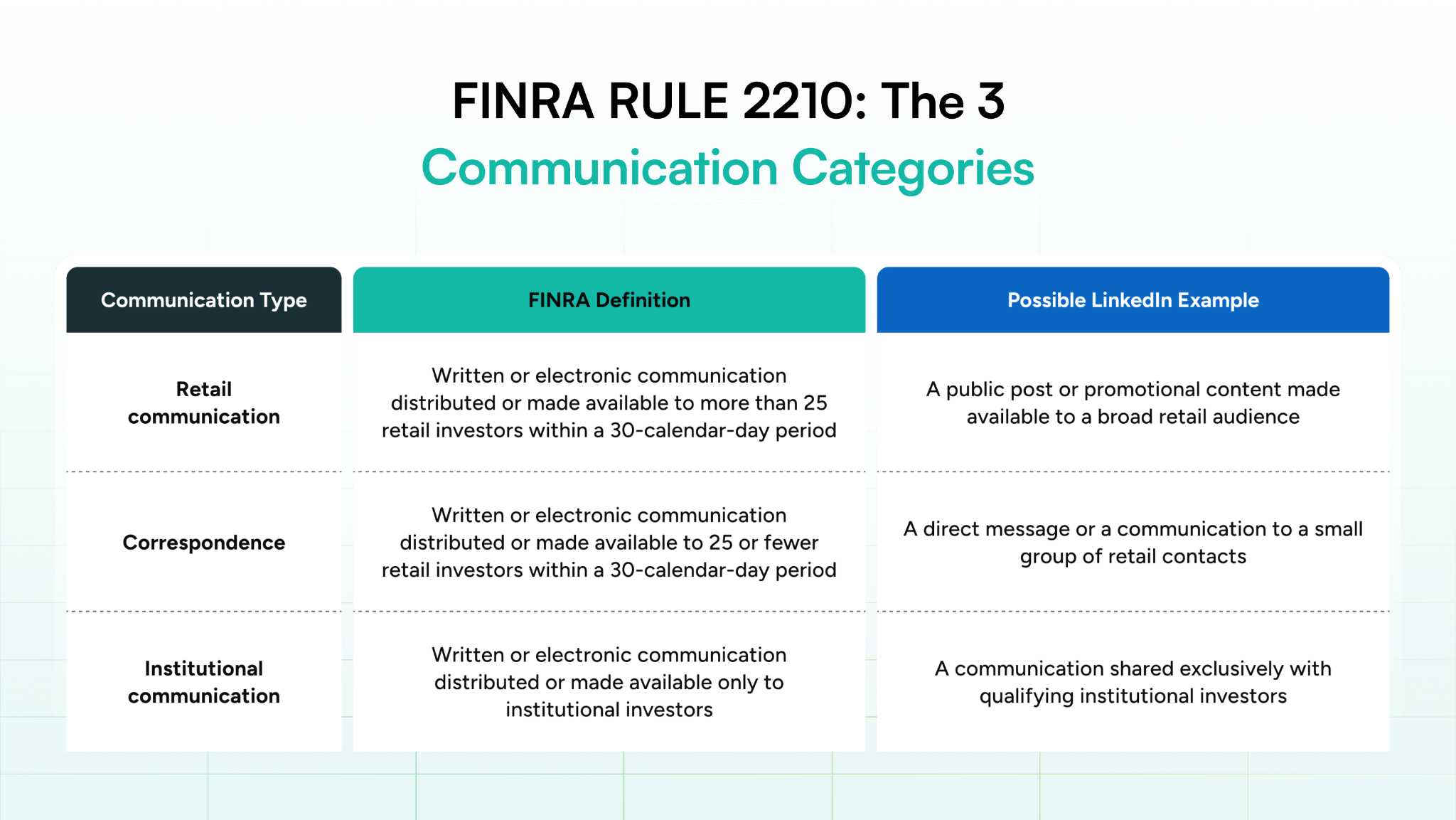
Note: These examples are illustrative, and the classification of each communication depends on its circumstances. A public LinkedIn post may be a retail communication, but the firm must assess the circumstances, including its distribution and intended audience. Similarly, a direct message is not automatically correspondence in every situation; the audience and applicable definitions will matter.
Each category can trigger different approval and supervisory procedures. For example, a communication intended for institutional investors should not be treated as institutional if it is also available to retail investors.
Static Profile Content and Interactive Posts Are Treated Differently
A LinkedIn profile contains information that can remain visible for months or years. An executive’s headline, About section, Experience descriptions, service descriptions, and Featured content may promote the individual’s professional services or the firm’s business. FINRA’s social media guidance distinguishes this kind of static content from interactive communications.
Under FINRA Regulatory Notice 10-06, static content on a social networking site is generally treated as an advertisement. Where it qualifies as a retail communication, the firm’s applicable Rule 2210 approval requirements may therefore apply before it is used. A material change to approved content may also require further review.
Interactive content is different. Posts and comments made in an online interactive electronic forum generally fall within an exception to the prior principal approval requirement. That does not mean they are exempt from FINRA’s content standards or the firm’s supervisory obligations. The firm must still have procedures for supervising the activity.
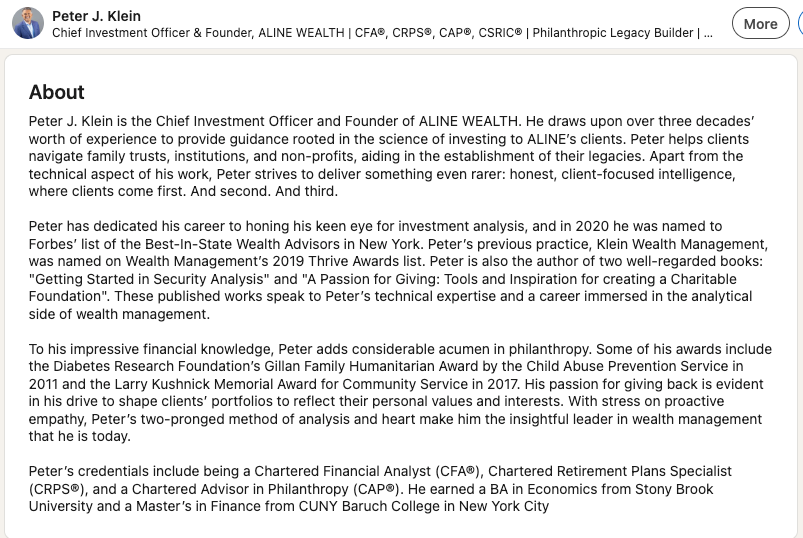
The nuances can be easy to miss. An executive may think of their LinkedIn profile as a personal introduction, but a headline such as “Helping investors achieve market-beating returns” or an About section describing the firm’s investment services may function as promotional communication. The fact that the content appears on an individual’s profile does not, by itself, take it outside the regulatory framework.
Example: An executive uses their LinkedIn About section to describe their firm's investment services, highlight professional credentials, and discuss their approach to managing client portfolios. Because this information remains visible on their profile, the firm should assess it under its procedures for static communications, including reviewing any promotional statements or claims about professional expertise for accuracy and compliance with applicable requirements.
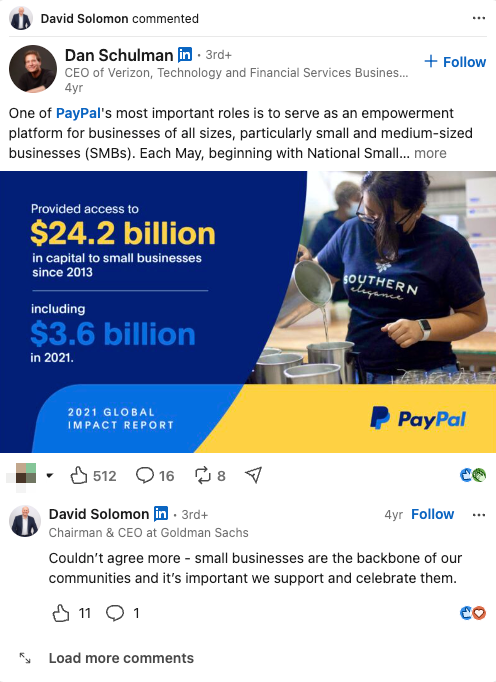
By contrast, the executive’s response to a comment on a LinkedIn post may be treated as an interactive communication. It may not require prior principal approval under the online interactive forum exception, but it must still comply with applicable content standards and the firm’s supervision procedures.
The Content Must Be Fair, Balanced, and Not Misleading
Rule 2210 requires communications with the public to be fair and balanced and to provide a sound basis for evaluating the facts about a security, industry, or service. Communications must not contain false, exaggerated, unwarranted, promissory, or misleading statements or claims. They must also not omit material information or qualifications in a way that makes the communication misleading.
For executives posting on LinkedIn, this applies to more than formal product promotions. A claim about the firm’s investment performance, a statement about the likely direction of a market, or a description of the results clients can expect may all raise questions under the rule.
Consider a few examples:
- Potentially misleading: “Our strategy consistently delivers superior returns.” This is a broad performance claim that would need to be assessed for accuracy, substantiation, and the relevant context.
- Potentially misleading: “This is the safest way to invest in today’s market.” The absolute wording may imply a level of certainty or protection that cannot be supported.
- Needs context: “We helped clients navigate market volatility.” The firm would need to consider whether the statement is accurate, whether it implies a particular outcome, and whether relevant qualifications are missing.
- More measured: “Our investment team recently published its analysis of the factors influencing market volatility.” This is a more factual description, although the underlying analysis and any linked material must still meet applicable standards.
Executives should be particularly careful with statements that imply guaranteed outcomes, predict future performance, or suggest that past performance will necessarily continue. Rule 2210 restricts predictions and projections of performance, as well as exaggerated or unwarranted claims, subject to specific exceptions. A disclaimer at the end of a post does not automatically correct a misleading headline or unsupported claim.
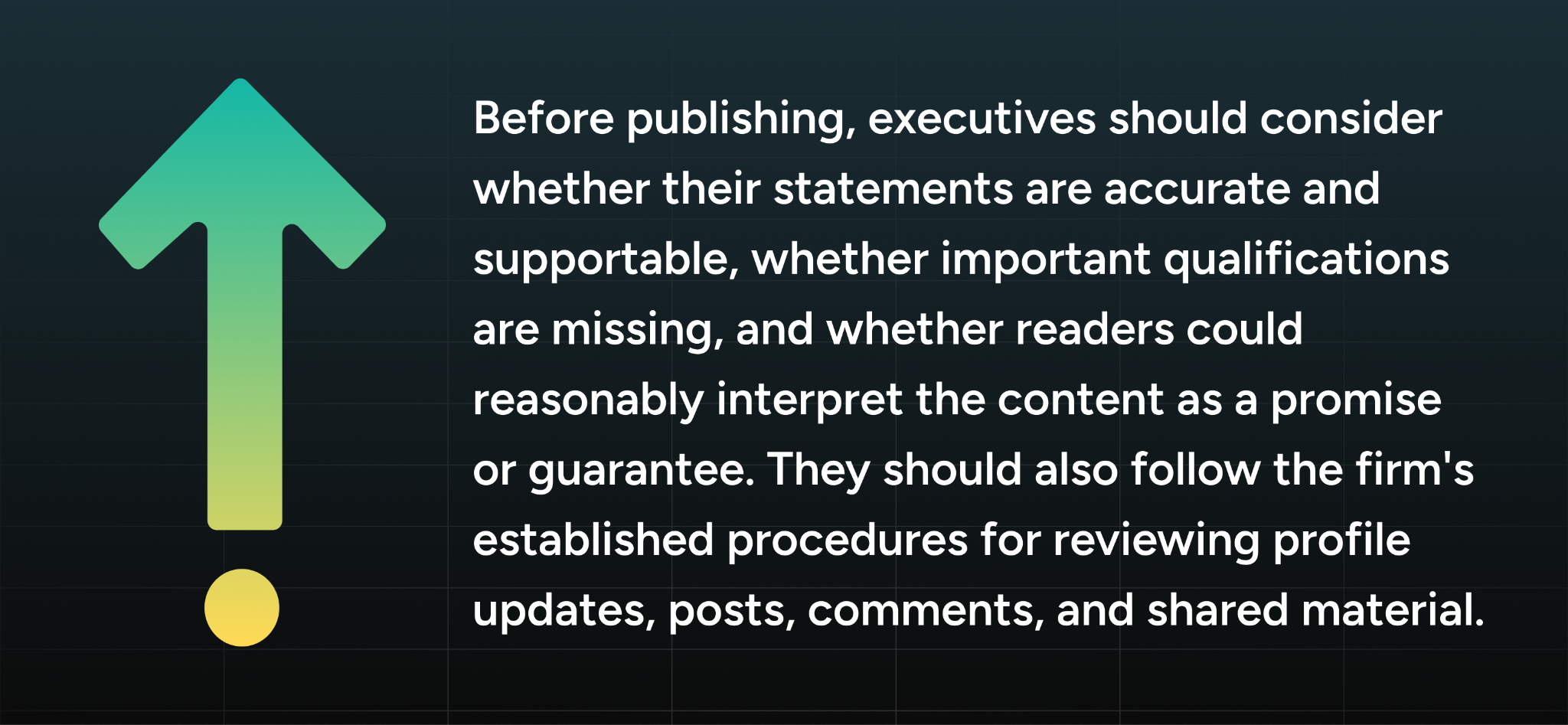
The same care applies when an executive shares or comments on another person’s content. Reposting a client testimonial, endorsing a third-party investment claim, or adding a positive comment to a promotional post can raise compliance issues. The firm should have clear procedures for deciding which third-party content employees may share, endorse, or engage with in a business capacity.
FINRA Rule 3110: How Firms Must Supervise LinkedIn Activity
Rule 2210 establishes standards for communications with the public. Rule 3110 addresses what the firm must do to oversee those communications.
It requires FINRA member firms to establish, maintain, and enforce a supervisory system reasonably designed to achieve compliance with applicable securities laws and FINRA rules. The firm must also document its supervisory arrangements in written supervisory procedures.
For LinkedIn, this means a firm can’t just rely on employees exercising good judgment when posting online. It needs a defined process for identifying business-related social media activity, determining who is responsible for reviewing it and responding when potential compliance issues arise.
What Should a Firm's Social Media Procedures Cover?
A firm's written supervisory procedures should explain how employees may use social media for business purposes and how that activity will be supervised. The procedures should be specific enough to guide executives and compliance teams rather than simply stating that employees must follow the firm's social media policy.
At a minimum, firms should consider the following areas:
1. Approved accounts and business use
The firm should identify which LinkedIn accounts and activities are permitted for business purposes. This may include an executive's professional profile, Company Page, business-related posts, comments, direct messages, and participation in industry discussions.
The policy should also clarify whether employees may use personal accounts to discuss the firm's business. Calling an account personal does not necessarily make business-related communications on it exempt from supervision.
2. Review and approval responsibilities
The procedures should identify which content requires prior approval and who is authorized to provide it. For example, static profile content that functions as an advertisement may require prior principal approval under Rule 2210. Interactive posts may fall within the online forum exception, but still need to be supervised under the firm's procedures.
Executives should know which changes they can make independently and which must go through compliance. A profile update that changes the description of the firm's services, adds a performance claim, or introduces a new product reference may need review before publication.
3. Ongoing monitoring
Firms should establish a reasonable process for reviewing business-related LinkedIn activity. Depending on the firm's business and risk profile, this may involve scheduled reviews, automated monitoring, keyword alerts, sampling, or other controls.
Monitoring should help firms identify communications that may create regulatory or reputational risks, including unsupported claims, unapproved promotions, misleading testimonials, and disclosures of confidential information.
4. Training and escalation
Employees should receive guidance on what they can discuss, what requires approval, and how to handle questions or comments that raise compliance concerns.
FINRA Regulatory Notice 11-39 specifically discusses training and education, following up on red flags, and monitoring social media activity. It also describes measures firms may use, such as employee certifications and spot checks of websites. These are examples of possible supervisory controls, not a single mandatory monitoring method for every firm.
For instance, if an executive repeatedly makes claims about investment performance that have not been reviewed, the firm should have a process for identifying the issue, investigating it, and taking appropriate corrective action.
The Firm Remains Responsible for Supervision
It would be wrong to assume that an executive's seniority or personal ownership of a LinkedIn account makes the individual solely responsible for its content. The firm's supervisory responsibilities remain relevant when the account is used for business communications.
Founders, CEOs, and other senior leaders often have profiles closely associated with their firms, and their public statements may carry considerable commercial influence. They remain subject to applicable supervisory requirements regardless of their position within the organization.
Firms may also impose stricter internal controls than the minimum requirements under FINRA rules. For example, a firm may require all business-related posts to be submitted for review, even where a particular interactive communication would not require prior principal approval under Rule 2210.
SEC Exchange Act Rules 17a-3 and 17a-4: What Firms Must Record and Preserve
Approval and supervision are only part of the compliance process. Broker-dealer firms must also meet applicable books-and-records requirements.
SEC Exchange Act Rule 17a-3 addresses the records broker-dealers must make and keep current. Rule 17a-4 addresses how certain records must be preserved, including communications relating to the firm's broker-dealer business.
These are SEC rules, rather than FINRA rules, but they are an important part of the regulatory framework for FINRA-member broker-dealers.
Rule 17a-3: Creating the Required Records
Rule 17a-3 sets out the books and records that a broker-dealer must create and maintain in connection with its business. The precise requirements depend on the type of record and the firm's activities.
In the context of LinkedIn, the key point is that business communications may create recordkeeping obligations. A communication does not necessarily become a required record just because it appears on social media. Its business purpose, content, and applicable recordkeeping provisions need to be considered.
For example, a LinkedIn exchange in which an executive discusses a firm's services with a prospective client may need to be considered under the firm's recordkeeping procedures. A business-related message that progresses into a discussion about an account or securities transaction may raise additional recordkeeping considerations.
Firms should therefore define which LinkedIn communications must be captured and how employees should ensure that business communications are conducted through approved channels.
Rule 17a-4: Preserving Communications and Other Records
Rule 17a-4 establishes preservation requirements for records covered by the rule. This includes originals of communications received and copies of communications sent by a broker-dealer relating to its business, as well as applicable approvals.
The rule also specifies different retention periods depending on the record category. For example, under Rule 17a-4(b), certain business-related communications must be preserved for three years, with the first two years maintained in an easily accessible place. Other categories of records have different retention requirements, so firms should determine the applicable period for each type of record.
For executives, these obligations may extend to business-related LinkedIn messages, posts, and other communications covered by the relevant provisions. Firms should also maintain appropriate documentation demonstrating that required reviews and approvals have been completed.
SEC Rules for LinkedIn: Advertising, Endorsements, and Records
For executives at SEC-registered investment advisers, LinkedIn activity raises a different set of compliance considerations from those that apply to FINRA-member broker-dealers. The central regulation is the SEC's Investment Adviser Marketing Rule, Rule 206(4)-1 under the Investment Advisers Act of 1940.
The rule modernized the SEC's approach to investment adviser advertising, bringing together the previous advertising and cash solicitation provisions into a single framework. It recognizes that advisers now promote their services through a range of channels and formats, including websites, social media, testimonials, endorsements, and third-party ratings.
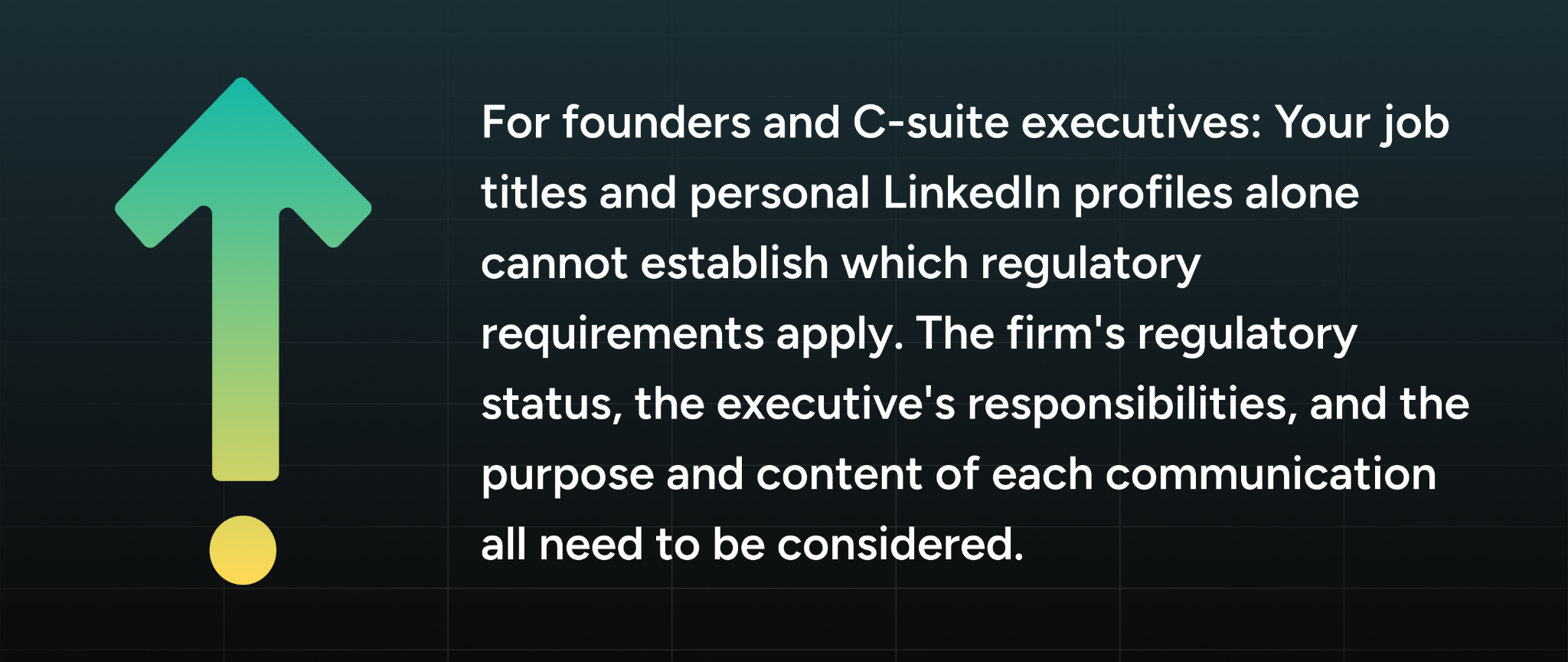
For LinkedIn, the important consideration is whether the communication falls within the Marketing Rule's definition of an advertisement and, if it does, whether it meets the rule's requirements. The framework is relevant to SEC-registered investment advisers, and advisers required to be registered with the SEC when they disseminate communications within the rule's scope. It does not automatically apply to every financial services executive, every broker-dealer, or every LinkedIn post. An executive's role, the firm's regulatory status, and the purpose and content of the communication all matter.
The SEC framework can be understood through four areas: determining whether a communication is an advertisement, meeting the rule's general content standards, complying with requirements for testimonials and endorsements, and maintaining the necessary records.
When Does a LinkedIn Post Become an Advertisement?
Under Rule 206(4)-1, the definition of an advertisement has two main parts. The first covers certain communications made directly or indirectly by an investment adviser that offer the adviser's investment advisory services to prospective clients or private fund investors, or to new investors in a private fund. The second covers certain compensated testimonials and endorsements, as well as third-party ratings, subject to the rule's conditions and exclusions.
It is important to note that not every LinkedIn post by an investment adviser is automatically an advertisement. A post sharing general industry commentary, for example, may not meet the definition. A post promoting the firm's advisory services or inviting prospective clients to engage with the firm may fall within it.
The First Part: Communications Offering Advisory Services
The first part of the definition covers communications that offer the investment adviser's services to prospective clients or private fund investors. It includes communications made directly by the adviser and those made indirectly on its behalf.
A LinkedIn post may fall within this definition when it promotes the firm's advisory offering, describes its investment management services, or encourages prospective clients to consider engaging the adviser.
Examples include:
- A post explaining the firm's investment advisory services and inviting prospective clients to schedule a consultation.
- An executive's About section describing the firm's wealth management offering and encouraging visitors to inquire about becoming clients.
- A Company Page post promoting a new investment advisory service to prospective clients.
- A post linking to a landing page designed to attract prospective clients for the firm's advisory services.
The communication needs to be assessed in context. A post does not become an advertisement only because it mentions the firm or its services. Equally, avoiding an explicit sales pitch does not necessarily keep a promotional communication outside the rule.
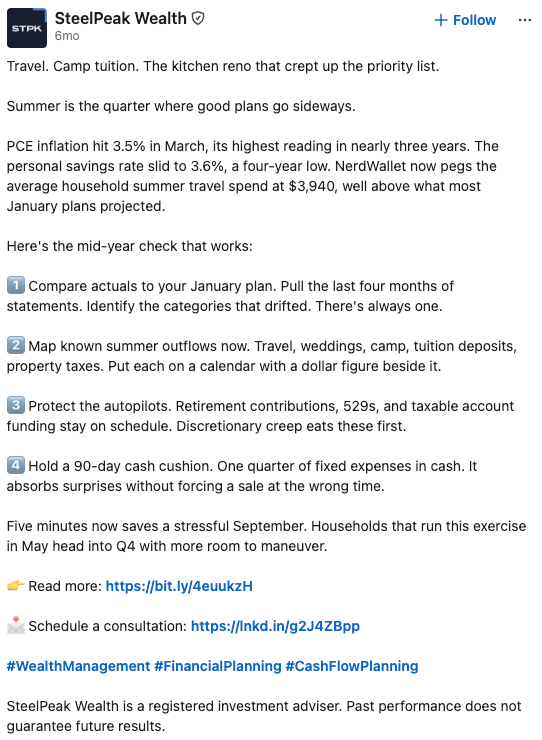
Consider the above LinkedIn post published by SteelPeak Wealth, a registered investment adviser. The post discusses household financial planning and managing upcoming expenses, before inviting readers to schedule a consultation. Although much of the content is educational, the direct invitation to engage the firm, combined with its promotion of financial planning services, makes it a useful example of a communication that may fall within the first part of the SEC Marketing Rule's advertisement definition.
Note: This is an illustrative example, not an SEC determination.
The Second Part: Testimonials, Endorsements, and Third-Party Ratings
The second part of the definition covers certain testimonials and endorsements when an adviser provides compensation, directly or indirectly, for them. It also covers third-party ratings relating to the adviser, subject to the rule's requirements and exclusions.
These provisions are relevant to LinkedIn, where advisers may feature client recommendations, influencer partnerships, industry rankings, and external reviews to establish credibility.
For example, an adviser that pays a business influencer to recommend its services on LinkedIn may be using an endorsement within the scope of the Marketing Rule. Similarly, an adviser that features a third-party rating in a LinkedIn post or on its profile may need to meet the rule's conditions for third-party ratings.
The fact that the content appears on another person's account does not necessarily take it outside the rule. If the adviser is involved in arranging, disseminating, or compensating for the communication, the circumstances need to be assessed.
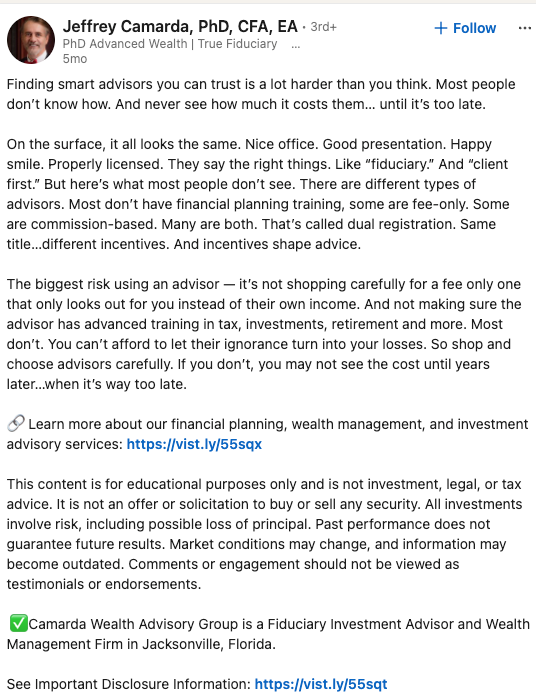
The advertisement does not have to appear on the advisory firm's official LinkedIn page. A post published by an individual executive may also fall within the SEC Marketing Rule's definition if the executive is communicating directly or indirectly on behalf of the investment adviser to promote its advisory services.
For example, Jeffrey Camarda has published LinkedIn posts discussing the importance of fiduciary advice and directing readers toward the financial planning, wealth management, and investment advisory services offered by Camarda Wealth Advisory Group.
This illustrates why compliance teams need to review executives' personal LinkedIn activity when it is used to promote the adviser's business. The relevant question is not simply whether the post appears on a company page or an individual's profile, but whether it is an adviser communication offering advisory services to prospective clients or private fund investors. Whether a particular post meets the definition depends on its content, context, and purpose.
What Is Excluded From the Definition?
The Marketing Rule contains exclusions that are important when assessing LinkedIn activity. These include certain extemporaneous, live oral communications; certain information in a statutory or regulatory notice, filing, or other required communication; and certain communications that do not offer advisory services.
The rule also excludes certain communications that include hypothetical performance, provided they are offered in response to an unsolicited request or to a private fund investor in specified circumstances. These are narrow exclusions, not a general exemption for social media content.
Executives need to differentiate between sharing information as part of ordinary professional commentary and communicating in a way that offers the firm's advisory services or promotes an investment opportunity.
For example: An executive posts an analysis of recent interest-rate movements and discusses how the development may affect the broader market. Depending on the content and context, this may be general commentary rather than an advertisement.
If the same post concludes with an invitation to prospective investors to engage the firm for portfolio management services, the communication may fall within the first part of the Marketing Rule's definition. The firm should assess the entire communication, including its call to action and any linked material.
The SEC Marketing Rule's General Prohibitions
Once a LinkedIn communication qualifies as an advertisement, it must comply with the Marketing Rule's seven general prohibitions. These apply regardless of whether the advertisement appears on an executive's personal profile, the adviser's Company Page, a sponsored post, or another online channel.
The rule is principles-based: it does not provide a list of approved phrases or a template that makes every post compliant. Instead, it requires advisers to consider whether the overall communication could mislead a prospective client or investor.
Material Claims Must Be Accurate and Supportable
An advertisement must not contain an untrue statement of material fact or leave out information needed to prevent a statement from being misleading. It must also not include a material factual claim unless the adviser has a reasonable basis for believing it can substantiate that claim if the SEC asks for evidence.
This is relevant to the way executives describe their firms on LinkedIn. Statements about assets under management, investment performance, client outcomes, years of experience, investment expertise, or the firm's track record should be accurate and supported by appropriate records.
Consider these examples:
- Unsupported: “We help clients consistently outperform the market.” The firm would need to substantiate the performance claim and assess whether the wording creates a misleading impression.
- Potentially incomplete: “We manage $5 billion in assets.” The adviser should be able to support the figure and ensure it is presented with the appropriate context, including what the figure represents and the date to which it relates.
- More specific: “As of [date], the firm reported $5 billion in regulatory assets under management.” This gives the reader a clearer basis for understanding the figure, although the firm must still verify the calculation and use of the term.
Avoid Implications That Create a Misleading Impression
An advertisement can be misleading even if every individual sentence is technically accurate. The SEC rule also prohibits information that would reasonably be likely to cause an untrue or misleading implication or inference about a material fact relating to the adviser.
For example, an executive might publish a post celebrating a successful investment outcome for one client. If the post implies that the result is typical of the firm's overall performance, the communication could create a misleading impression, even if the individual result is genuine.
Similarly, describing a strategy as “proven” or “low risk” without adequate context may suggest a degree of certainty that the adviser cannot support.
Executives should therefore review not only the literal wording of a post but also the impression it is likely to leave with its intended audience.
Benefits Must be Presented Alongside Material Risks and Limitations
The rule requires fair and balanced treatment of potential benefits and any associated material risks or limitations.
This also applies to LinkedIn posts that explain an investment strategy, describe a financial product, or promote a particular approach to portfolio management.
For example, an executive might write: “Our strategy gives investors access to attractive returns through a diversified portfolio of emerging-market opportunities.”
If the post discusses potential returns but omits material risks associated with emerging markets, such as currency volatility, liquidity constraints, or political and regulatory uncertainty, the overall presentation may not be balanced.
The requirement does not mean every LinkedIn post needs a lengthy risk disclosure. It means that when an advertisement discusses potential benefits, it must give fair treatment to the material risks and limitations associated with those benefits.
References to Specific Investment Advice Must be Fair and Balanced
An advertisement that refers to specific investment advice provided by the adviser must present that advice in a fair and balanced manner.
For example, an executive might highlight a successful investment recommendation in a LinkedIn post. If the post selectively presents the positive outcome while leaving out relevant context, it may give readers an incomplete picture of the adviser's investment advice.
The firm should assess whether the example is representative, whether important qualifications are missing, and whether the communication could be interpreted as evidence of broader investment success.
Performance Information Requires Particular Care
Performance claims are among the most closely regulated aspects of investment adviser advertising. The Marketing Rule places specific conditions on how advisers may present performance information.
Some of the key requirements include:
- Gross and net performance: An advertisement generally cannot show gross performance without also showing net performance. The two presentations must be calculated over the same period and using the same methodology, and presented in a way that facilitates comparison.
- Prescribed time periods: Performance generally needs to be presented over one-, five-, and ten-year periods, with each period ending on a date no less recent than the most recent calendar year-end. If the relevant portfolio has not existed for a required period, its actual life is used instead. The rule contains specific treatment for private fund performance.
- Related performance: Advisers generally cannot select only the best-performing accounts or portfolios from a group of substantially similar portfolios. The rule requires performance to be presented in a way that does not cherry-pick results, subject to specified exceptions.
- Extracted performance: If an adviser presents the performance of selected investments taken from a larger portfolio, the rule generally requires the total portfolio's performance to be provided as well, subject to the rule and relevant SEC staff guidance.
- Hypothetical performance: Model, backtested, and projected performance is subject to additional requirements. Advisers must have policies and procedures reasonably designed to ensure the information is relevant to the likely financial situation and investment objectives of the intended audience, and must provide sufficient information to understand the assumptions and risks involved.
- Predecessor performance: An adviser may use performance from a predecessor firm only when the applicable conditions are met, including requirements concerning the personnel and accounts responsible for the performance and appropriate disclosures.
The rule also prohibits statements suggesting that the SEC has approved or reviewed an adviser's performance calculations or presentation.
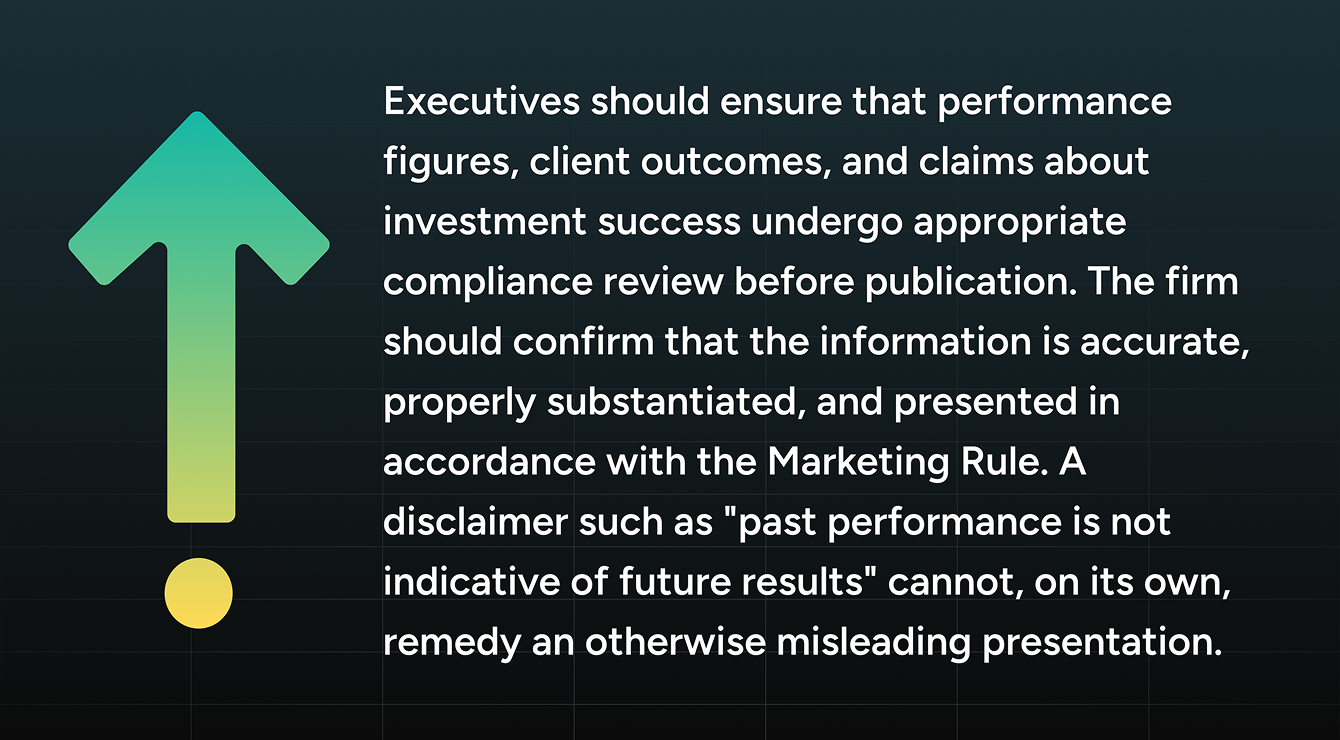
These requirements apply even when performance information is presented in a short LinkedIn post or graphic. A chart showing a strategy's historical returns, for example, does not become exempt from the Marketing Rule because it is designed for social media.
The SEC staff's Marketing Compliance FAQs provide further guidance on how these provisions apply in specific circumstances. In its January 2026 update, the staff addressed questions involving model fees and the presentation of gross and net performance, among other issues. The FAQs are staff views, not binding rules or Commission-approved interpretations, but they are useful when assessing how the SEC staff approaches particular compliance questions.
Testimonials, Endorsements, and Third-Party Ratings
LinkedIn gives investment advisers several ways to share recommendations and external recognition. Clients may describe their experiences with an adviser, industry professionals may recommend a firm, and executives may highlight rankings published by financial publications.
The SEC Marketing Rule permits testimonials, endorsements, and third-party ratings in advertisements, but only when the applicable conditions are met. The requirements vary by content type.
Testimonials: When a Client Recommends the Adviser
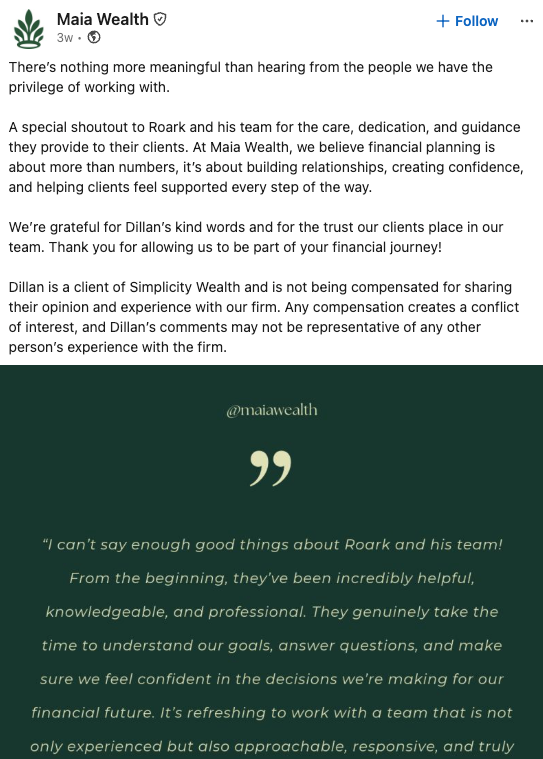
A testimonial is a statement made by a current client or investor in a private fund advised by the adviser that describes their experience with the adviser or its supervised persons, solicits prospective clients or investors, or refers them to the adviser.
On LinkedIn, this could include:
- A client recommending the firm in a post.
- A client describing their experience working with an investment adviser.
- A client publishing a recommendation that the adviser then shares on its company page.
- A client commenting that the firm's investment team helped them achieve a particular financial outcome.
A client's decision to publish a recommendation voluntarily does not establish whether the adviser may use it in an advertisement. If the adviser incorporates or shares the statement as promotional content, the applicable Marketing Rule requirements must be considered.
Endorsements: When Someone Other Than a Client Promotes the Adviser
An endorsement is a statement by someone other than a current client or private fund investor that indicates approval, support, or recommendation of the adviser or its supervised persons, describes their experience with the adviser, solicits prospective clients or investors, or refers them to the adviser.
For example, an industry commentator who recommends an investment adviser on LinkedIn may be providing an endorsement. The same may apply to a business influencer who publishes a sponsored post promoting the adviser's services.
The difference between a testimonial and an endorsement is important because the rule defines them by the relationship between the person making the statement and the adviser.
Required Disclosures: Who Is Speaking, and Are They Being Compensated?
When an advertisement includes a testimonial or endorsement, the adviser must ensure that the required disclosures are made clearly and prominently at the time the communication is disseminated.
These include:
- Whether the person giving the testimonial/endorsement is a current client or investor, or not.
- Whether the person has received cash or non-cash compensation.
- A brief statement of any material conflicts of interest arising from the person's relationship with the adviser.
- The material terms of any compensation arrangement, including a description of the compensation provided or to be provided.
- A description of any material conflicts of interest arising from the relationship or compensation arrangement.
For example, if an adviser compensates a business influencer to recommend its services, the post cannot simply read “I highly recommend this firm.” The required disclosures must explain the promotional relationship and relevant compensation and conflicts.
A vague hashtag or disclosure buried among unrelated hashtags may not provide the clear and prominent disclosure required by the rule. The adviser should ensure that the reader can understand the relationship without having to search for it.
Oversight, Written Agreements, and Disqualification
The adviser must have a reasonable basis for believing that the testimonial or endorsement complies with the Marketing Rule. This means it needs a process for checking the promoter, the content, and the relevant disclosures rather than simply allowing the post to go live.
The rule also generally requires a written agreement between the adviser and the promoter describing the scope of the agreed activities and the terms of compensation.
There are limited exceptions. A written agreement is not required for a promoter who is an affiliate of the adviser or who receives de minimis compensation of no more than $1,000, or the equivalent value in non-cash compensation, during the preceding 12 months. The de minimis exception also affects certain disqualification requirements; it does not remove all disclosure and oversight obligations.
The rule further restricts compensation of promoters who are ineligible persons because of specified disqualifying events within the preceding ten years, subject to the rule's exceptions. Advisers need to assess these requirements before engaging a promoter.
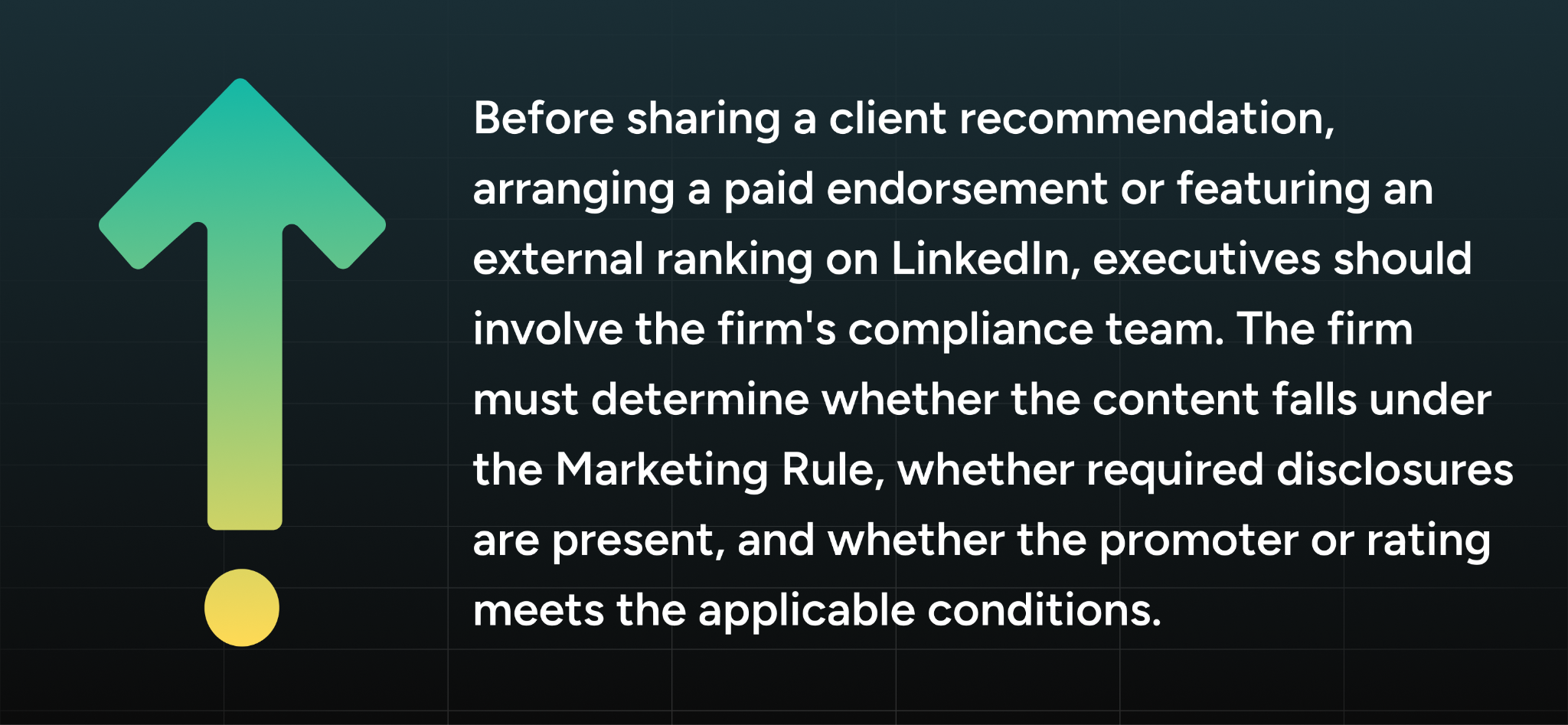
For an executive, this has practical implications when arranging LinkedIn collaborations. A paid recommendation, a complimentary service offered in exchange for a post, or another non-cash benefit may constitute compensation. The firm should determine whether the activity falls within the rule and ensure the relevant disclosures and controls are in place.
Third-Party Ratings: Using External Rankings and Awards
A third-party rating is a rating or ranking of an investment adviser provided by someone who is not a related person and who provides ratings or rankings in the ordinary course of business.
Examples might include:
- An industry publication ranking the adviser among the leading firms in its category.
- A financial services platform giving the firm a rating based on a survey.
- An independent organization recognizing the adviser in an annual industry ranking.
The adviser may include a third-party rating in an advertisement only if it meets the rule's conditions.
First, the adviser must have a reasonable basis for believing that any questionnaire or survey used to prepare the rating is structured to make it equally easy for participants to provide favorable and unfavorable responses. It must not be designed to produce a predetermined result.
Second, the advertisement must clearly and prominently disclose:
- The date on which the rating was given and the period it covers.
- The identity of the third party that created and tabulated the rating.
- Whether the adviser provided compensation, directly or indirectly, in connection with obtaining or using the rating.
For example, an adviser that posts “Named one of the top wealth management firms of the year” should not assume that the award can be used without further checks. It should understand how the ranking was produced, who conducted it, what period it covers, and whether any compensation was involved.
SEC Books-and-Records Requirements: What Advisers Must Retain
The Marketing Rule governs what an adviser can communicate in its advertisements. Rule 204-2 under the Investment Advisers Act addresses the records advisers must create and maintain to show how they conducted their business and complied with applicable requirements.
For LinkedIn, compliance responsibilities continue after an advertisement has been approved or published. Advisers must preserve covered communications and maintain the supporting records required under the rule.
Copies of Advertisements and Other Communications
Under Rule 204-2(a)(11), advisers must make and keep a copy of each advertisement they disseminate, directly or indirectly.
This can include LinkedIn content such as:
- Promotional posts published on an executive's profile or the firm's company page.
- Sponsored posts and other paid promotional content.
- Videos, graphics, and other material used to advertise advisory services.
- Advertisements featuring testimonials, endorsements, or third-party ratings.
- Other specified communications distributed to ten or more people outside the firm.
The requirement is not limited to content published by the adviser's marketing department. If an executive disseminates an advertisement on the firm's behalf, the adviser needs to consider its recordkeeping obligations too.
For oral advertisements, the rule allows certain alternative methods of recordkeeping, including retaining written or recorded materials used in connection with the communication. There are also specific provisions for compensated oral testimonials and endorsements.
Records Supporting Claims, Performance, and Disclosures
Keeping a copy of the LinkedIn post is only one part of the requirement. The adviser may also need to retain records that support the claims and disclosures contained in it.
Rule 204-2 includes specific recordkeeping requirements relating to marketing communications, including:
1. Performance calculations and supporting documentation
Advisers must retain the books, records, internal working papers, and other documents necessary to form the basis for, or demonstrate, the calculation of performance or rates of return presented in advertisements and other communications.
For example, if a LinkedIn graphic presents the firm's historical investment performance, the adviser should retain the underlying calculations and supporting material needed to demonstrate how those figures were derived.
2. Testimonial and endorsement disclosures
If the required disclosures are not included in the advertisement itself, the adviser must retain a record of the disclosures provided to clients or investors.
For example, if a firm shares a client recommendation or paid endorsement on LinkedIn, it should be able to demonstrate which disclosures accompanied the communication and how the applicable requirements were addressed.
3. Evidence supporting testimonials, endorsements, and third-party ratings
The adviser must retain documentation substantiating its reasonable basis for believing that a testimonial or endorsement complies with the Marketing Rule and that a third-party rating meets the rule's requirements.
For a paid endorsement, this may include records of the promoter's relationship with the firm, the relevant compensation arrangement, the review process, and supporting disclosures.
For a third-party rating, the adviser should retain relevant material supporting its assessment of the rating's preparation and the disclosures made. Rule 204-2 also specifically requires a copy of a questionnaire or survey used to prepare a third-party rating if the adviser obtains a copy.
4. Records relating to performance audiences
For certain performance presentations, the adviser must maintain a record of the intended audience. This is particularly relevant to hypothetical performance, where the rule requires advisers to consider whether the information is relevant to the likely financial situation and investment objectives of the intended audience.
These records help demonstrate that the adviser considered not just what it published, but also whether the presentation was appropriate for the people expected to receive it.
How Long Must These Records Be Retained?
Under Rule 204-2(e), the records covered by the advertising and performance provisions in paragraphs (a)(11) and (a)(16) generally must be maintained in an easily accessible place for at least five years from the end of the fiscal year in which the adviser last published or otherwise disseminated the relevant communication. The first two years must be kept in an appropriate office of the adviser.
The retention period is linked to the last dissemination of the communication, rather than simply the date on which it was first published. Other records under Rule 204-2 may have different retention requirements, so advisers should apply the period relevant to each record category.
What Does This Mean for LinkedIn Archiving?
A screenshot of a LinkedIn post may help preserve how the content appeared, but it may not capture all the records required under Rule 204-2.
For example, a screenshot of a post featuring a client testimonial may show the wording and accompanying disclosure. It may not, on its own, show the adviser's basis for believing the testimonial complied with the rule, the terms of a compensation arrangement, or the review undertaken before publication.
A more complete recordkeeping process should account for the relevant material, which may include:
- The published advertisement and any associated graphics, videos, or links.
- The date of publication and the period during which the content was disseminated.
- The final approved version and relevant review documentation, where maintained under the firm's procedures.
- Supporting evidence for material factual and performance claims.
- Required testimonial, endorsement, and third-party rating disclosures.
- Compensation arrangements and relevant promoter documentation.
- Performance calculations and supporting working papers.
- Records of the intended audience where required.
The adviser should establish how it will capture, index, retrieve, and preserve these records in accordance with its recordkeeping obligations. Rule 204-2 permits electronic storage, subject to requirements designed to safeguard records and make them accessible and reproducible when requested by the SEC.
Advisers should have a recordkeeping process that captures both the advertisement and the material needed to support it. Executives should not assume that deleting a LinkedIn post removes the firm's obligation to retain the relevant records.
How the SEC Requirements Work Together
Consider an investment adviser whose CEO publishes a LinkedIn post promoting the firm's investment strategy. The post includes a client recommendation and a chart showing historical performance.
The firm would need to consider several requirements:
- Rule 206(4)-1 – Advertisement: Determine whether the post falls within the definition of an advertisement and assess it against the seven general prohibitions.
- Rule 206(4)-1 – Testimonial: If the client recommendation qualifies as a testimonial, ensure that the required disclosures, oversight, and other applicable conditions are met.
- Rule 206(4)-1 – Performance: Check that the performance information meets the applicable presentation requirements, including gross and net performance and the relevant time periods.
- Rule 204-2 – Recordkeeping: Retain the advertisement, relevant performance calculations and supporting material, and records relating to the testimonial and its disclosures.
FINRA vs. SEC: Where the Rules Differ and Where They Intersect
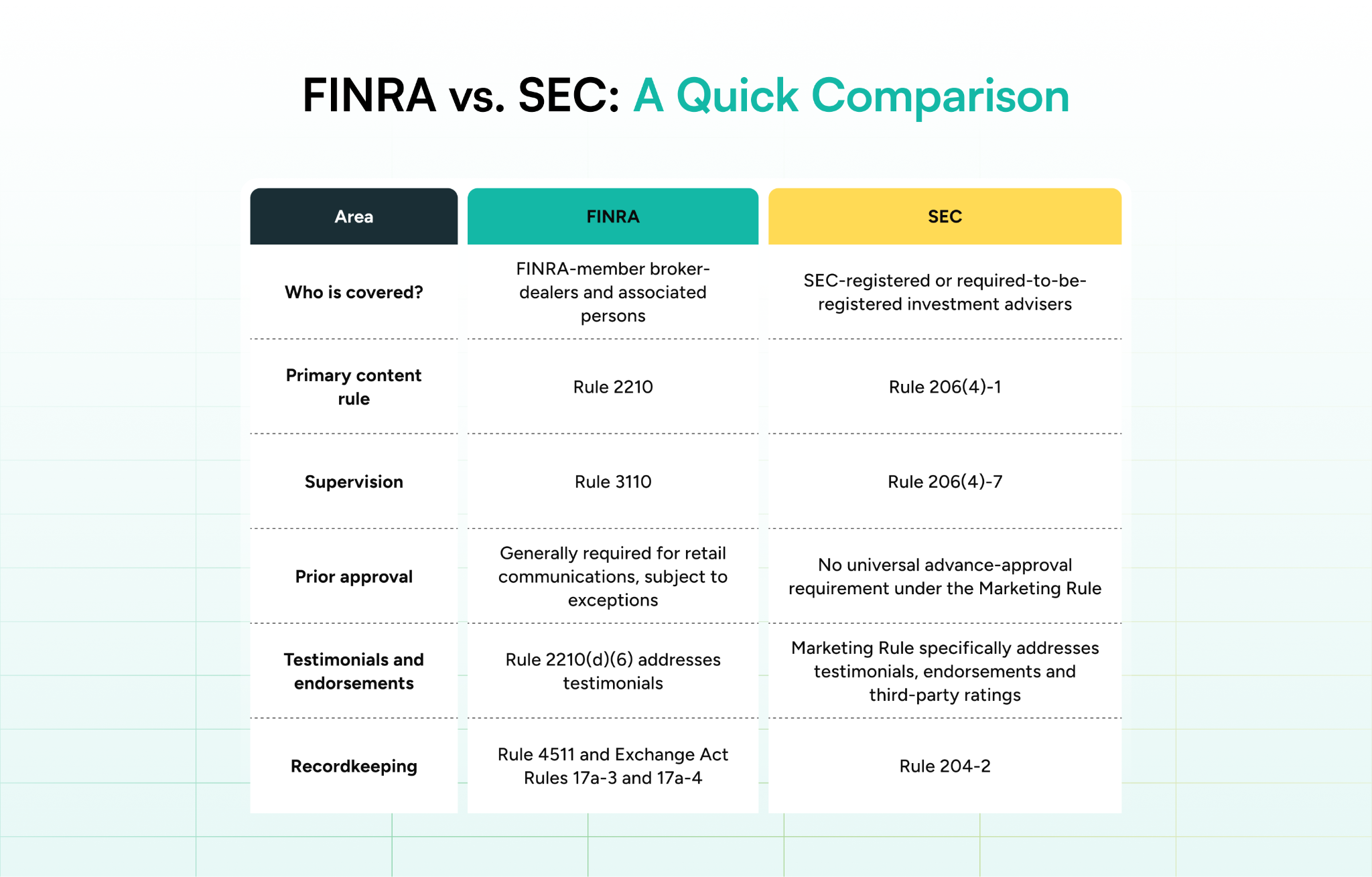
Even though FINRA and the SEC both regulate aspects of financial-services communications, their requirements are not interchangeable. Which rules apply to a LinkedIn post depends on the regulated entity, the services being promoted, and the capacity in which the executive is communicating.
For executives at dual-registered firms, a single post may raise obligations under both frameworks. This understanding is particularly important when reviewing promotional content, client testimonials, and business-related activity on personal LinkedIn accounts.
Where the Requirements Differ
The biggest differences concern the scope of the rules, pre-publication approval, and the treatment of testimonials and endorsements.
Scope:
FINRA Rules 2210 and 3110 apply to communications and supervision involving FINRA-member broker-dealers and their associated persons. The SEC Marketing Rule applies to advertisements by investment advisers registered or required to be registered with the SEC.
Content Standards:
Both frameworks prohibit misleading communications. However, FINRA Rule 2210 establishes standards for public communications, while the SEC Marketing Rule sets out seven general prohibitions specifically for investment adviser advertisements, alongside detailed requirements for performance claims.
Approval and Supervision:
FINRA generally requires principal approval of retail communications before first use, subject to exceptions. The SEC Marketing Rule does not impose universal advance approval of advertisements, although Rule 206(4)-7 requires advisers to maintain compliance policies and procedures.
Testimonials and Endorsements:
FINRA Rule 2210(d)(6) sets conditions for testimonials in retail communications and correspondence. The SEC Marketing Rule has a more detailed framework covering testimonials, endorsements, and third-party ratings, including disclosure, oversight, and disqualification requirements.
Recordkeeping:
Broker-dealers follow FINRA Rule 4511 and Exchange Act Rules 17a-3 and 17a-4. SEC-registered investment advisers follow Rule 204-2, including its requirements for retaining advertisements and supporting records.
What This Means for Executives at Dual-Regulated Firms
An executive's job title or the firm's overall registration status does not, by itself, determine which rules apply. The relevant questions are:
- Which legal entity is providing the service being promoted?
- Is the executive communicating in a broker-dealer or investment-adviser capacity?
- Does the content constitute a communication under FINRA rules, an advertisement under the SEC Marketing Rule, or both?
For example, a post promoting brokerage services may fall under FINRA's communications framework. A post promoting investment advisory services may fall under the SEC Marketing Rule if it meets the definition of an advertisement. Where both entities or activities are involved, the firm may need to assess the post under both frameworks.
This is also why executives should not assume that activity on a personal LinkedIn account is outside compliance oversight. Business-related communications can remain subject to the firm's supervisory and recordkeeping obligations.
Regulatory Requirements vs. Internal Firm Policies
Firms may establish internal controls that are more restrictive than the minimum requirements imposed by FINRA or the SEC.
For example, a firm may require every LinkedIn post to receive advance compliance approval, even where the applicable regulation does not require prior approval for that particular communication. It may also restrict the use of personal accounts, require approved language for testimonials, or mandate periodic reviews of executive profiles.
These are potential internal controls, not universal regulatory requirements. Executives working with personal branding agencies or ghostwriters should therefore follow the firm's written supervisory procedures and compliance policies rather than assume that meeting the regulatory minimum is sufficient.
Note: A firm subject to both frameworks must assess which requirements apply to each communication. Neither framework automatically replaces the other.
What Can Financial Services Executives Actually Post on LinkedIn?
Financial services executives do not need to restrict their LinkedIn presence to regulatory announcements or carefully worded company updates. Educational content, industry commentary, and professional insights can all play a role in building credibility.
The challenge is that the regulatory implications of a post depend on more than its subject. An educational explanation of an investment concept is different from a post promoting the firm's advisory services. A client recommendation raises different questions from an independent industry observation.
Rather than treating content categories as automatically permitted or prohibited, executives should understand what makes each type of post sensitive and how its purpose, wording, and context affect the compliance assessment.
Educational Posts: Sharing Knowledge Without Giving Individual Advice
Explaining financial concepts, discussing retirement planning considerations, or breaking down changes in investment regulations can help executives demonstrate expertise.
For example, an executive might publish a post explaining how interest rate changes affect bond prices or outlining considerations for business owners planning their eventual exit.
The distinction to watch is between general education and content that becomes an investment recommendation or promotion of advisory services. A post that explains a financial concept will not necessarily constitute an SEC Marketing Rule advertisement. However, a promotional invitation or description of the firm's advisory offering may change that assessment.
For FINRA-associated executives, educational content must also meet the applicable standards for public communications. Presenting an investment strategy as universally suitable or implying a guaranteed outcome can be misleading.
Industry Commentary: Expressing Opinions Without Making Unsupported Predictions
Executives can use LinkedIn to discuss market developments, regulatory changes, and emerging trends in financial services. A considered perspective on a new regulation or an explanation of how changing economic conditions affect businesses can demonstrate professional judgment.
The risk increases when commentary moves from interpretation to prediction. Statements about which assets will outperform, where markets are heading, or what returns investors can expect need particular scrutiny.
FINRA Rule 2210 restricts predictions and projections of investment performance, subject to specified exceptions. The SEC Marketing Rule also requires advertisements to avoid misleading implications and to present potential benefits fairly alongside material risks and limitations.
Company News: When an Announcement Becomes Promotion
Leadership appointments, new offices, business milestones, acquisitions, and service launches are natural subjects for company-related LinkedIn content.
A straightforward announcement about an office opening is different from a post promoting a new investment advisory service. The latter may fall within the SEC Marketing Rule's advertisement definition if it offers advisory services to prospective clients.
Claims about the firm's capabilities also deserve attention. Descriptions such as "industry-leading", "most trusted" or "best-performing" can create misleading impressions if they cannot be adequately substantiated.
Promotional Content: Describing Services Without Promising Outcomes
Executives may want to explain what their firms offer, identify the clients they serve, and invite prospective customers to start a conversation.
For example, a wealth-management executive might publish a post explaining how the firm works with business owners approaching retirement and inviting interested readers to schedule an introductory consultation.
Such content can constitute an advertisement under the SEC Marketing Rule when it offers investment advisory services to prospective clients. For a FINRA member, it may fall within the applicable communications categories under Rule 2210.
The concern is not promotion itself, but how the service and its potential benefits are represented. Statements that imply guaranteed financial security, assured investment outcomes, or universal suitability can be misleading.

Performance Claims and Client Outcomes: When Success Stories Become Sensitive
Investment returns, portfolio performance, and client success stories can be particularly sensitive subjects on LinkedIn.
An executive might want to share that a client achieved a certain return, that a portfolio outperformed a benchmark, or that the firm helped a business owner preserve wealth during a market downturn.
Even where the underlying figures are accurate, the way they are presented can create a misleading impression. A single successful outcome may be mistaken for a typical result, while a performance figure without sufficient context may give readers an incomplete picture.
FINRA Rule 2210 restricts misleading performance claims and predictions. The SEC Marketing Rule contains detailed requirements for presenting investment performance, including gross and net performance and certain types of extracted or hypothetical performance.
Client Testimonials and Endorsements: Social Proof Is Not Just Another Post
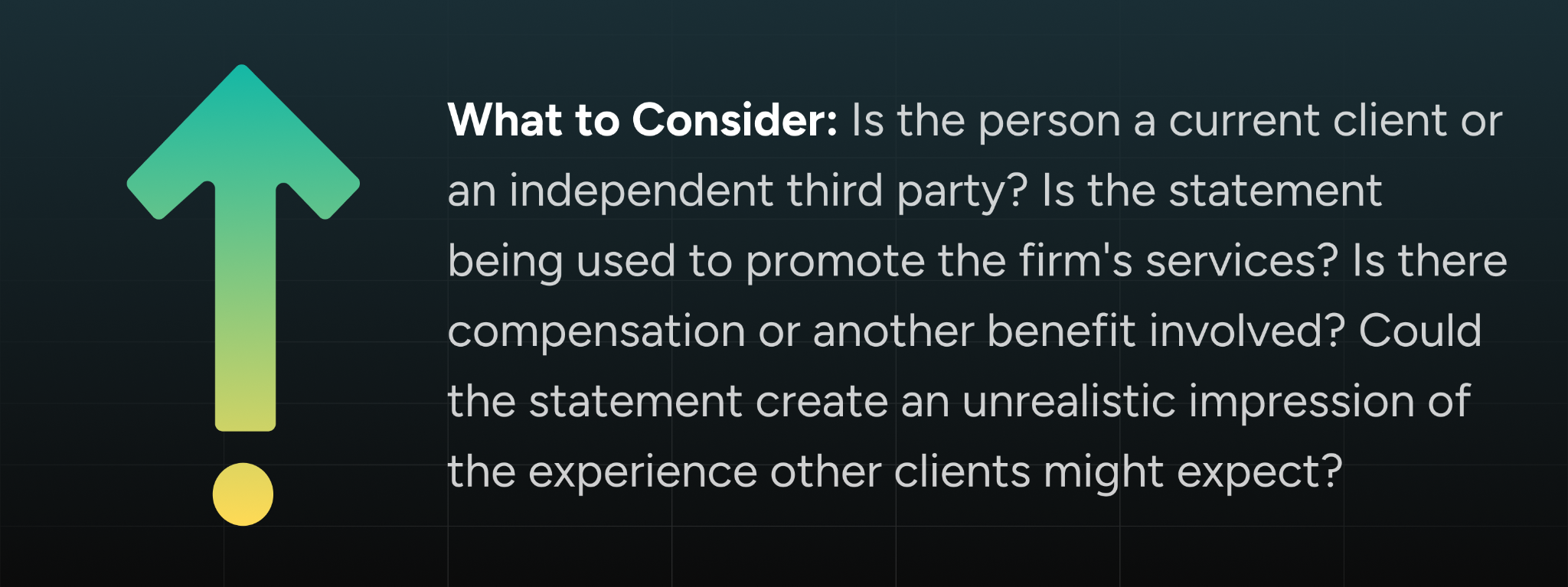
Client reviews, appreciation messages, and recommendations from industry peers can provide powerful social proof. Executives might want to share a client's positive LinkedIn post, publish a video testimonial, or feature a referral partner discussing the firm's services.
However, the person's relationship with the firm matters. Under the SEC Marketing Rule, a statement from a current client or private fund investor may be a testimonial, while a similar statement from someone who is not a client may be an endorsement. Both are subject to specific requirements when used in an advertisement.
FINRA Rule 2210(d)(6) also sets conditions for testimonials in retail communications and correspondence. Separately, firms need to consider whether sharing or adopting a third party's statement makes it their own communication.
Reposts and Shared Content: Sharing Can Signal Endorsement
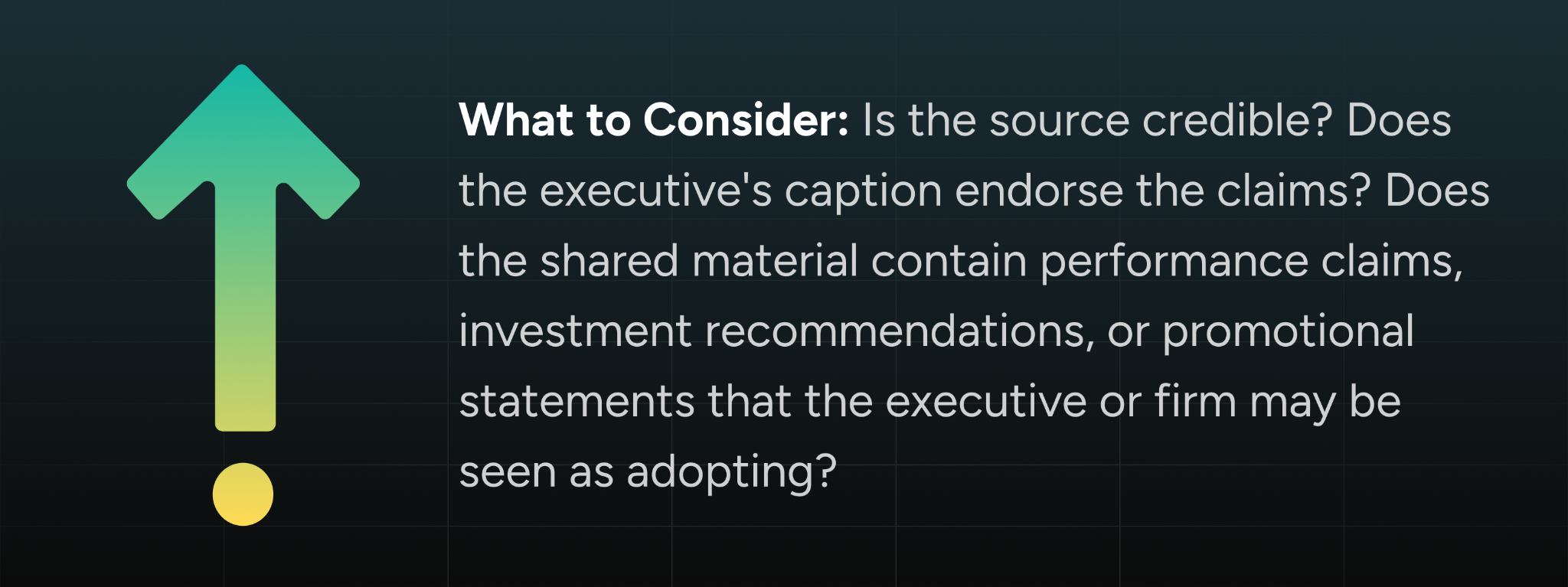
Sharing an industry article, research report, or another professional's LinkedIn post may appear less sensitive than publishing original content. But a repost can communicate more than simply drawing attention to an external source.
For example, an executive who shares an article predicting strong returns from a particular investment and adds "This is exactly why we recommend this strategy" is doing more than circulating industry news. The accompanying commentary may adopt the original claims or turn the post into a recommendation or promotion.
FINRA's social media guidance distinguishes between third-party content that is genuinely independent and content a firm or associated person adopts or becomes involved in. The SEC framework also considers an adviser's role in preparing, editing, endorsing, or presenting third-party content.
Comments and Replies: Informal Engagement Still Has Boundaries
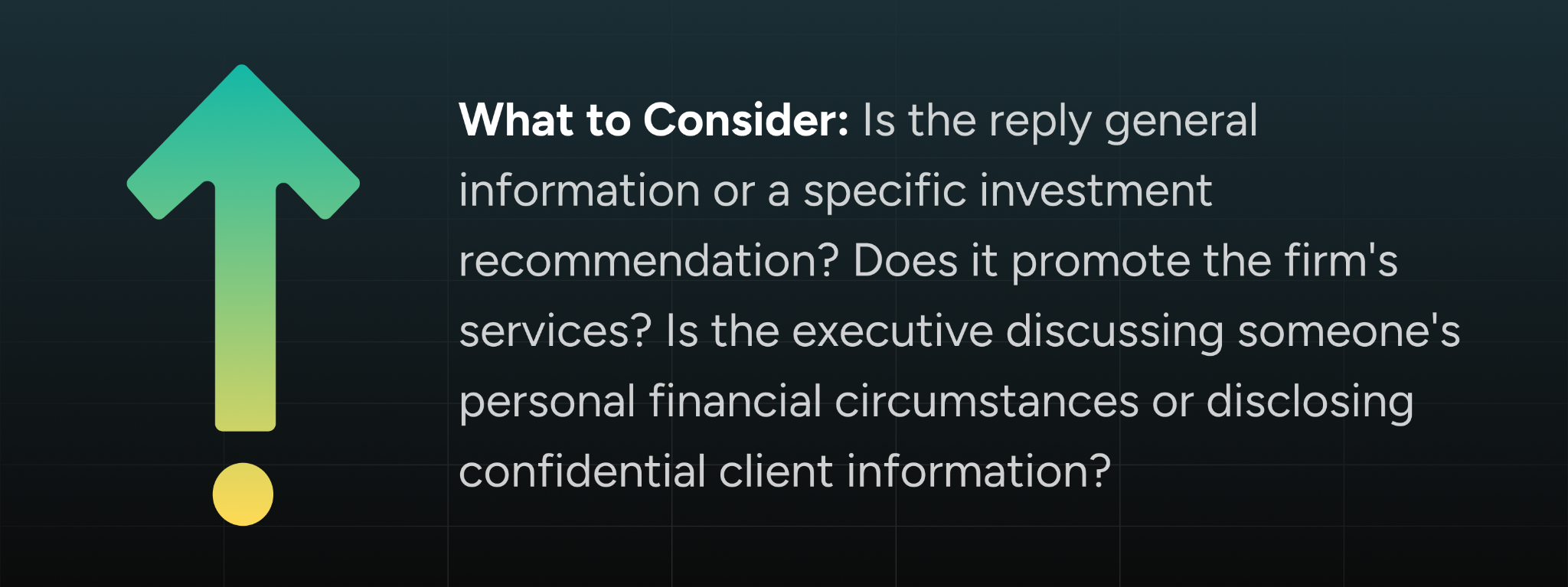
Comments and replies are an important part of LinkedIn engagement, but a short interaction can become a business communication.
An executive might respond to a prospect asking about the firm's services, answer a question about a specific investment, or thank a client for publicly praising the firm. Each interaction carries different considerations.
For FINRA-associated persons, interactive comments and replies may fall within the interactive electronic forum treatment, which generally means they do not require the same prior approval as static content. They remain subject to applicable content standards and supervision.
For investment advisers, comments can also raise questions about whether the adviser is promoting its services, adopting a third-party statement, or providing information that could be interpreted as individualized advice.
The Broader Principle: Context Takes Precedence Over Content Labels
The regulatory treatment of LinkedIn content depends on its substance, purpose, audience, and the capacity in which the executive communicates. Educational posts, promotional updates, client recommendations, and informal interactions each need to be assessed in their proper context.
Executives can maintain an active LinkedIn presence by sharing informed perspectives, discussing industry developments, and participating in professional conversations. A clear understanding of the applicable regulations and the firm's compliance procedures helps them make informed decisions about what to publish and how to engage with their networks.
What Happens When a Post Is Edited, Deleted, or Challenged?
LinkedIn content can change after publication. An executive may correct a statistic, edit a caption, remove an outdated link, or delete a post after receiving feedback. A comment thread may also develop in a direction that was not anticipated when the original post was approved.
Firms should establish procedures for:
- Edits after approval: Material changes may require another review or approval before the revised version is used.
- Corrections: Errors should be addressed through the firm's established correction and escalation process, with relevant versions and records preserved as required.
- Deleted posts: Deleting content from LinkedIn may not remove the firm's obligation to retain a required record.
- Unexpected engagement: A comment or reply that raises a compliance concern may need to be escalated rather than handled informally by the executive.
- Complaints or regulatory inquires: Relevant content and supporting records should be retrievable through the firm's recordkeeping process.
A Practical Pre-Publication and Recordkeeping Checklist
Below is a concise checklist that executives can use to understand what a functioning process should cover.
- Confirm the regulatory capacity in which the executive is communicating.
- Identify whether the content is subject to FINRA, SEC, or both sets of requirements.
- Check the communication category and applicable firm policy.
- Verify factual statements, performance figures, and supporting evidence.
- Confirm that required disclosures are present and readable.
- Obtain the necessary review or approval before publication.
- Ensure the published version is captured by the firm's archiving system.
- Route relevant comments, messages, and complaints through established procedures.
- Re-submit material edits for review where required.
- Periodically review static profile content and Featured material.
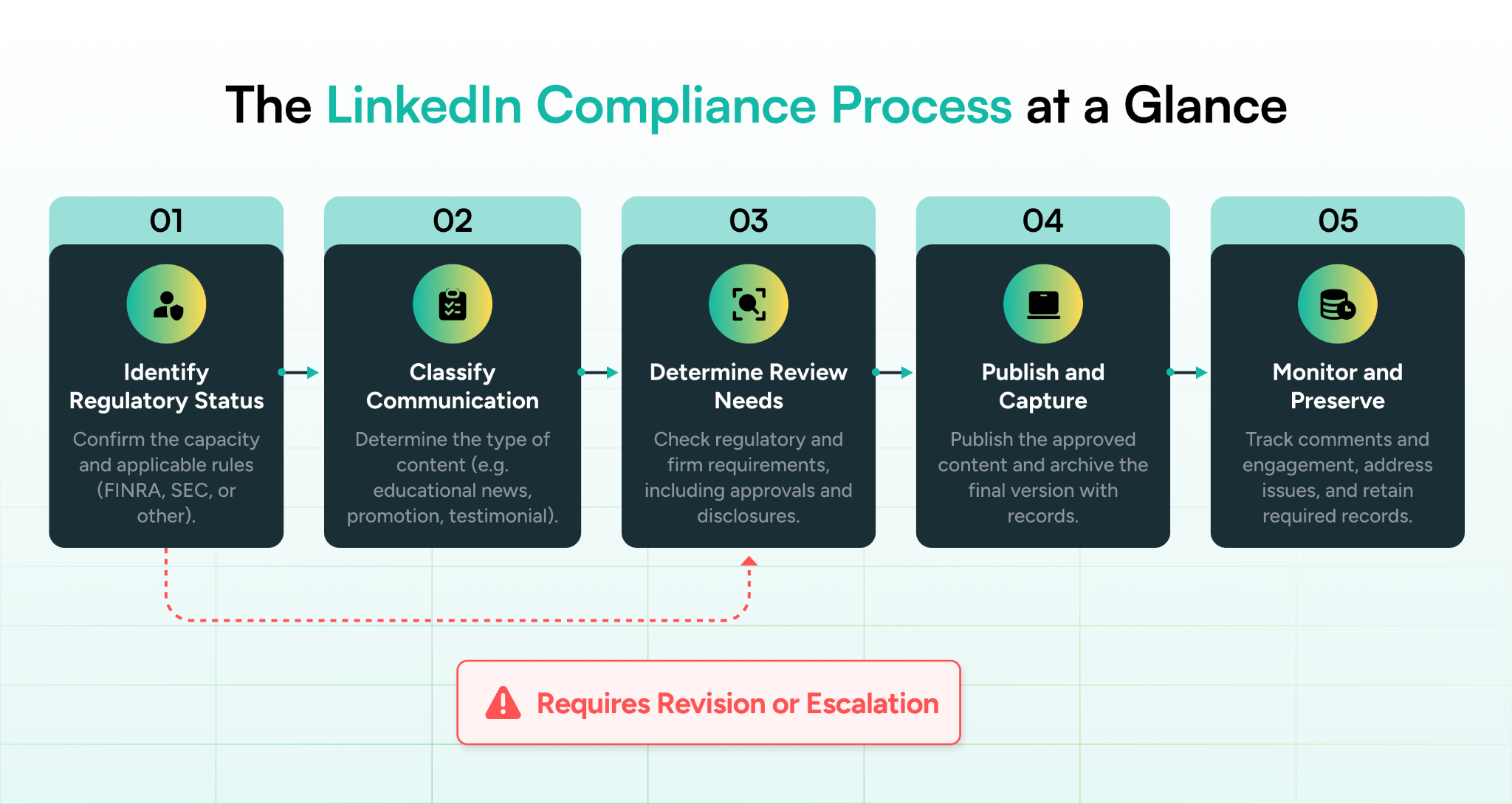
Note: This checklist provides practical guidance and does not constitute a compliance certification. Completing these steps does not, by itself, establish compliance with all applicable regulatory requirements.
How a Compliant LinkedIn Ghostwriting Workflow Should Work
Outsourcing content creation does not outsource regulatory responsibility. A LinkedIn ghostwriter or external agency can help develop ideas, research topics, and prepare drafts, but the financial services firm still needs to ensure that its review, approval, supervision, and recordkeeping requirements are met.
Establish Responsibilities Before Content Creation Begins
Before the first post is drafted, everyone involved should understand their role. A ghostwriting arrangement can involve several people, and unclear responsibilities can create gaps in the review process.
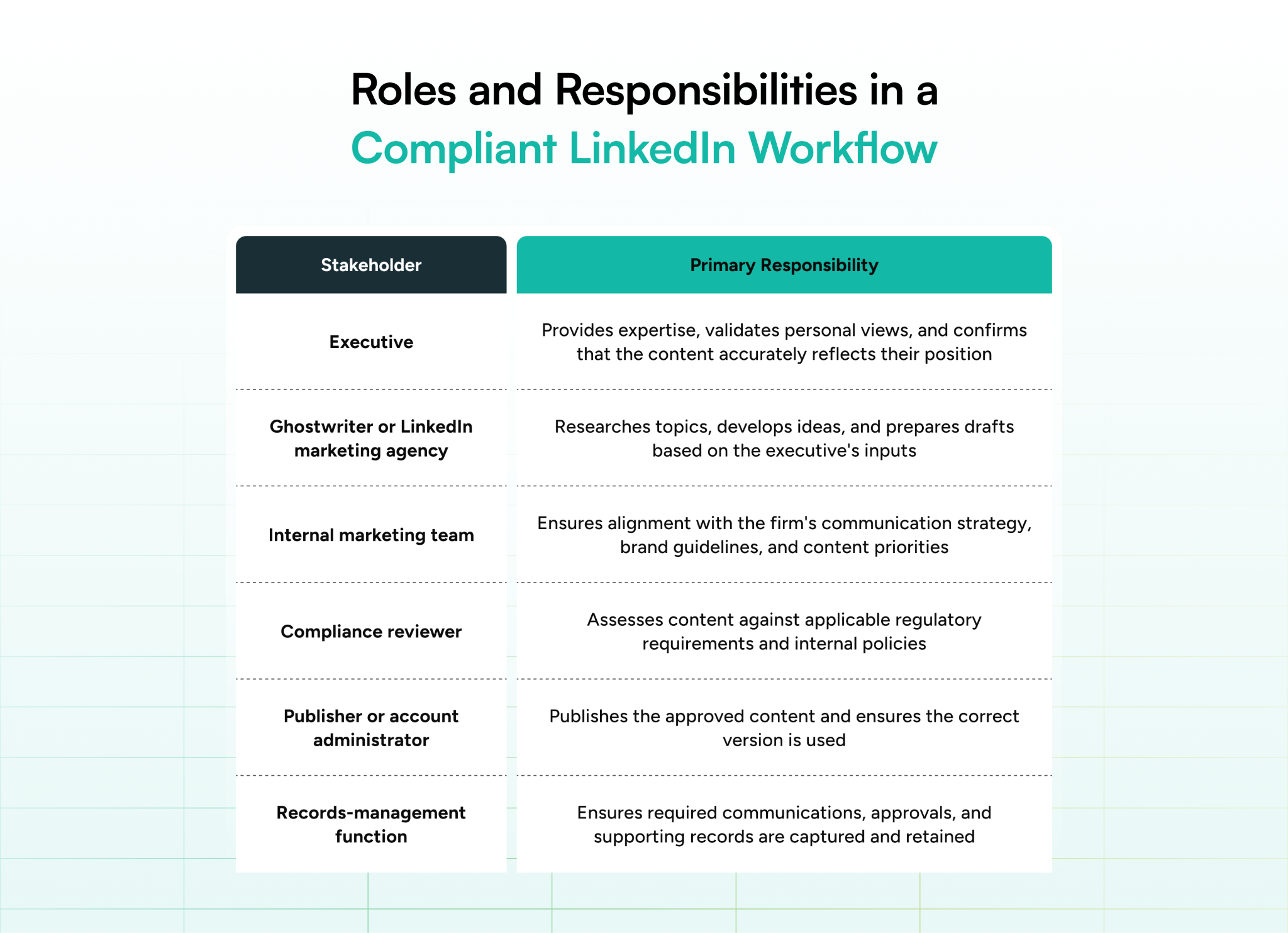
The exact allocation will vary between firms. In some organizations, the compliance team may review drafts directly; in others, marketing may act as the first point of contact before escalating content for compliance review. The important thing is to clearly establish who owns each stage.
Start With a Proper Content Brief
A compliant workflow should begin before the ghostwriter starts writing. The executive or internal marketing team should provide a brief that gives the writer enough context to develop accurate content without making assumptions about the firm's services, products, or claims.
A useful brief should cover:
- The intended subject: What does the executive want to discuss?
- The audience: Is the post intended for clients, prospective clients, industry peers, employees, or a broader audience?
- The executive's perspective: What is their actual opinion or experience on the subject?
- The business context: Does the post relate to a specific service, product, investment strategy, or company announcement?
- The evidence: Are there approved sources, internal data, or supporting documents?
- The intended outcome: Is the purpose to educate, comment on an industry development, communicate company news, or promote a service?
This is also where the writer should identify potential compliance concerns early. For example, a post discussing investment performance, client outcomes, or a specific advisory service may need more scrutiny than a general commentary on an industry development.
The writer should flag those issues rather than trying to resolve regulatory questions independently.
Research and Draft With Substantiation in Mind
Once the brief is agreed, the ghostwriter can develop the draft. Research should be based on credible sources, and factual claims should be traceable to their original evidence. Claims involving statistics, market forecasts, investment performance, client outcomes, or competitor comparisons require careful verification.
The writer should also distinguish between:
- Verifiable facts and the executive's personal opinions.
- General educational information and recommendations.
- Historical results and projections or expectations.
- The executive's own experience and claims made on behalf of the firm.
For example, if a draft says that a particular investment strategy has consistently outperformed its benchmark, the writer should not treat that as a simple stylistic claim. It needs supporting evidence and may trigger specific regulatory considerations.
Similarly, a ghostwriter should never invent a client story, attribute an opinion to an executive without their confirmation, or turn an informal comment into a claim about the firm's results.
Remember, the writer is responsible for producing a well-researched draft, but the executive and relevant firm representatives must validate the substance of what is being communicated.
Build Compliance Review Into the Drafting Process
Once the draft is ready, it should move through the firm's designated review process. This should not be treated as a last-minute formality. Compliance reviewers need enough context to understand what the post is communicating, who it represents, and where its claims originate.
Depending on the content, the review may involve checking:
- Whether factual statements are accurate and adequately supported.
- Whether the post could be interpreted as investment advice or a recommendation.
- Whether benefits and risks are presented fairly.
- Whether performance claims meet applicable requirements.
- Whether testimonials, endorsements, or third-party ratings trigger additional conditions.
- Whether disclosures are required and appropriately displayed.
- Whether the post is consistent with the firm's policies and approved communications.
The writer should be prepared to revise the draft in response to feedback. However, the ghostwriter should not independently decide that a compliance concern is immaterial or remove a required disclosure to improve the post's readability.
A clear feedback process helps prevent multiple versions circulating without anyone knowing which one has been reviewed.
Obtain Approval and Control the Final Version
After the required reviews have been completed, the post can move toward publication. The process should make it clear:
- Who has authority to approve the communication.
- Whether approval is required for this particular category of content.
- Which version has been approved.
- Whether the executive or publisher can make minor changes.
- What happens if the post needs to be changed after approval.
One particularly important control is version management. Imagine that compliance approves a post, but the executive later changes the headline, adds a performance statistic, or rewrites a sentence before publishing. Even if the change appears minor, it could alter the meaning of the communication.
The firm should have a clear process for determining whether the revised version needs to be reviewed again. The publisher should use the approved version rather than relying on a draft copied into an email or messaging thread.
Publish and Capture the Communication
Publication should be treated as a distinct stage, not just the end of the writing process. The person responsible for publishing should confirm that:
- The correct account is being used.
- The approved version is published without unauthorized changes.
- Required disclosures remain visible and accessible.
- Links, images, and attachments are correct.
- The post is captured by the firm's designated recordkeeping system.
The firm should also establish how business-related comments, replies, and direct messages are handled. A post can generate conversations that move beyond its original purpose, and those interactions may raise separate supervisory or recordkeeping considerations.
The ghostwriter may help prepare responses, but should not independently answer questions that require professional judgment, discuss a client's circumstances, or provide investment advice on the executive's behalf.
Monitor Engagement and Escalate Issues
The responsibilities do not end once a post is live. Executives may receive questions about products, investment strategies, market conditions, or individual financial circumstances. A seemingly routine comment can turn into a request for personalized advice or a complaint.
The workflow should establish:
- Who monitors comments and replies.
- Which types of questions can receive an approved general response.
- When a response must be referred to the executive, compliance team, or another qualified professional.
- How complaints, misleading comments, or potential disclosure issues are escalated.
- How relevant interactions are captured and retained under the firm's procedures.
Unexpected engagement can also introduce issues that were absent from the original post. For example, a third party may make an unsupported performance claim in the comments, or a prospective client may publicly share sensitive financial information.
The executive should not feel compelled to respond to every comment immediately. In regulated financial services, knowing when to pause and escalate is an important part of responsible communication.
Maintain a Clear Record of the Entire Content Lifecycle
A final control is ensuring that the firm can reconstruct what happened to a communication if it needs to review it later. Depending on the firm's requirements, the relevant records may include:
- The original content brief and source material.
- Drafts and substantive revisions.
- Compliance comments and approval records, where applicable.
- The final published version.
- Publication details and associated disclosures.
- Supporting evidence for claims.
- Relevant post-publication interactions and escalations.
Not every draft, internal discussion, or revision is necessarily subject to a regulatory retention requirement. The firm's compliance and records-management teams should determine which materials must be preserved, the appropriate retention periods, and the systems used to maintain and retrieve those records.
Effective recordkeeping should allow the firm to establish which version was reviewed, what evidence supported its claims, and how subsequent issues were addressed.
What a Ghostwriter or LinkedIn Marketing Agency Should Never Do
A ghostwriter or agency should never:
- Publish content before the required firm review or approval.
- Invent performance figures, client stories, testimonials, or executive opinions.
- Make unsupported claims about investment outcomes or the firm's capabilities.
- Assume that a post is exempt from review because it appears on an executive's personal profile.
- Change approved content without following the agreed review process.
- Respond to client-specific investment questions without appropriate authorization.
- Treat a disclaimer as a substitute for accurate, balanced content.
Conclusion
For financial services executives, effective LinkedIn communication requires an understanding of FINRA and SEC requirements, careful content development, and appropriate review and recordkeeping processes. With the right workflow, executives can share their expertise, engage their networks, and build a credible professional presence while meeting applicable compliance obligations.
At GrowedIn, we have experience translating nuanced financial topics into engaging LinkedIn content while working within the regulatory boundaries that surround financial services communications. If you're looking for support with your executive LinkedIn presence, schedule a call to discuss how we can help you build lasting visibility and credibility.
Disclaimer: This article is intended for general informational and educational purposes only and should not be construed as legal or regulatory advice. Regulatory requirements may vary depending on the firm, individual, and nature of the communication. Readers should consult their legal or compliance teams for guidance specific to their circumstances.

Frequently Asked Questions
Do FINRA rules apply to financial services executives on LinkedIn?
FINRA rules apply to FINRA-member broker-dealers and their associated persons when they use LinkedIn for business-related communications. The requirements depend on the nature of the communication, the individual's role, and the firm's supervisory procedures.
Does the SEC Marketing Rule apply to every LinkedIn post by a financial adviser?
No. The SEC Marketing Rule applies to advertisements by SEC-registered or required-to-be-registered investment advisers. Whether a LinkedIn post qualifies as an advertisement depends on its content, purpose, audience, and context.
Do financial services executives need compliance approval before publishing on LinkedIn?
Not every post requires advance approval under the same regulatory requirements. FINRA generally requires principal approval for retail communications, subject to exceptions, while the SEC Marketing Rule does not impose universal advance
Can financial advisers share client testimonials on LinkedIn?
Yes, but testimonials and endorsements are subject to specific requirements. SEC-registered investment advisers must consider the Marketing Rule's disclosure, oversight, and disqualification provisions. FINRA-member firms must also consider applicable communications standards, including Rule 2210(d)(6).
Do financial services firms need to archive LinkedIn posts and messages?
Firms must preserve business-related communications and other records covered by the applicable recordkeeping rules. FINRA-member broker-dealers generally follow FINRA Rule 4511 and Exchange Act Rules 17a-3 and 17a-4, while SEC-registered investment advisers follow Rule 204-2. Retention requirements vary by record type.
Can financial services executives use ghostwriters for LinkedIn content?
Yes. Executives can work with ghostwriters or external LinkedIn marketing agencies, provided the arrangement follows the firm's applicable compliance, supervision, and recordkeeping procedures. The use of a ghostwriter does not remove the responsibilities of the executive or regulated firm.
Do FINRA and SEC rules apply simultaneously to a financial services executive?
They can. An executive associated with a dual-registered or affiliated organization may be subject to different requirements depending on the regulated entity, the services being promoted, and the capacity in which the individual is communicating. The firm's compliance team should determine which requirements apply.
LinkedIn Compliance for Financial Services Executives: FINRA & SEC Rules
- FINRA and SEC requirements govern different aspects of LinkedIn communications by financial services professionals.
- FINRA Rule 2210 sets standards for communications with the public, including accuracy, balance, and required approvals.
- FINRA Rule 3110 establishes supervisory responsibilities for business-related communications, including social media activity.
- FINRA Rule 4511 and Exchange Act Rules 17a-3 and 17a-4 address broker-dealer recordkeeping obligations.
- The SEC Marketing Rule applies to advertisements by SEC-registered or required-to-be-registered investment advisers, not every LinkedIn post.
- SEC rules impose specific conditions on testimonials, endorsements, third-party ratings, and investment performance advertising.
- Whether educational posts, industry commentary, company updates, or promotional content trigger regulatory requirements depends on their context and purpose.
- Prior approval, ongoing supervision, and recordkeeping are separate obligations, and firms must establish procedures for each.
- Financial services executives can use LinkedIn ghostwriters, provided content creation and publication follow the firm's compliance review process.
- A well-managed LinkedIn presence combines relevant executive content with appropriate regulatory oversight, substantiation, and recordkeeping.


Insights Hub
LinkedIn Lead Generation Strategies

How to Build a LinkedIn Brand That Isn't Founder-Dependent