
Go Deep, Not Wide on LinkedIn

What You’ll Learn in this Issue
- Why executives need focused visibility that reinforces real-world credibility, not broad reach
- How going deep aligns your online presence with your expertise, attracting the right audience and opportunities
- Why precision, consistency, and relevance matter more than posting frequency or follower count
Most executives don’t suffer from a lack of visibility on LinkedIn.
They suffer from diluted visibility.
Plenty of reach, plenty of impressions, and very little that reinforces how they’re actually known offline.
That’s why one principle sits at the centre of how we think about LinkedIn at GrowedIn, how we write for our own profiles, and how we build long-term strategies for clients.
Go deep, not wide.
For executives, LinkedIn is not a growth hack or a content game. It’s a reputation layer.
Used well, it improves how you’re perceived. Used poorly, it blurs it.
So what does “going deep” really mean on LinkedIn, and why does it matter more than chasing reach, formats, or short-term attention?
Let’s break it down.
Why This Matters for Executives
Executives already have credibility offline.
Your LinkedIn presence is not meant to manufacture authority. It’s meant to reinforce what already exists.
This is where the idea of going deep, not wide, matters.
Going deep means being deliberate about who you speak to, what you say, and why you show up at all. It’s choosing relevance over reach, clarity over volume, and consistency over spikes of attention.
When visibility becomes unfocused or overly performative, it creates a mismatch between how you operate in real life and how you appear online. Over time, that mismatch chips away at trust.
Going deep keeps your digital presence aligned with your professional stature.
It attracts the right conversations, the right peers, and the right opportunities, without forcing volume or chasing attention.
This isn’t about growth for growth’s sake. It’s about precision, consistency, and long-term reputation.
Who Can Be Exempted
Not everyone needs to follow this approach.
Going wide can make sense for:
• Influencers building large communities with a clear content mandate
• Individuals raising awareness or mobilising support
• Freshers without an established offline reputation who are experimenting to find their niche
• Small product-led businesses that benefit from mass visibility
• People in entertainment, lifestyle, or other public-facing professions
For these groups, scale itself is part of the strategy.
What to Prioritise When Going Deep
Going deep starts with caring more about what you say than how often you say it.
That usually means fewer posts, but better ones. Posts that are thought through, relevant to the people you actually want to reach, and clear about what they’re trying to say.
It also means publishing at a pace that fits how executives work, not forcing yourself into a content schedule that belongs to full-time creators.
If the numbers look smaller, that’s usually fine. The right people are reading, and those are the people who matter.
The same thinking applies to networking too.
You don’t need to connect with everyone. And follower counts stop being important once the right conversations start showing up.
Executive Spotlight
Victoria Gamlen is a brand strategist who helps growth-stage companies build identities strong enough to scale.
On LinkedIn, she mixes industry critique with practical brand thinking, especially around why B2B SaaS struggles with positioning and what happens when companies ignore their customers.

In one post, she breaks down how many SaaS companies never had a demand problem. They had a fundamentals problem. And why marketing feels hard when you skip the basics of understanding who you serve.
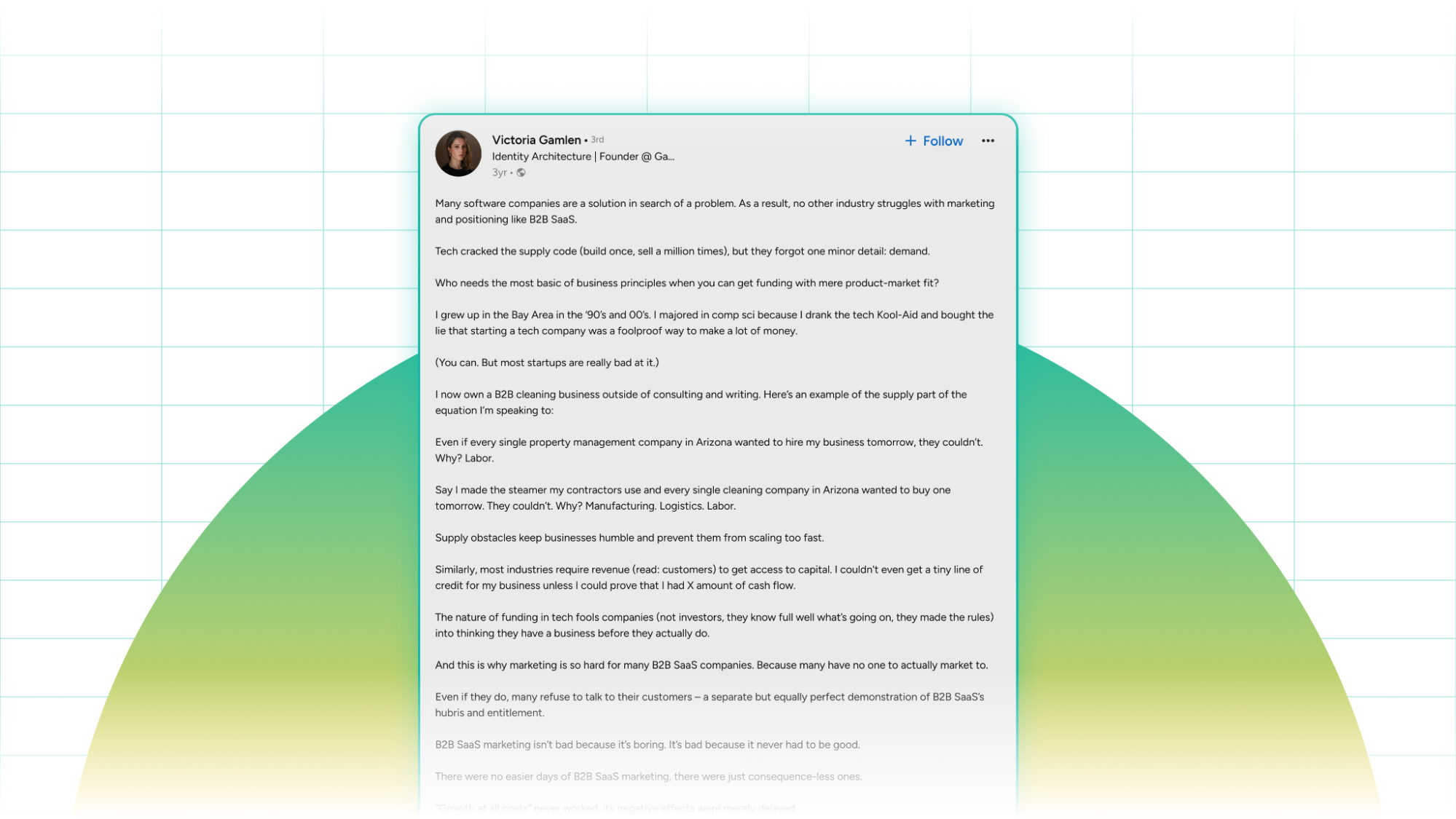
If you want clear, incisive takes on identity, strategy, and brand discipline, Victoria is a voice worth following.
Resource of the Week
AudioPen helps you turn raw voice notes into clean, structured text.
%20(1).png)
If you think better by speaking than typing, it’s a great tool to bridge that gap.
If you don’t want another standalone tool, you can use ChatGPT’s voice feature the same way. Speak your thoughts and prompt it to structure, summarise, or format them exactly how you need.
Perfect for executives who want to publish weekly but don’t always have the time, or the interest, to sit down and write from scratch.
Coming Up Next…
When leaders stay quiet, others write their story for them. That silence can erode investor confidence, repel top talent, and leave a narrative vacuum that’s hard to fill later.
Next week, we’ll unpack how a public narrative protects reputation and creates optionality for leaders.
Till then, remember that depth beats breadth every time.


