
Why Personal Profiles See Better Reach on LinkedIn

What You’ll Learn in this Issue
• Why personal profiles drive higher engagement, trust, and conversions compared to company pages
• The distinct roles each plays, from storytelling and insights to brand legitimacy and official communication
• How to combine employee advocacy and company content into a balanced strategy for stronger overall performance
LinkedIn feels very different today than it did a few years ago.
It’s not just a place to post updates. It’s where people build trust over time, and where ideas move through conversations and connections.
As a result, the debate around personal profiles vs. company pages keeps coming up. But the answer isn’t either/or. Both matter. They just serve very different roles and are treated differently by the algorithm.
In this issue, we look at how individual profiles and company pages are performing today, what the data reveals, and how the most effective strategies combine the strengths of both, drawing insights from The State of LinkedIn Report, Spring 2026.
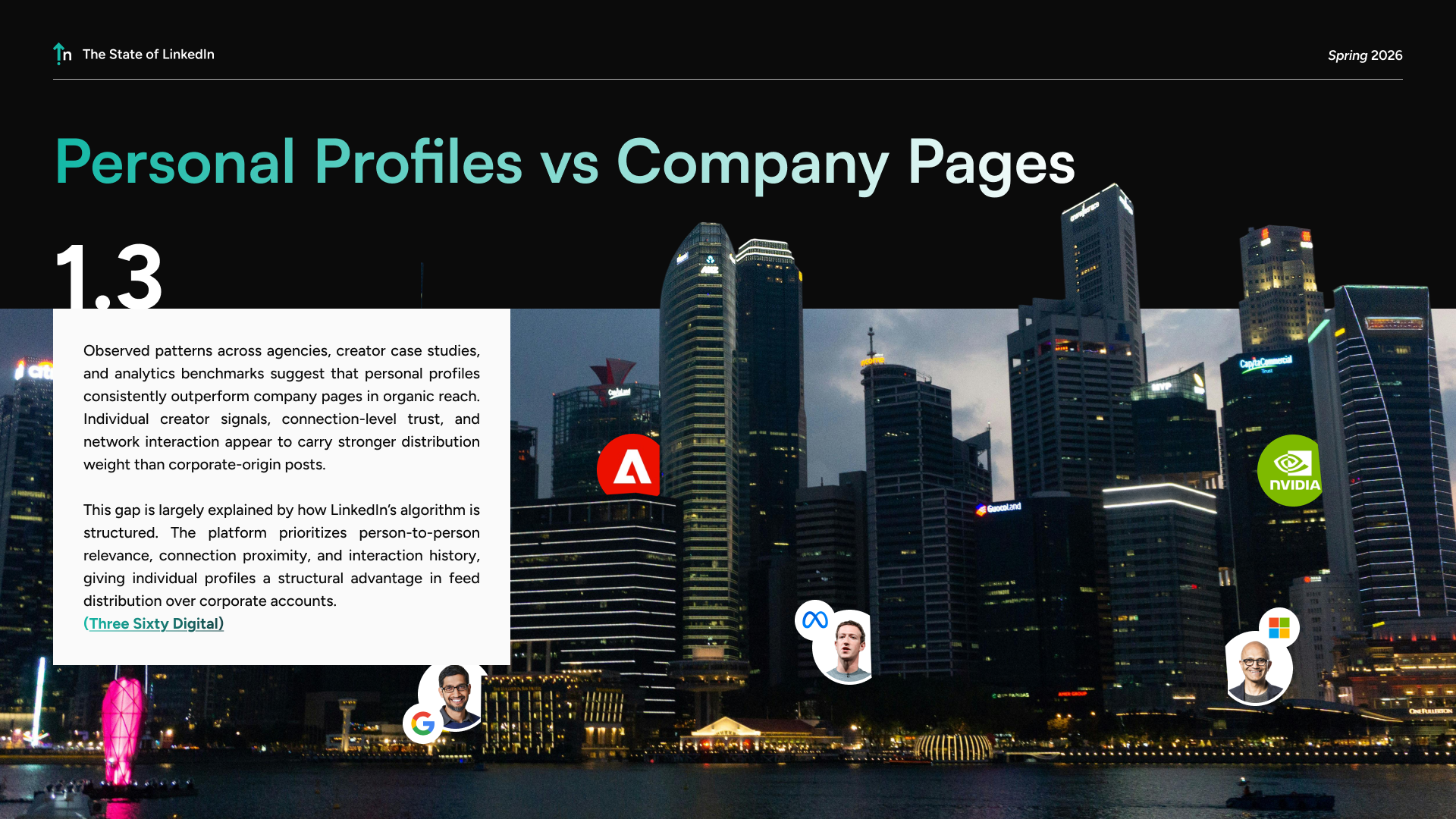
Why Personal Profiles Win on LinkedIn
LinkedIn runs on human connection.
Posts from leaders feel conversational and credible, while company pages often sound like announcements people scroll past.
That’s why personal profiles consistently outperform brands in reach, engagement, and trust. People like to follow people.

Pillars Play Differently
Content performs differently on personal profiles versus company pages.
Company pages work best for exhibiting culture, product updates, and customer stories. Personal profiles shine with insights, opinions, and storytelling.
Why a Company Page Is Necessary
Company pages play a critical supporting role. They act as your brand’s place for legitimacy checks, official updates, hiring signals, and search visibility.
Company pages validate the attention that personal profiles bring in like an anchor.
Algorithmic Advantage
LinkedIn’s algorithm clearly leans toward personal profiles. Individual posts trigger conversation, dwell time, and back-and-forth, signals the feed rewards.
Company pages, by design, are built more for legitimacy and paid distribution. They’re essential for ads, but organically, people still outperform logos.

Power of People
Employees have 10× more connections than company pages, and leads from their networks convert 7× more often.
Employee advocacy amplifies reach and trust at scale, proving that individual voices outperform brand pages for engagement and business impact.
Why Both Matter
Relying on just one channel leaves gaps.
Company-only content can feel distant and narrow. Personal-only content may lack design, research, or credibility support.
The strongest approach blends both: a hybrid model, 70% employee-generated insights and stories, 20% company-led announcements, 10% cross-promotional content, delivering reach, trust, and balance.
Blending personal and company content strategically boosts your presence. And like many things on LinkedIn, this one works best with balance and consistency, too. These insights come from The State of LinkedIn report. You can access the full report here.
Executive Spotlight
Keith Armstrong brings a calm, fundamentals-first voice to LinkedIn at a time when search and AI discourse is often reactive and noisy. With a background in web, discovery, and growth, his writing resists hype and stays rooted in how the internet actually works.
In this post, Keith compares AI to the rise of web templates in the 2010s, a shift that raised the floor while flooding the market with sameness. Competing on output alone, he argues, is a losing game. The real edge comes from craft, taste, and judgment.
Keith is a strong follow for people who care about craft, clarity, and doing the fundamentals well, even when trends say otherwise.

Resource of the Week
Synthesia is a starter tool for creating avatar-led videos without filming.
The free version is limited and watermarked. The paid version offers more avatars, longer videos, and basic brand control.
This may not be ideal for building executive presence, but it’s a low-friction way to experiment with video or spark ideas before investing deeper.

Coming Up Next…
In the next issue, we’ll break down a team member’s real experience across LinkedIn’s two feed views and what it reveals about the ideal feed preference.
Till then, remember, it’s not creator or company pages. It's creator and company pages, used together.


